Life in Communism 2.1.
Regreening the Taiga
By Carla O’Gallchobhair
© Carla O’Gallchobhair, 2026. To Mamon, Cathal, Tanya, Evgeni, and Maksim, Michael, Vicky, Odile and Jean-Michel, Vicky and Nora and all tree protectors and true friends of Russia
And the people at House Kopernikus
“You can cut all the flowers but you cannot prevent spring from coming.”
Pablo Neruda
“Only with a burning patience will we restore the quiet forest that will give everybody peace, justice, and dignity.”
Pablo Neruda
“And again I am looking for you, the woods, dark protector, and your marvellous roaring – Now it’s your turn! I leave the word to you!”
Conrad F. Meyer
Preface in Illyria and Saint-Denis. Manifesto of the Tree Protectors
January of Year 20 of the Revolution, where 2021, Year of the World Revolution is Year Zero
Manifesto of the Tree Protectors, by Natalie and Jean-Saïd
1)Every tree is sacred.
2)The revolution can start with protecting a single tree.
3)We don’t want agglos of a million homeless people, but agglos of a million healthy trees.
4)For every house, a number of trees, at least 1 or 2, as determined by the village assembly.
5) Pull out all the tarmac on the roads, parking lots, playgrounds, and so on. Instead plant grasses, flowers, bushes, and trees!
6) Stop mining and industry, have only small, non-polluting workshops, close down and deconstruct airports, limit railroad tracks and harbour installations!
7) Don’t cut down, but regrow the forests!
8) Protect the forests and our communications and intranet with bio-thickets!
9) Where the forests have been decimated, start a march of the trees to reclaim their ground!
10) Regrow the forest animals together with the trees. If ever a forest needs to be cut back, do it gradually! Use dancing big dinos to deconstruct and clear, instead of drills and saws!
1)Second fasco brigade: Stuck in the Taiga without sponsors
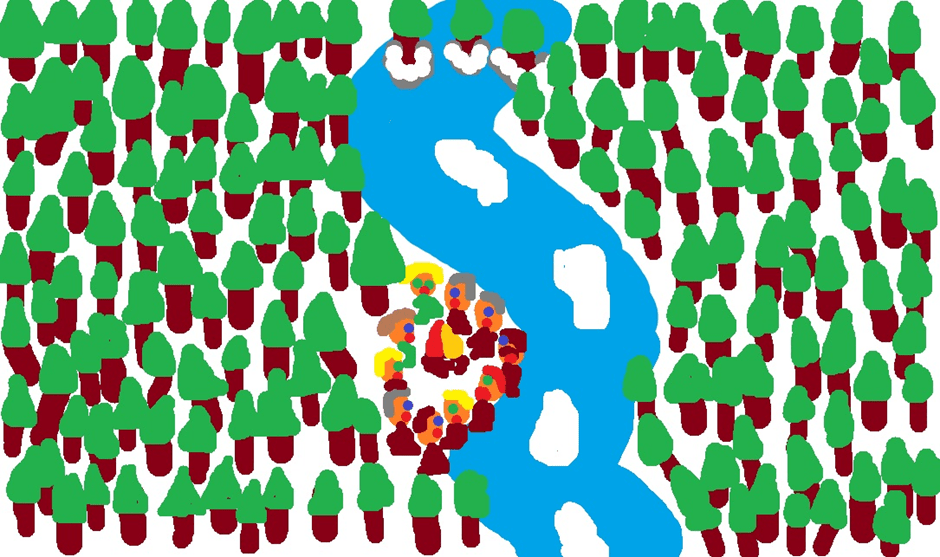
Klaus Newman and Co. at the Fireplace, by Maksim and Zhenya
Stuck in the Taiga without sponsors
“So, aren’t you glad to be on the train?” Jean-Saïd asked Natalie as the train rolled out of Paris Nord early next morning, but then it was déjà vu all over again. Jean-Saïd felt exactly like on the desert testing ground that the capitalist-Neonazi criminals had poisoned with Sarin and other toxins and where as a result, comrade Rafiq had vomited at Boaz. This time it was Natalie who puked, and the whole load went into Jean-Saïd’s face.
“Au secours! Help!” shouted Jean-Saïd, and Natalie’s sister Georgette was intraline even before comrades Saïd, Rodion, and Boris could come in from the corridor where they were chatting. “Never will I let Rodion off with you,” Saïd was talking to comrade Boris, “alone. He is a big baby. In fact, he needs as much protection as Jean-Saïd and darling Natasha.”
“Don’t worry, Little Jean-Saïd!” Georgette was just saying when they came in. “It’s not the fascos yet! It’s just morning sickness!”
“That means that you are…,” Jean-Saïd thought he was probably radiating like a nuclear bomb.
“…Pregnant with Lino or Lina. Mamon,” comrade Francine, “and Georgette saw it as soon as I got out of the train from Marseille the other day.”
“You looked exactly like me at four weeks, green, but happy!” Georgette joked.
“That means that I will have to start university only in the fall,” Natalie recalculated her planning for Jean-Saïd. “Do you really have to start in March?” she asked him. “Not really,” he said, with his arm around her. “I’ll just have to go back to the triangle of cooperatives a few times until September to be with the transport beam brigade at the Red July lab at Racah.” Red July lab after the month the world revolution started in most world regions in 2021, Year Zero. “And the comrades at Institut Galilée will also want to see results.”
“Are you crazy?” asked Natalie. “First, we will be in Novgornyi, to confer with Maksim, Zhenya and the others. Probably comrades Volya, Liubko, and Siobhan will also be back from Palestine already. They travelled to Istanbul by Mediterranean ferry, then to Odessa by Black Sea ferry, and then by train via Moscow to Novgornyi. From Novgornyi, we’ll go to Moscow to get the advice of the Moscow Recycling Hounds. They also said they will lend us one or two of their real hounds, in case we get in trouble with the fascos. And then we will go to Novosibirsk where we’ll stay with the buffalohumans and Professor Besogon at the Zoological Institute. And from there, if it is not too cold, we’ll visit Botur, Nurgun, Delegey, and Botur Jr. or B.J., in Yakutia. That’s already a lot of travelling. And on top of that you want to beam all the way from Novosibirsk to Palestine, and several times even? That’s much too dangerous, 4500 km over mountains and over water. You were lucky that it worked this time.” Just the other day, Jean-Saïd and his uncle, comrade Saïd had travelled back over 3000 km from Palestine to Illyria on a yellow beam. This revolutionary discovery is akin to the neural or brain waves used for the red intranet and bio-wifi. It replaces traditional energy by focus, which determines the direction of travel and allows you to summon the beam, and intensity, which allows you to disassemble into molecular state, travel on the beam, and then reassemble at the final destination. This method was still in the trial phase, however, and Jean-Saïd was member of a mixed Palestinian-Jewish brigade of young top revolutionary physicists working harmoniously on its development. And their test sites were in the vicinity of the triangle of three mixed Palestinian-Jewish farming cooperatives – State of the Reconciliation, Palestinian Refoundation, and Red Palestine –, North of al-Khalil or Hebron. The Illyrians had already had good relations with them for a long time.
“Well, if you insist, I’ll have to come with you!” Natalie prattled on, and Jean-Saïd pulled her closer. “We shall see!” They were about to fall asleep peacefully as Natalie felt a bit better, when their Novgornyi comrades, Maksim, Zhenya, and their friend Danya popped up intraline. “Dobroe utro, are you on the train already? Yes? Well, then that’s good! Because if you are fasco-hunting, you are going in the right direction. Klaus Newman and consorts – let’s call them that, because he is ex-Rheinmetall as well, and he and his associates have replaced Pappberger and consorts –, are in the Russian lands too. In fact, they even came by beam, be it not with a yellow beam, but with their fasco highly energy- intensive golden beam. They asked their sponsors to transport them to South America where their old stooge Gerardo Trilei still has a villa they could have lied low in, instead their sponsors dropped them in the middle of the Taiga. They are sitting freezing around the fireplace at minus 20 or so somewhere on the river Yenisei.”
“Who are these sponsors?” asked Saïd, who had come back in from the corridor with Boris and Rodion upon receiving the bio-message. “And are really all ten of these, I suppose young fasco terrorism expert, comrade Jean-François would call them barons there? Even sick old Wolf Scheuble and lady Elke Hardlife?”
“Well, here are some bio-videos, our comrades, the wolf, the deer, and the grouse took,” said comrade Danya. “There you can see the fascos around the fireplace, here are some close-ups, and we’ve got some pictures of their hook-ups with the sponsors as well.”
Can’t you get them out of there?
Bio-call with the Uberytes, by Jean-Saïd and Natalie
“Oh, we know those,” said Natalie. “That’s the Uberytes: Henri Uber, Fernando Deliverando, Louis Deshalles, and Viesturs Volt. Their plan is to lie low until the counter-revolution sees better times again, maybe to contribute to its rebirth, and also to make sure their children and grandchildren have enough to live on even if they don’t get along with their young revolutionary comrades. These Uberytes organise their economic activities around four underground activities. Underground refers to the fact that they are not self-managed, meaning the brigade foremen don’t rotate. There are permanent bosses instead of workplace assemblies deciding all day-to-day as well as strategic matters. And they produce illegal goods and services that have failed the material and ethics checks and therefore have to be sold against crypto, or other money substitutes. First among the four activities are so-called logistics stations, similar to the private post-offices run by DHL (Louis Deshalles is still on board), Hermes, UPS and others, as well as pick-up and delivery services such as Amazon, Uber (Henri Uber is the main mover and shaker of the whole game plan), and Deliverando (Fernando Deliverando is also still on board). Second come semi-clandestine sports studios offering instruction in violent martial arts including weapons’ training. Third are semi-clandestine cultural centres, offering cheap amusement against pay, including in some places, disco dancing, night clubs, and brothels. And fourth is the evergreen classic of underground capitalist activities, private clinics.
“Well, I am optimistic!” Henri Uber was just telling Klaus Newman and consorts. “You say there are just small hamlets up there in the Taiga, but still people want their creature comforts, don’t they? They want airstrips for planes to land in winter to bring necessities, and paths and transporters or dog toboggins to get through from the railroad lines, don’t they? They want to be allowed to cut down trees to repair their house or to fire their kettle. They are not going to approve this tree manifesto without a good dose of ‘Human lives matter’, are they? And then, after the mavericks have been victorious, maybe the bigger hamlets won’t object to a logistics station to be set up there, will they?”
“There won’t be enough custom!” sighed Dorian. “You are losing your time. They can get their stuff transported for free by self-managed logistics enterprises and organisations working within the economic circuit.” The logistics enterprises are self-managed like all other workshops and enterprises in the economy. That means there are no longer any bosses, hierarchies and bureaucracies at the enterprise, workshop or social organisation, and the workshop assembly decides on all matters from petty quarrels to strategic planning. Brigadiers rotate every day. Logistics enterprises especially can also be considered social organisations, since the expeditors and recipients participate in their workplace assemblies as well, just like students and parents do in schools. The assemblies of social organisations can be as large as small village assemblies, 200, 600 and up to 2000 participants, depending on the continent and region. As the assemblies get larger, moderators will rotate every hour or even more often, and as many individuals, neighbourhood assemblies, and brigades as possible will get their say.
The economic circuit means everybody works their socially necessary labour time of fifteen hours plus fifteen hours at least of creative, social, and other pleasurable work. In return, she and or he gets everything for free at the market, share point, or directly from the producing workshop, including the inputs for their farms, workshops, social organisations, which comprise schools and logistics organisations.
“Well, then why don’t you get the hell out of there? Either Viesturs or I can send you a plane?” offered Henri Uber. “Depends where you want to go, to Western Europe, Canada, or the ex-U.S.?”
“No, no, we are not wimps! The case for ‘Human lives matter’ deserves to be made and cries for action!”
***
After the virtual screen with the Uberytes had disappeared again, the fascos continued discussing it. “Had it been the Russian ex-crypto-oligarchs, we could have negotiated something,” Fritz Schneid said, “but with these Americans, no way!”
“And then there are still the Soonouties or rather already Outies, moribund old Bill Doors, Satya Mersoon, Sundar Pinchai, and Larry Note.”
“They are also nasties!” agreed Elke not as ready to pronounce them dead yet as her husband.
“First the intranet did away with cables and metallic wifi-towers and most devices,” her hubby continued. “And now the intranet plushbots and fluffbots, Elke and I call them flushbots, will radically economise on material for all those that remain. This will obliterate the need for all their heavy Doors and Froogle devices and silly software…,” Andrew chuckled.
The (Soon-)Outies, by Laurence and Emmanuel
“Well, couldn’t the bankers set us up somewhere in North America in a quiet place?” asked Wolf Scheuble.
“But they try to provide mainly for the retirement of the successful crypto-oligarchs, or do they finance resistance fighters as well?” asked Julian Redswan.
“No, no,” said Reinhart Fischer. “They finance the resistance as well, in Canada especially. The main action at the moment is ‘de-popping’, which can refer to animal or to humans deemed unneeded, and ‘thinning out the forest’. They, Larry Fink, Mort Buckley, James Hooley, Ron O’Hanley, Charles Merrill, Robert Capito, all of them do a lot of agitation at village assemblies, except Warren Smorgasbord, who is a bit old already, over ninety.
The banksters…, by Faroukh and Sarah
“The bastards,” shouted Natalie. “They pretend to be revolutionaries and do ‘de-popping’ and ‘thinning out’… What is that supposed to mean? We’d call it next round of the attempt at animal and plant genocide!”
“Apparently, they are also after our robots,” said Jean-Saïd. “In Palestine we heard David Toter has some plan for attacking our plushbots and fluffbots and grow-up-with-you harpoids designed to save material, especially metal, minerals, and rare earths. After all, the intranet reduces the heat risk as the neural waves used to transport it are at least 50 million times less energy-intensive than the pre-revolutionary intranet. So, for the new generation of laptops and grow-up-with-you robots, also called harpoids – since they can have all kinds of shapes from traditional laptops to human, animal, plant, or useful thing –, we shall be able to use textiles for cover instead of metal and plastic.”
“Here you can see them on our picture,” Little Pierre piped up from Illyria. “Our plushbot is in teddy bear shape and our grow-up-with-you robot is a traditional robot, but economising metal, made from soft, live material. Every year it can grow up to ten centimetres along with the kid that keeps it.
“The fascos disparage them as flushbots, yet in contrast to their synthetic crap, ours will be made of good natural material. And you won’t have to replace them every three years as the capitalist profit-mongering required.”
Hatebots being dropped on our Plush- and fluffbots and grow-up-with-you harpoids for everyone, by Petit Pierre, Malik, and Mao
“Toter promises that our lovebots will wriggle in agony, which would probably also compromise comrades’ Josip’s and Karla’s moral imperative: ‘Don’t do anything harmful! Material check! Rely on the decisions by the village and other assemblies!’ Do you know anything about that latest conspiracy?” asked Jean-Saïd.
“No, we don’t know anything specific about that plan yet,” said Maksim, “only that it involves hatebots. Yet it is probably something they have arranged for the future, when we’ll have really distributed our plush- and fluffbots and grow-up-with-you harpoids and society can be seriously harmed with sabotaging them. However, we have learnt that here in the Russian lands, they want to cut down the Taiga, they call it thinning out, and murder the animals, they call it de-pop. Their alleged rationale is that turning the Taiga into an eco-idyll like we are planning, would be much too costly. Human lives matter, and to them this means we need to maintain mining, industry, and big-scale transport infrastructure, you know, harbours, railroads, if not airports, or rebuild them if already deconstructed.”
The Big Animals, by Zamir and Odile
“Let me call the Big Animals!” Zelim asked. “After all, I have de-briefed them when they agreed to be rehabilitated and they trust me. They are Aistov and Gusev, experts on processed foods. Belkov and Lysov are specialists on pharmaceuticals. Kotov, Kozlov, and Volkov are knowledgeable on phones. Medvedev, Rybakov, and Oleinyi are authorities on equipment and complex manufactured products, including weapons. Finally, Slonek is the main mover on iron, steel, and other metals, graphite and other minerals, as well as rare earths, and Zhuravlev a major shaker on oil and gas. From among all these former sponsors, somebody is bound to know something about their scheme.”
Soon he was back with the Big Animals intraline, sitting around a virtual table comrade Timur – computer wizard with the Moscow Recycling Hounds, adoptive son of comrade Sergei and now living in Murmansk with his wife Nina –, had designed. That way people would be able to follow Zelim’s rehabilitation sessions from all kinds of places and understand who was there. Each of the Big Animals had valuable intel to report. “Yes, we know about the presence of these Germans,” said Grigori Medvedev, formerly heavy industry capitalist. “Newman and consorts, fascos or Neonazis, whatever you want to call them. Piotr Zhuravlev even had to supply them some oil and gas for their energy-intensive golden transport beams, didn’t you, Piotr?”
“Yes, I did. And they asked me whether there were still any old nuclear facilities they could relaunch to use for that purpose. I didn’t say. The revolution is dismantling them, sending the rods to salt mines and underwater caskets, and decontaminating the areas around them. They are none of their business.”
“Yesterday still, these fiends contacted me and asked for guns to be dropped from a plane or drone at some specified location on the Yenisei,” laughed Lavrenti Oleinyi. “And they have asked Matvei for a boat, and Grigori for airplanes.”
“And what did you answer?” “That we were no longer in the business,” said Grigori. “At least Lavrenty wasn’t.”
“What is that supposed to mean? That you and Matvei want to help them?”
“No, it was supposed to mean that we were already more than not in business. That we are already revolutionaries.”
“They asked Anatoly – Aistov – and me whether we could not write a piece for Pravda arguing that thickening and expanding the Taiga would negatively affect food supply,” reported Vladimir Gusev.
“We said no,” continued Aistov. “Because the climatic zone of the Taiga anyway is not conducive to big-yield agriculture. Not only is it cold, but also dry. On the other hand, we wrote in Pravda, expanding and thickening the Taiga might improve air, soil, and water quality, and even hold some harvestable wood ready for the future. Not massive amounts, we would not advocate cutting down large areas of the forest, obviously, neither here in European Russia, nor in the East. We have signed the tree manifesto ourselves. Yet in case of need, just little amounts.”
“That’s good,” Zelim was relieved. “They did not get you to testify in their favour.”
The Taiga is sick, but from you, by Olivier and Danièle
“They, especially one of them, called Fritz, like the other one, Fritz le Merc, but this one has got brown hair and a different last name as well, wanted some kind of testimony from Evgeni – Lysov – and me as well,” said Avgustin Belkov. “Although it was almost advice on sabotage you would call it. They asked whether there weren’t some weeds or bugs affecting the Taiga against which they could sell some spray to concerned village assemblies in the area. We said ‘no’ as well, and we did a survey among concerned village assemblies that you are welcome to look at. Comrades Sergei Viktorovich, Evgeni, and Andrei from the Moscow and Novgornyi Recycling Hounds helped us with it. Very small assemblies mind you, most of them, more like hamlets. We had over 5000 respondents from over one thousand tiny assemblies all over the Taiga, East to West, North to South, so it was representative I think. There were no such weeds or bugs, they said. The forest was just generally weak and unhealthy, especially in the Southern areas close to the big cities and mining, industrial, and transport facilities. The chemicals were already eating them. Several respondents noted: ‘You would be driving out the devil with Satan, or rather Monsatan, to use the old brand name.’”
“Then three of the new Nazis, called Elk, Andrew, and David, wanted to know whether we phone producers, Valentin Kotov, Leonid Volkov, and Sergei Kozlov, that’s me, would be interested in their counter-revolutionary phones and plush- eh flushbots, and possibly humanoid and android robot production as well. We told them we weren’t available as crypto-producers, as we were engaged in a full course of rehabilitation. Yet then they asked something interesting, and they wanted to know the same from you, Avgustin and Evgeni, didn’t they? About some animal-robot creation they had in mind, and I was thinking of the young Illyrian, what is his name, not Matvei, Marius, right, who wants to create the wonder-cattle. I think they are on your trail there.”
“That is only one of the options I am researching,” said Marius, chewing on a bit of bark. “The idea is to create an animal that is very frugal, can live in the Taiga, for instance, and eat tree-bark, moss and fern, yet can give milk like a goat, and even meat if necessary like a cow, also wool like a sheep, lay eggs like a chicken, carry loads like a donkey, pull a plough like a horse, stand guard like a dog, even cuddle like a cat, you see, an all-round wonder-cattle or wonder-pet. And we – I have some friends in Novosibirsk, Russian lands and in Córdoba, Argentinian lands, who are thinking along the same lines –, we are considering three options. First, cross-breeding, maybe coupled with an educational effort as well, you know raise them better, as good Communists who ignore species barriers. Second, growing the animal artificially in a test tube from sperm and egg or even joining the DNA only. Very carefully, of course, respecting full moral protocol at every step! And third, creating some harpoid, part-live, part-robot, and that is probably what this Toter wants help with. Well, he is not going to get it from my comrades and me, because we know, he will use harmful materials, and he will put his beasts to harmful uses as well, probably place them into some competition with the live animals.”
“Did they want you to produce nanobots as well?” Jean-Saïd asked the Big Animals, “or synthetic neurotransmitters?”
“Neurotransmitters, those are this singer’s speciality, isn’t it? I call him singer, because his name sounds like a mixture of two German pre-revolutionary anti-war singers, whom we used to know here in the Russian lands as well, Reinhart Mey and Helene Fischer. He did not ask anybody for anything, probably because he felt that he knew more about neurotransmitters than any of us, even Avgustin and Evgeni. The arrogant type, you know! Yet he might try to hire workers against crypto, if he and his buddies make it to an agglo.”
“So, nobody is helping them at the moment?”
“Of course, they are helping them,” Grigori laughed. “I think, the friends of this Klaus Newman at Rheinmetall have sent them a plane, or several even, with drones, to drop survival goods and guns. The Uberytes are producing bug sprays and weed-killers for them although we told them they weren’t needed. And either Rheinmetall or one of the Uberytes, Viesturs Volt, most likely, could help them travel, since his logistics stations operate in the Baltics. Yet conceivably the other Uberytes could also send them a plane from Canada or Alaska. Henri Uber is Canadian. They could air-lift them out if they wanted to be air-lifted, but apparently, they don’t. They want to cause havoc, you see!”
“Well, can’t we sting them?” asked Jean-Saïd. “Just send a normal small rescue and emergency or scientific exploration plane, wind- and solar-powered like all revolutionary planes of course, pretend we are Viesturs or some other Uberyte, land them somewhere and get a quorum for a spontaneous militia brigade to arrest them for intended sabotage?”
“It’s worth a try!” said comrade Sergei of the Moscow Recycling Hounds.
“I’ll organise it!” offered comrade Timur. “They won’t know me so well, since they are a new generation of counter-revolutionaries. I can pretend I want to help them and then get them picked up by spontaneous militia if you comrades make sure they have a quorum, obviously.”
“Can we come with you?” begged Jean-Saïd. “We can be your kids or your nephew and niece?”
“Won’t they remember you from Palestine?” “No way, we’ll be wearing big scarves and hats. We’ll just look like Russian kids, or if they want to be racist, I can be part Chechen, or Yakut.”
“I’ll be the Kazakh co-pilot!” said Saïd. “Under no circumstances am I letting you go on a plane with these villains without protection!”
“How many people does the plane carry?” “Twenty max without baggage or ten with baggage,” said Timur. “Saïd and I, plus ten of them, plus you two… and Boris and Rodion might be able to hide somewhere as well. As long as they don’t have too much baggage.”
“Well, the Rheinmetall fascos just brought them three tents, more cooking stuff, and more weapons probably… Our bio-thicket spies are reporting suspicious cases. They will have to leave them behind.”
Novgornyi in Winter, by Jean-Saïd and Natalie
“You, Jean-Saïd and Natalie will spend just one night in Novgornyi for the time being, and one in Moscow at ul. Grudinova 21.”
The Lenin kolkhoz and ul. Grudinova, by Olivier and Danièle
“That’s just for the time being. Later on, you may stay longer at both places, of course. Sergei already said you can take two recycling hounds, Volk and Krasochnyi. They will protect you and help you fasco-hunting, don’t you worry.”
At the Novosibirsk Zoological Institute, by Olivier and Danièle
“Then you may fly with Timur while Maksim, Zhenya, and Danya will go on by train to the Novosibirsk Zoological Institute where the buffalohumans live and where we’ll all be meeting up later, also any other young or young-at-heart comrades from Illyria who might still want to join you. Come spring, we can then tip-toe into the Taiga all together.”
2) Attempted Plant and Animal Genocide: Next Round
Air-lifted, by Zamir and Odile
Air-lifted
“So, who do you work for?” Fritz Schneid asked. He had sat directly behind Timur and Saïd and was bending forward so as to be able to hear them above the noise from the wind propellers.
“Viesturs Volt!” said Saïd, thinking this was the most plausible answer that would please the villains. “That is a lie. I just bio-messaged him. He doesn’t know of any plane.”
“We are ‘Human lives matter’,” said Timur. “Ever heard of Grigori Medvedev?”
“More bullshit, he declined to work with us, precisely for being ‘Human lives matter’. You are liars, out for crypto at best, and at worst, under-cover revolutionaries. We want you to land this plane right now!” And he put a revolver to comrade Timur’s head. They had insisted for the fascos to leave the huge cases with arms behind, but there was nothing they could have done against small handguns not worn openly without immediately awakening their suspicion. Now they had raised their suspicion anyway. Reinhart Fischer, who was sitting next to Schneid behind Saïd put a gun to Saïd’s head as well and said. “Or better even turn around to where we came from. It was a mistake to leave our gear there.”
Further back in the plane, Jean-Saïd and Natalie were making friendly conversation with Elke and Andrew Hardlife. When the plane veered around, she got up and shouted: “What’s wrong?”
Schneid turned around and said: “The pilots are fake. They do not seem to be working with anyone we know. Reinhart and I are asking them in a nice way to get us back where we came from.”
“But you can’t,” said Timur, trying to bite down a grin. “Look down. There is another plane there, looks like it is a militia plane. It is a rescue and emergency (R&E) plane like ours, but it has a red star on its side, and the people standing around there are all wearing yellow vests with red stars over their snow coats. That means they must be spontaneous militia. And that means somebody must have called the militia on you. Did you meet any of the neighbours?”
“No, yes, I don’t know whether it was a neighbour. I met a little angry old man when I went into the forest to shoot some fowl and set some traps. He said, ‘Don’t you know the Taiga is a protected zone, no poaching?’ I told him to go fuck his mother.”
“Well, I am afraid, he didn’t like that and bio-called the village assembly about a quorum for a spontaneous militia brigade. In a hamlet of twelve houses maximum – most hamlets in the Taiga are even smaller –, you can guess it wouldn’t have taken long for 20 or even 30% to say yes to a spontaneous militia brigade to defend their papie.”
“But my encounter with him happened yesterday already.”
“Then, if the hamlet was super-small, they probably had to ask men from further away to join them. And they needed to organise a plane as well. Ladno, you tell us what to do. We can land you there, but the militia will probably want to ask you some questions.”
“O.k., then, proceed to… where did you say you wanted to take us?”
“South-West to a hidden airstrip, and from there, another plane will pick you up. I don’t know the details. Viesturs or Grigori or their representative, I am not sure which – it all went intraline and very fast –, said to stick around with you until the relay comes.”
From the Stone Age onward: tree murder, smoking guns, and food poisoning, by Zamir and Odile
When they finally landed it was in a very desolate area. Tree trunks were lying around that nobody had bothered to carry away. You could still imagine nice, young tree-cutters ruining their eyes, ears, and backs murdering them for money. There was an old oil drilling and refinery site, whose towers you could still imagine burning and smoking. Maybe they had wanted to aggrandise the site further shortly before the revolution but had not gotten around to it? Or was it one of Zhuravlev’s clandestine sites? Everything still looked as if it had been recently used. Close by, there were untilled grain and vegetable fields, and in a hangar, Jean-Saïd and Natasha found some sacks with big violet balls, probably fertiliser or insecticide that someone had probably wanted to spray but had not gotten around to. “Maybe one of Aistov’s or Gusev’s old lairs?” Jean-Saïd ventured. “Because these are not pre-revolutionary toxins, they are no more than two years old. I wish we had Che,” young agronomist, “here with us, or Maher,” young chemical genius. “They could tell us what they are.”
“It says here Monsatan XF-19-20,” read Natalie. “Well, that sounds like a clandestine production from last year or early this year.”
“Take some samples, and your comrades as well as our Recycling Hound comrades agronomists-chemists, Oleg and Dima will examine them,” said Timur. “But now let’s get back to the plane. It’s getting dark, and I can see our fascos have lighted a fire. Yet have they managed to cook anything?”
They were not too surprised to find that the fascos had tried to run for it. In fact, there were scratches on the airplane door where they had tried, unsuccessfully, to get back in. Maybe one of them had a pilot licence? The fire had not been for cooking but for lighting torches.
“Let me guard the plane,” said Timur. “And you get on with your forest exploration. If you need me, just whistle!”
“Probably, one of them remembered that fire scares animals, even predators,” Rodion suggested. “Yet they are not going to get very far anyway. Down here on the Southern edge of the Taiga, the trees may be weak, but the bio-thicket is all the more thistly. In fact, let’s ask some birds, squirrels, and weasels whether they know where they have run.”
“What about Volk and Krasochnyi?” wondered Saïd, and just as he said that, the two of them came running from the direction of the oil field, barking loudly. They led the six of them across the site, still looking menacing and toxic even covered partly by snow as it was. “I wonder why nobody has started to deconstruct it yet,” said Natalie. “It really must have been working quite recently still, probably producing oil derivatives for illegal medicines and synthetics.” Illegal, because the immense majority of village assemblies had already decided to rely on revolutionary natural medicine. This referred to the path-breaking remedies comrade Fabienne and others were developing and or testing at Institut Pasteur. And almost all village assemblies had decided to give synthetics a miss and to return to natural textiles, as well as wood instead of plastic, natural colours instead of oil-based ones etc. “And they would have made heavy lubricants for their weapons here,” said Boris. “I bet Pappberger and Newman were buying those.”
And then they were already in the woods. Rodion had been right. There was plenty of thicket, but luckily, the Nazis had freed a track with some machete, axe or similar tool and they were able to follow them, guided by the dog. “Where did they get the axes?” wondered Saïd. “How did comrade Timur know how to land here?”
“It’s one of Zhuravlev’s old sites,” Timur came intraline. “But they may have received some help from the Uberytes. I am getting a live feed now, something they are sending to the Uberytes. Watch and listen to this! A Siberian tiger is just questioning them.”
Questioned by the Tiger
Questioned by the Tiger, by Jean-Saïd and Natalie
“I have heard you want to kill lots of animals, so that there will be fewer bio-wifi-towers, is that correct?”
“No, no, we no longer want to wreck their revolutionary crap, let them have their bio-wifi. We want to de-pop and thin out just so that there be more of everything for those of us who remain. There will be fewer humans as well, a million at most, the upper 10000 and the rest to serve them!” explained David Toter. “And fewer plants. Just to get here, we had to get through an enormous amount of underbrush. Not needed. But those humans, animals, and plants that do remain, the stronger and healthier ones, will live better and have a new generation of robots to help them. Look!” And he showed the tiger a screen with a robot mirroring him, the tiger.
“I know those,” the tiger yawned. “Here in the Taiga even the kids will have them. Not all of them have them yet, but by the beginning of next school year, they will. They are called grow-up-with-you robots. They can look like your children or they pick a form they like, but then it will have their size, like this. And he just touched the screen with a paw whereupon it produced a little boy with a small Siberian tiger next to him. And next year, the boy will look like this, and the tiger correspondingly larger as well. No need to kill anyone for that.”
And when he noticed that they were looking aghast, he touched the screen again, and it showed a hamlet, with a small one-room school building, a few houses, and a share point. “You probably wonder how I know this. It is because I live in this village. I was an orphan, and a human family brought me up. We have opposite cases as well where animals brought up human orphans. I know of one boy who grew up with wolves. Your dogs would know the case,” and he barred his teeth in a friendly smile in the direction the Illyrians were coming from.
“What do you mean, we haven’t got any dogs!” said Julian Redswan. “Don’t tell me they are already on to us?”
“In that case, sorry pal, we have got to go!” said Dorian and tried to hold the tiger back with a torch while the others got away. Yet the tiger, who was used to humans, just walked alongside them in the bio-thicket. The bio-feed showed them hitting away at the underbrush and screaming out when the thistles hit them, whereas the tiger just ducked under it and or it bent away for him in a friendly way. The bio-thicket could clearly distinguish friend and foe.
“So, we have clarified the issue of killing us,” said the tiger. “There is no need for it, since different species can live together like equals, at least here in the Taiga. After all, you humans will no longer cause any pollution now that you have no more cars, planes only as an exception and solar- and wind-powered ones at that. And you are using bio-wifi, meaning no more metallic wifi-towers, no more cables, no more devices, except those grow-up-with-you ones or plush and fluffbots made of light and abundant material.”
“That’s exciting,” said Andrew Hardlife. “Elke and I want to make these plushbots or fluffbots. Maybe in the shape of a Siberian tiger.” He tried to flatter the beast. “Do you know of humans around here who would make them for us?” Reinhart Fischer gave him a warning look, but it was too late. The tiger had understood and almost went at Andrew’s throat. “Don’t you know that the revolution has abolished exploitation? They would not make them for you, but for themselves, they are not slaves. And anyway, why would they? They have me to talk to, I am real.”
“That’s true!” laughed Reinhard Fischer. “You are the real deal. Andrew and Elke were thinking of children in the agglos!”
“Maybe,” the tiger pondered the explanation. “With kids here, the most popular plushbot shapes are tools, you know, hammers and sickles and things. And you’d have to come to the village assembly and propose the founding of a self-managed workshop. But why would you hide out here? You look like agglo lovers to me! You are probably the kind that is sad that the cities are no longer as crowded and debauched as they used to be! The revolutionaries have drawn up a manifesto to make the Taiga pristine again. Why don’t you work with the revolution?”
“We will,” said Klaus Newman. “But what about a tool workshop, since the kids love even their flufftops in tool shape?”
“I can read your mind,” the tiger frowned. “You are thinking, ‘and produce guns in a backroom’, and this man,” he turned towards David, ‘is thinking of killer robots and nanobots carrying poison,’” and this one, he turned towards Fritz Schneid, “‘insect sprays to clean up the whole Taiga.’ And this when I have just explained to you, we want to let the Taiga be. The birds or bigger insects can eat the smaller insects, don’t worry. And I wasn’t finished yet… You,” he turned towards Reinhart, “are thinking of ‘neurotransmitters to foul up their intranet.’ Didn’t you just promise us you did not want or didn’t need to phase the intranet anymore? I think you are criminals!’” And he fleshed his teeth at them so that they dropped their axes and jumped back. almost entangling themselves in the underbrush. Scheuble and Elke literally came to sit in thistly bushes and had difficulty getting up again. Tino Kryptolla did his best to help them up.
“Hey, you seem to be a nice man,” said the tiger and rubbed himself against Tino’s legs like a cat. “What can you do? These three are only killers,” and he pointed at Julian, Dorian, and old Scheuble, “And the six of you just produce weapons, nothing useful. And you,” he repeated his question. “What can you do?”
“Do you know rivers where you could wash out gold around here?” asked Kryptolla. “I tried it where we were before, I think it is to the North East of here, and I found a few pieces. Look, even little crumbs like this are already worth quite a lot!” And he plucked some out of a purse.
The tiger jumped back in disgust. “You are a gold digger? They are terrible people. They got minting rights from the Tsar who wanted to make sure that any wealth from the gold would carry his picture, but then these diggers committed terrible usury with these coins.”
“You guessed it,” Tino flashed his teeth back at the tiger. “I am a banker.”
“The gold diggers killed lots of tigers as well for their skin,” the tiger continued angrily. “They think only about money.”
The video ended with the tiger staying back deeper in the forest in disdain, yet vigilantly, while the ten villains made their way huffing and puffing, using their axes to cut through the bio-thicket. It seemed to the Illyrians that they could hear the poor plants screaming in agony.
“Now that we no longer have the video, we might lose them,” warned Saïd. “So, let’s stay focused on the path!”
“But look, there is a new video by a bird, an owl it seems, since it’s already dark.” “No, I am a grouse,” they heard the bird’s quiet song via bio-message. “I am handing on the feed to my friends, so you will get a continuous film. And when you hear ‘vui’, follow that direction, that means that they have changed tack.”
They promised to do that and marched on, only to have their way barred by a giant tiger. “Look, it is late already, and without me to guide them back to the North East, they have lost their way. They are already walking in circles. Can’t you hear the grouse?”
Indeed, standing still for a moment, they noticed quite a few ‘vui’’s which seemed to indicate that the villains had lost their way. “Just leave them to it,” said the tiger. “They are just going to lose nerve and start fighting amongst each other. Or they are going to bed down somewhere in the forest, and there we, the real big animals will hold them for you. Either another tiger, although they are rare still – we will still need a few decades to recuperate from our near-extinction –, or a bear, a wolf, or even a large reindeer , somebody will keep them in check for you until tomorrow morning. Meanwhile you can come with me to my village. It is quite revolutionary, everybody is very enthusiastic. And you wouldn’t believe it, the little old man is there, from the North East, he took the militia plane part of the way, and then walked for a day to get here, because he wants to testify against these animal murderers and abusers as he calls them. You and your dogs will get something to eat, you may sleep or continue watching the bio-feed so you know what they are doing, and then in the morning, you’ll be fit to catch them. We, the animals and plants of the forest, we shall help you, don’t worry. We are happy about your tree manifesto. It seems that you seriously want to treat animals, including tigers, plants, and humans equally and well from now on. Let’s hope they don’t prevent you from realising this idea. And now, please follow me. The village is not very far from here, yet we have to walk fast, I can tell you are already tired.”
“Let’s bio-message Timur to come there in the morning as well,” said Jean-Saïd. “That way, if we manage to catch them, I am sure the comrades in comrade Tiger’s village will give us a quorum, we can immediately fly them back to Moscow, or another place with a safe prison. Where would that be?”
***
“Novosibirsk,” piped up none other than Peter Gar, Pierre le Gars who had arrived there by train even before Olivier, Danièle, Zamir, and Odile’s slated arrival. Olivier was interested in their fasco terrorist methods, Zamir in their metal-mongering, Danièle in the forest, and Odile, budding kindergarden nurse, was probably coming along to keep Zamir company. Yet what was Peter Gar doing in Novosibirsk?”
“I brought along Égale,” he explained. “She wants to learn about buffalohumans. She knows some Sudanese water buffalos who look very similar to the Babagidas and their son Jamie, who married Little Lily, who is more of a European-type buffalo, lighter in shade. A handsome couple! Well, Égale would like to acquire the magical knowledge of how to change into a buffalo and back into human herself, and obviously, she wants to ask the buffalohumans for advice.”
“But why would she want to become a buffalo?” wondered Natalie. “She has got her children, she has lived in the French lands for a while now already, first in Saint-Denis, then in Illyria with you, Peter Gar. Then she visited Ireland with you, and then the two of you came to Palestine with the Sumud Flotilla. I remember it was great to see you, to have made it, to have prevented the nazi submarines from ramming our ships with the help of the dolphins, and then to have reconquered the Nazi Rheinmetall corvettes for self-management. And this by just talking to the sailors intraline. Anyway, Égale is with you now, she is a mother, she has had a lot of adventures already…”
“Yes, but as sad as it is, her heart draws her back to Sudan, and as the Africa experts among you may know, there are still a lot of fascos fighting the revolution from the underground in Sudan. Not only in Sudan, but in Senegal, and Niger, and even in Chad as well. We shall hear about that from Omsinbaba, and Seth, and Noah. But yes, in Sudan as well. Égale wants to go in there as a buffalo, and possibly I shall accompany her, as I am also empowered by the magic spell and can change back to buffalo state and back, and see what is happening. The ability to shape-shift will save our lives she hopes, because the counter-revolutionaries have been known to kill both humans and animals indiscriminately, and it will be good to be faster than the posse. Anyway, for now we are here at Professor Besogon’s institute trying to learn the ins and outs of it from the other buffalohumans, comrade Vicky, her daughter Nora, and Nora’s and Robby’s sons Volya and Tolya of course, as well as the Tangs, the Babagidas, the Al Qatans, the Kumars, and the O’Caffertys, including their children, and grandchildren. I am also glad to see my old friend Tom, who is also Leonid’s,” Professor Besogon’s, “friend and here to visit with him. And anyway, to bring it all to a good end or rather continuation, we hope to welcome you here soon as well.”
3) The Track
Questioned by the Owl, by Olivier and Danièle
Questioned by the Owl
They met the owl first when they were still relatively far to the South. They were just crossing an old, not quite fully deconstructed road next to several railroad tracks. “Why so many? Why didn’t you think of the animals and plants?” it purred, probably already used to revolutionaries who would assure the animals that things were going to change especially now that we were developing the yellow beams into a more reliable method of communication. For a while now, we have had bio-messaging, bio-audio and -video-calls and bio-wifi with harp – human, animal, robot, and plant – bio-wifi towers to carry them. We can already converse with animals and plants via the harp in simplified nature-speak and more elaborate nature language and are about to have harp and haproid assemblies in every village and neighbourhood and return to having much closer relations with animals and plants.
Instead, Fritz Schneid said: “If the bug and weed exterminator does not work, maybe we could de-pop the Taiga with a good forest fire? We could blame it on indigenous poachers.”
“Well, maybe that would be too retrograde!” said Klaus Newman. “Why not a good brown pulse, based on ultra-high-frequency gamma waves. They are as bad as nuclear bombs, believe you me! We could launch it from Rheinmetall drones.”
The owl started to quiver with fear, its feathers were beginning to look all frazzled as if it they were already attacking it with a brown pulse. “But why would you want to de-pop the Taiga?” it asked, its voice shaking.
“Oh, silly, because we need it for industry!” said Toter. “Robots of all sizes, from giant size down to nanobots. The nanobots could control us even if our mind and body no longer function. We could overcome death, you see. Not only for humans,” he consoled the poor owl in a sudden whiff of humanity. “But also for animals. Yet we would no longer need so many live specimen of each kind. If we needed them, we could always reproduce them. We could also cross-breed them.” And when he spotted some interest in the owl’s frightened eyes, he continued.
“Did you ever fancy being with another kind of animal. A tiger maybe, or maybe another bird? An owl crossed with an eagle, that would be something, wouldn’t it? Wise and powerful at the same time!”
“They want to turn the whole world into a science lab,” whispered comrade Marius who was listening intraline from Illyria. “A horror cabinet.”
“Listen to yourself!” hissed Danièle. “You want to do the same with the wonder-cattle.”
“Yeah, but I want the wonder-cattle to populate and feed the world, not to destroy and de-pop it!” Marius retorted angrily.
“Leave your theoretical discussions for later!” whispered Julie. “Let’s listen!”
“They could be friendly robots as well,” Andrew was just consoling the poor owl again. “You know flushbots and grow-along robots just like the revs are making them. Only we would control them of course. I mean what do you need these silly moral imperatives for? Just gimmickry!”
“I suppose we could have other imperatives,” crooned Elke. “Efficiency imperatives, for instance! And what is no longer efficient gets de-popped.”
“Look, as long as you are live, you will feel very well,” Reinhart Fischer told the owl. “We have almost mastered the art of fine-tuning the neurotransmitters, and they work for humans, animals, plants, robots, all these harpists and harpoids. Even if we expedite your physical self to the beyond,” he coughed. “I mean owl heaven.”
“When we die, we Siberian owls become spirit owls and guardians of wisdom at the caves of Batagay.”
“Yeah, quite! Even if we expedite you to the bat cave, you’ll feel chirpy all the way. The revs have invented a similar technology of recombining the neurotransmitters. It makes them travel fast, with less energy, and safely on a beam. You wouldn’t know anything about that?” he asked the owl who looked at him with pity.
“Of course, I can fly. And I also use mainly willpower, focus and intensity of feeling, to guide me and move my wings. Naturally, I need to eat as well. Another rumour is that you want to starve us, the animal and plants of the Taiga, as well as the revolutionary humans. Is that true?”
“Well, look, if you don’t do what we want, we’d have no other choice, would we?” asked Julian. “But you are a wise owl, aren’t you? You’d work with us, wouldn’t you?”
“D’accord,” said the owl. “Look where your comrades Dorian and Wolf are walking now, Dorian is supporting Wolf. That’s the edge of the forest, no more tracks or roads after that, only small utility trails leading from hamlet to hamlet. You’d best get yourself into there and under the canopy of the trees very fast. We have a big storm in coming. That will hopefully make you reconsider your plan of cutting down the whole forest and killing all the animals. You will see what a wonderful and protected world we have in there. I must now leave myself. My family is waiting for me. And it lifted herself into the wind and disappeared into the cover of the tree tops within seconds.”
Questioned by the Bears
The Imperialist Interlude, 1992-2021: Delayed Colonisation, by Laurence and Emmanuel
“Trumpel was right,” Wolf told them as they caught up with Dorian and him and they were trying to make it into the woods as fast as the owl. “Remember, he gave this speech at Davos, the World Economic Forum. He said, we, and he meant the transatlantic and Far Eastern establishment lost a lot of time between 1992-2021 as far as Russia and especially Siberia were concerned. The Europeans did alright in European Russia, at least before the Ukraine war, the Chinese did well in the Far East. Yet we should have gone into Siberia en force, with corporations, sanction everybody who does not do what we want, we should have gone in with the military if we had to. ‘If you really think about it,’ I remember I heard Trumpel say. ‘Russia is just like a big Cuba, an elongated island in front of America’s nose, and we should treat it the same way. Sanction it, starve it, go in with troops if necessary. If I were Neputin, pardon Morbidov and consorts, I should make a deal very quickly. And these Big Animals should finally join Human lives matter.’”
The others had to laugh so hard that they did not notice it had begun to snow and hail voluminously, the wind had also picked up to what seemed like 120 km an hour. They reached the bio-thicket on their last legs and crawled through it onto a moss-grown patch somewhat deeper in the woods where they could rest.
For us revolutionaries, the bio-thicket has a two-fold use. It can stabilise the forest ground and low-growing, weak trees that the storm might throw over easily if they stood by themselves. Yet just as important a function of the bio-thicket is that it is an excellent regulator of the intranet. A network of bio-wifi towers closer to the ground than the canopy, which is further up, and higher up in comparison with moss, ferns, flowers and grasses which are closest to the ground. And the small trees, bushes, higher grasses, and forest flowers are not only wifi-towers. They need not automatically forward any stupid fasco message, they can sort and filter. In fact, as comrade Colin will explain in all detail, you can use this capacity of bio-wifi together with the Chinese Wall Security Suite which protects mainly robots and other devices in order to protect revolutionary communications and track fasco felons at the same time. And you can come up with plans to neutralise and arrest them as happened in this case.
In fact, once our ten enemies had rested a while on the moss and recuperated enough to stumble on, they ran into the wide-open arms of a eleven member strong bear family consisting of grandmother and grandfather bear, daughter bear and her husband, and of course, their seven cuddly and boisterous cubs.
Right when Klaus Newman, David Toter, Fritz Schneid, Reinhart Fischer, Julian Redswan, and Dorian Kopf had drawn their hand guns and wanted to send them to the bear cave at Batagay, where they would be as happy as the owls as David Toter told himself when he was ready to shoot, a big tree branch came crushing down almost killing or at least seriously maiming all of them. “You can come with us!” said Grandfather Bear in slow nature-speak. “Our cave is big enough for all of us.” Still shaking from having barely avoided being chopped by one of the trees they wanted to murder, the ten criminals climbed over the trunk and were escorted by the bear family to another huge tree behind which an earth mound opened the gate into the bear family’s home. Great was their surprise, when they entered, to find five humans already cowering there. They had different clothes on, big green trapper coats as a matter of fact and had their scarves pulled over their faces, yet Dorian and some of the others could not help the suspicion that they had seen them before.
In the bear cave, by Faroukh and Sarah
However, the air being bad in the cave, they just bedded down where they were told to, in the middle of the cave, warmed from all four sides by the four grown-up bears and the three larger cubs, while the four smaller ones had sidled up to the five other humans. So, this is how they all slept, for a long while.
Sometime, in the middle of the night, Jean-Saïd woke up thirsty and hungry, because it was him, Natalie, Saïd, Rodion, and Boris of course who had arrived by yellow beam just in the nick of time to make sure the ten gangsters did not escape them and caused any harm in the process. He noticed that a water hole was to his right, and there were some pieces of meat, raw of course, leaves, needles, and bark. He drank some water already thinking that he was going to have to do with that, when he spotted some honey stored in a mould formed by some stones. He had just stuck a finger with some of it into his mouth, when the mother bear pulled him to her side and allowed him to suck her breast. Never, thought Jean-Saïd, had he tasted anything that delicious before. Then she quickly shooed him away when one of the gangsters, Tino Kryptolla, moved in his sleep and threatened to wake up.
In the morning, it turned out that Saïd, Rodion, and Boris had brought sandwiches, dried apples and other goodies from Tiger’s village, Le Tigre, as they called it, not knowing its Russian name, if it even had one. They even had enough food to share it with the gangsters. “Didn’t imagine that disassembled, reassembled dried apples could taste so good!” Boris blurted out by mistake, and Reinhart Fischer whirled around towards him.
“You are able to use their revolutionary gimmickry?” Julian Redswan was surprised. “Explain!”
“Well, you must be able to concentrate to summon the beam. Be as precise as you can when telling the beam where to go, ‘Get us away from the brunt of the storm!’ won’t do!’ So we told them, ‘Get us to the bear’s cave by the earth mound and the big oak, because we know our friends the bears live there!’” His native Russian and precise instruction were gradually dispelling the fears of the fascos. These couldn’t be the revolutionaries from the airplane, these had to be locals. ‘The beam comes, and you get on it, you may even bring a backpack, but you don’t get on with your full weight. Rather, at the same time that you summon the beam you already wish for yourself to disintegrate, or disassemble if you prefer. So, by the time the beam comes you will be ready to disassemble. That is not so bad. You will feel a slight crumbly feeling starting with one side of your head, left or right, that depends on the person. Then your whole body will slowly crumble, until you reach a point nil or zero at about the mid-point of your journey, where you will be fully disintegrated into molecules and you’ll literally feel nothing at all. Yet at that point, if all goes well, you will already be starting to reassemble.”
“But that sounds too easy! There must be a glitch to it! You probably have to be a revolutionary in good standing, don’t you?” wondered Julian.
“Well, aren’t you?” Boris cornered him.
“What happens in bad weather?” Reinhart Fischer asked quickly, so that hopefully, Julian’s blunder would be quickly forgotten. Well, he was just Killingbeil and Pistorius’ merc, but still, what a dumb question!
“Well you couldn’t beam travel in weather like this,” said Rodion and held his finger up for silence for them to hear the wind beat about the treetops. “But in fair weather, almost anywhere. You see, it doesn’t depend on energy levels, just on your focus and intensity of feeling.”
“Could you help us learn it?” asked Wolf Scheuble. “Maybe we would need several dummy runs, over fifty meters or so, then 100 metres, then 500 metres, until we are primed for the big journey.”
“Well, where in the German lands would you like to go?” Also a dumb thing to ask, typical Boris, fumed Saïd, because how would a Siberian peasant know a German accent? Yet maybe he was just jealous of Boris because of the way Rodion and he were sometimes looking at each other? When he met them, Boris and Rodion had been an item, but then Boris had gone after comrade Karima, had played father to her beautiful and smart daughter Zafira, and when Jean-Wadi and her moved in together and Zafira became mother of a little girl, Sandrine, grandfather to a young comrade. Boris had wanted Rodion to do the same with Rashida, but Rashida had followed her own light and married Noah’s friend Seth. And Seth had adopted Little Adilah, and now Adilah’s daughter Akila, too. Of course, it was silly to suspect Rodion of infidelity. He had assured Saïd many times of his eternal love, called him the best thing that had happened to him in his life. So, better to focus on what was happening right in the here and now in the bear cave.
Because Wolf Scheuble seemed to have just babbled a major secret. “Well, to Chechnia, or would that be too far?”
“Far, yes,” Saïd sighed, whose Russian was also quite good, since he had spent several years in Russia around the time of the world revolution of 2021, Year Zero, and who could pass for a Tatar, Bashkir, or Chechen, “and also over deserts, lakes, and mountains. That can cause difficulties except in very fair weather conditions. Well, when were you planning on going?”
“Preferably, very soon,” sighed Scheuble. “We have friends there who will have a wedding, and I am already an old man. I would like to see them before I die.” The friends could only be Fritz Merz, Lars Killingbeil, Boris Pistorius, and Arnim Pappberger, because whom else would a German ex-politician and reactionary know in Chechnia? Maybe they, or at least Scheuble for himself had decided that tiger- and storm-ridden Siberia was not quite for them, and that they might be of greater benefit to the Cause as part of the team that worked at Pappberger and Co.’s liberation?
“That is no problem. Come the morning we, I myself and my friends here, including the two boys who are also quite good at it, can help you prepare yourself,” Saïd assured him. While the Neonazis and the bears were snoring or at least sleeping deeply, the five Illyrians spent the next couple of hours bio-messaging the comrades at Uyutnoe and in Groznyi. “So, you’ll have ten more coming soon. I suspect they came to Siberia to find a good opportunity to go to Chechnia. From Palestine directly, with all the hype surrounding them, it would have been much more difficult.”
“I think you are underestimating them,” comrade Jean interrupted from Illyria. “I think they also wanted to explore the Taiga as the location for a new animal and plant genocide, because why else ask all these questions about forest fires, herbicides and pesticides, and people willing to work with them, be they Uberytes, Big Animals, or simple villagers? I think you as Taiga brigade will be very lucky to get rid of them, and I think we should make sure they get arrested in Chechnia. Jean-Saïd, listen!” And now Jean’s bio-message reached his son only via the subliminal delta channel.
The storm lasted for a full three days. Their rations became extremely small, especially as they had to share them with ten voracious, egotistical fascos. Luckily, the bear mother found a heap of nuts in a corner of the cave that lasted bears and humans for the third day of their captivity. Finally, on the fourth morning, the storm finally cleared. There were at least twenty centimetres of new snow. Yet Julian, Dorian, Newman, Toter, Schneid, and Fischer immediately went hunting. Some of the bears as well went foraging , while Andrew, Elke, Scheuble, and Kryptolla took their first lessons in yellow beam travel.
When the others came back and they had shared some fish and fowl over the fire, the second round of trials now involved everyone. Jean-Saïd and the others couldn’t help smiling about the trouble the fascos had focusing and finding the right intensity for their beam to reach its destination. At the first few trial runs, all ten of them reassembled and landed far short of the length of beam they had requested, the good ones made 70-80 metres out of a hundred, the bad ones like Scheuble and Kryptolla only 10 metres.
“Think of what you want to do there, visit with your friends, dance at their wedding, then only summon the beam,” said Jean-Saïd and even send an anonymous bio-message to them, ‘You want to free Pappberger and Co., then for heck’s sake, wish for that, otherwise you are never going to get there.’” He saw some of them blush, so they had to have gotten it, but the results remained abysmal.
“I hate doing this,” Jean-Saïd bio-messaged Rodion to say, because his native Russian was less suspicious, he and Natalie could only pretend to be native Yakuts. “We have to start all over again. Think of a bio-message, you all know how that’s done, I trust. You focus on the intended recipient and recipients, that determines the wave-length, and then the content and intensity of your message regulates the frequency. For the next ten minutes simple try to send as many bio-messages you can, to whomever in the wide, wide world. Then note how many answers you get, divided by the number of messages you sent. That’s your score. One, two, three, and go!” The score was around one out of four for all of them. That was not a bad score considering that bio-wifi, bio-thicket and harp natural wifi towers would block messages they would recognise as coming from known fascos.
“They were probably using the diss techniques their Chinese tutors developed,” interjected Jérôme. Those were dissimulating techniques Chinese associates of the Dragons, a group of oligarchs similar to the Uberytes, had developed. You could be a different persona on each intranet wavelength, delta, theta, alpha, beta, gamma. Let us say spontaneous militia hunting after fascos on gamma, which would explain a certain exposure to fasco communications, a revolutionary barter correspondent on beta, which would explain frequent travel, a good local revolutionary on alpha, a family man or woman on theta, which would explain a certain desire for discretion, while the real conversations with criminal associates would unfold only on the subliminal delta level.
“Now put at least as much focus and intensity into your summoning the beam, disassembling and reassembling,” Jean-Saïd continued with his bio-messages to Rodion, thinking all the whole what a joke it was they were tutoring unrepentant fascos. Well, as long as the rogues got arrested as a result, and their four barons in their Chechen prison did not get freed. “Biomessage them ‘Think of your friends in Chechnia. Biomessage them: We are coming!, even before you summon the beam.’” This time the results were a lot better. Most managed to travel the full hundred metres already, only Scheuble, who was physically ill, managed to do only ninety.
Most of them had followed Rodion’s advice of sending a bio-message to their destination, and the three Chechens in Illyria, Aslan, Muhammed, and Zelim received concerned messages from their friends on ul. Kadyrova in Groznyi as well as the mountain hamlets Uyutnoe and Iasnoe Pole. “Listen, our Georgian spontaneous militia guarding Pappberger and Co. are getting signals from the detainees that their liberation is already imminent. We thought Newman and Co. were still with you?”
“They are,” bio-messaged Jean-Saïd. “We are just trying to expedite the process. The sooner they get down there, the sooner you’ll be able to arrest them.”
The shadows were getting longer. They sat down for a second instalment of fish and meat. Everybody, including the Illyrians ate hungrily. Finally, comrade Boris broke the silence.
“Well, I think the five of us are going to make back to our village tomorrow. We have been abusing the friendship of the lovely bear family. Thank you, friends!” He wanted to say comrades, but then checked himself.
“We think that after your generous instruction, we’ll be ready to depart for Chechnia tomorrow on a beam,” said Scheuble. The five Illyrians could see the other fascos flinch. Not only that, but they were beginning to catch a flurry of excited bio-messages.
“Don’t be silly, Wolf!” that one had to be from Klaus Newman. “We can’t just leave like that. We’ll have to kill them first.”
“Who is they?” Elke bio-messaged in a tiff.
“Everybody, the five of them, as well as the bears. Don’t you understand?!” Andrew tried to explain it to his wife. “They will grass us up otherwise! They will betray us, even the bears will. And remember, they are bio-wifi-towers, and all their friends as well. The news of our coming will reach Chechnia before we get there.”
“But wait a minute!” shouted grandfather bear. “We protected you from the storm. We and our human friends gave you to eat and mothered you.”
“Why kill what saved you?” wailed the bear mother, thinking of how she had nourished Little Jean-Saïd. Were they only jealous that they had not gotten the same treatment?
“It is only about these other humans, these Russians!” Elke tried to calm down the bears. “They may betray us!”
“But remember, they taught you to use yellow beam!” said one of the bear cubs.
“O.k.,” said Scheuble tonelessly, as if he hadn’t heard the bears’ plea. “When will we do it?”
“We’ll have to kill them” 1, by Jean-Luc and Marius
“Now is as good a time as any,” said Newman, and he, Toter, Fischer, Schneid, and Kryptolla got up, pulled their guns and tried to fire. Yet only blanks came out. This is what Jean-Saïd as a lone young wolf, or rather together with Natalie, had accomplished last night on their own on instructions by Jean-Saïd’s papa.
“Use brown beams!” ordered Newman. “All of us!” Of course, the Illyrians had already summoned red shields and beams. They were summoned just like yellow beams, with the focus determining the direction and wave length, and the intensity the frequency and strength of the shield or beam. In this case, since they were only five, and facing ten very strong opponents, the Illyrians tried to make them extra-strong. In a quiet moment after lunch, they had also instructed their friends the bears in summoning red shields and beams, and they were naturals at it. They threw the red beams standing on their hind legs, as bears can, with their front paws, and kept the red shields around them at the same time.
“We’ll have to kill them” 2, by Jean-Luc and Marius
Yet even very strong red shields and beams could not withstand the fasco brown or hate waves, which can even be lethal under some circumstances. Luckily, it had begun to snow, that hampered the diffusion of their toxins a little bit. Nevertheless, the Neonazis managed to break their shields and one after the other, the Illyrians and the bears tumbled down. Yet, hooray, they had managed to use their red beams before they fell. Each of them had launched at least two, and that meant that the Neonazis fell down as well, incapacitated at least for a while. The discrepancy in the strength of the beams favoured the Nazis, however. The revolutionary red beams, red self-defence beams as they are also known, stun the opponent for half an hour at most, the fasco brown beams for a lot longer if they do not even kill you.
About two hours later, a spontaneous militia brigade finally arrived from Le Tigre, or Tigr in Russian, in Timur’s plane. Oh, what a look of devastation. The gangsters had tried to explode the bear cave, so as to make people believe that the storm had killed the bear family and its guests. However, they had been too weak and or too antsy to pull everybody back into the cave. So, the cave’s ceiling was half-down, but luckily, nobody was inside. The eleven bears and the four Illyrians were still lying in a jumble as they had fallen. The strongest ones, the four adult bears, the three older cubs, as well as comrades Boris and Rodion were just gradually coming to again. No sign of the fascos. They were gone. “Let’s look for footprints!” There weren’t any to be found.
“They must have left by yellow beam!” guessed Natalie.
“So, can you believe this?!” pondered Jean-Saïd. “They wake up after half an hour from our red beam. They try to blow up the cave, but they forget to pull us into it first, or they don’t manage. Anyway, these are clear signs of confusion and weakness. Yet then all of a sudden all ten of them summon yellow beams, disassemble, and make a flawless departure to Chechnia. Does it make sense?”
“It’s hard to believe, isn’t it?” said Natalie. She frowned, and was clearly concentrating. “Try to do what I am doing, you comrade bears as well. Just try to alert every reindeer, every little ant, every tree, every little piece of moss in a 200 km radius and beyond. Somebody must have seen or felt them. Have they really gone to Chechnia. Where are they?”
“Meanwhile, we should go back to Tigr!” urged Timur. “What if they beam themselves there and cause havoc there?” His proposal was accepted as a sensible precaution by everyone. Five of the spontaneous militiamen stayed with the bear family to protect it, should the Neonazis come back and try to silence them.
While they were still on the plane on the way back to Tigr, they got two distress messages. One was from the Neonazi’s initial camping site where a few militiamen had still been keeping the cases with weaponry. Nobody would have believed what had happened on the basis of their lacklustre performance of yesterday. They had arrived on yellow beams and stunned all of the militiamen. Yet a squirrel had observed what happened next. They opened some of the cases, and took out some round yellow balls that looked like grenades, except they were yellow. They lighted them with matches, stood there as if to summon a yellow beam but then in support of it, or instead of it for some of them, for instance, Scheuble, a much bigger golden beam devolved and they disappeared on it whole, without having to disassemble.
The second message was from the bear cave. The bears had already gone back to sleep in the part of their cave that was still inhabitable. The five brave militia men had lighted a fire and were guarding them. And fortunately they did, because all of a sudden with a big bang, one or several yellow plus golden beams disappeared into the ground like lightning, and the ten gangsters jumped off, rifles in hand, which now probably had real ammunition in them again that they picked up at the old camp site. Therefore, the guards did not hesitate and wait for a quorum but immediately used the strongest red self-defence beams available to them, “even threw burning logs at the devils from the fire,” as one of them put it.
When the villains woke up again, they had militiamen and bears all around them. They now used a ruse, and used brown beams only against the five militiamen, yet took care not to kill them. Then they tried to reason with the bears. “‘You see how these revolutionaries keep chasing us around,’ one of them said, I think it was Fischer or Schneid or both of them and used some kind of spray on us. We started to feel very mellow. Maybe, we thought, we should not so openly have preferred the five people from Illyria, but they were so much nicer, and talked to us in nature-speak and even in nature language,” one of the older cubs explained.
“And we gave in. ‘Ladno, you may leave,’ grandfather said. ‘But you may never return. You have caused enough mischief already. Comrade Tiger and comrade Owl have talked badly about you as well.’ Yet the Neonazis were not contrite at all. Again they did the trick that the squirrel described, that is, they summoned a yellow beam, but instead of disassembling, they threw one of their yellow grenades at it, and then disappeared fully assembled, with baggage even, on a broad golden beam. It looked impressive but it stank, like the stuff they used to bring the roof of our cave down, like gunpowder, or maybe like nitrogen fertiliser. So, we herewith issue a warning to all our fellow animals, plants and humans. These people are evil. And they use killing machines and extremely polluting modes of travel, worse than old-fashioned combustion-engine cars. It will be clear to everyone why we bears chased them.
The Wolves
Assembly of the wolves, by Zamir and Odile
“So, wait a minute,” the young light grey wolf bio-messaged to his fellows, about 30 of them, who were lying around the ten gangsters. “I got a whole lot of intel intraline on these people already. The first one says: ‘Beware of them. They can use yellow beam, but they have to reinforce it with some kind of burning yellow ball, like a lightning.’ That’s them! They arrived on this yellow ray, and there I can see one of those yellow balls stick out from this one fellow’s backpack. ‘They were cheeky to comrade Tiger, threatening him with flames although he was guiding them to the village where he has been living with the humans.’ ‘They were cheeky to comrade Owl, making her guide them over all these many railroad tracks and calling her ugly.’ ‘They were cheeky to comrade Bear and his family, abusing their hospitality and devouring their supplies for the whole winter. Yet they incapacitated them and quite a few humans with their nasty brown beams. Make sure that they don’t use them on you.’ Oh, yes, and here is a complaint by trees and bio-thicket on their path that they ruthlessly cut them down on many an occasion.”
“You should let us go!” the villains were begging at the same time. “We just landed here, because one of us, Andrew, disassembled by mistake and was afraid he would no longer be able to re-assemble if the journey to Chechnia took too long. But we are not in Chechnia yet, are we?”
“No,” said comrade Dark-grey wolf, who had taken over as brigadier of the day from comrade Light-grey wolf. “You are still in the Taiga.”
Brought down by a pack of wolves was the title in l’Humanité, with as a sub-title, one of the moving lines by the wolves: ‘You fascos give us a bad name, but you are worse than we are.’
“You not only kill animals because you are hungry like we wolves do, but you humiliate them. We move in packs, where everybody has a say, but you even reject the rotation of all positions of authority that we revolutionaries have now instituted in human society as well. The brigadier changes every day at least. The moderator or moderators, let’s say at an enterprise, cooperative, social organisation or other workplace meeting, or at a village assembly changes at least once an hour. The workplace assembly or other organisational meeting may not have more than 500 people in attendance, usually it is no more than 50, since most workshops are small, the village assembly no more 600, it used to be 2000, but the numbers have come down considerably.
“The chairman or chairwoman at neighbourhood assemblies – no more than seven households maximum –, changes at least once a week, or at every meeting, if it is more than once a week. In a haproid assembly, you can have a panel of moderators consisting of at least one animal, one human, one robot, and one plant, changing every hour at least. And the panel should make sure that speaker lists also alternate between animals, humans, robots, and plants.
“So, you want us to set you free? Where do you want to go then with your beam?”
“To Chechnia.”
“There is this young researcher on yellow beams, comrade Jean-Saïd from Illyria in the French lands. He and his girl-friend will travel all the way to Palestine with a yellow beam, so how come you can’t?”
“We will,” promised Scheuble. “I have just been a bit chicken because of my age, but I can do it.”
“Don’t say ‘a bit chicken’. Chicken aren’t all that wimpish. Sometimes they even take on wolves, and humans, like predators.”
“We have heard that you want to saw down the Taiga and kill its native animals. Why?”
“It will be an example for other cases of wildlife habitat all over the planet, where the forest is taking over and the principle of ‘Human lives matter’ is being ignored.”
“But it should be. I mean of course there may be some isolated hamlets with well-meaning people in them who won’t gun down animals or force them to gulp down a hook like you do with fish,” said a black wolf. “Yet the largest part of the world should be pristine nature again, so the animals and plants may roam and grow wild again and the humans may breathe. You see, both sides will win. We agree with comrade Owl about the Siberian railroad. It takes much too much space, and it prevents many animals from migrating. And we agree with comrade Jean-Saïd and Natalie and many other right-thinking humans that we should dismantle the old mining and industrial ruins as quickly as possible. Maybe the dinosaurs could do another dance?”
By train or by ray?
By train or by ray, by Jean-Saïd and Natalie
“In the light of what our comrades, the tiger, the owl, the bears, the wolves and many other animals have told the fascos and us, it makes sense to travel by the more environment-friendly yellow ray or beam rather than by train, let alone plane,” said Jean-Saïd. “Don’t you agree?”
“We do,” said comrades Botur and Nurgun, and their eldest son, Delegey and his little brother B.J. nodded as well. “Yet when will you be back? You have barely scratched the surface of understanding the Taiga. Ladno, you may understand about symbiosis as between tiger and the humans who brought him up, you may understand how a bear cave works, but you still wanted to come by train, although you can see now how distressing it is to the animals and plants. You still have understood only half of what comrade Tiger, comrade Grouse, comrade Owl, the bears, the wolves, and the other animals were trying to tell you.”
“Well, we shall be back soon. Yet you must admit, seeing the fascos struggle with their ugly yellow grenades that they need to burn up so that they can travel intact, we realise we need not be in the least contrite about our yellow beams. They only use less than a thousandth of the energy that their golden beams use. And it is all neural waves, meaning our bodies generate that energy on the basis of our nutrition, our exercise, and learning. Yet they can get us almost everywhere safely. We have to popularise them as a means of transport, over short and even over longer distances.”
4) The Haproid Assembly Implements the Manifesto
The Haproid assembly at Tigr, by Olivier and Danièle
Gathering the Evidence
“It is extremely hard to come by the evidence of what the Neonazi fascos really intend to do if they ever got back into power. Here in Chechnia, they were probably going to reinstate Dudaevysm and use it as a basis to exercise pressure on a potentially hostile capitalist state in Russia. In Palestina, they were going to reinstate the capitalist, bourgeois, Zionist state and resume all the abuse, exclusion, and violence against the Palestinians. And now we know what they were about to do in Siberia and to the Taiga in particular. They were going to commit an ecocide of major proportions: spray toxic insecticides and herbicides, chop trees, kill animals, resume mining and pollute industrial production, and even nuclear proliferation.
“Here, our Mongolian comrade, intranet hacking specialist Temujin found this Human lives matter! manifesto on the intranet. One of the Newman and consorts group members seems to have written it. Who could it have been?”
1)Resume industrial production and use economies of scale,
“That means they want to have huge polluting factories again,” said Natalie.
“Not only that, but they probably want to abolish self-management and hierarchy checks,”comrade Jana, expert on self-management, originally from Bosnia, warned intraline from Illyria. “And self-management means not only permanent rotation of all positions of authority, neighbourhood assembly chair, brigadier, foreman, moderator, but also extreme vigilance to prevent the reemergence of bureaucracy within the workshop or enterprise. If there even is a management and accounting brigade, its members should rotate every week, every month, or every quarter at least. All workers in the workshop, enterprise, or organisation should serve on the management and accounting brigade for an equal term. And of course, the foremen of such a brigade should switch daily like in all other brigades. Everybody is capable of doing sums, subtractions, multiplications, and divisions, if not, they will learn. In fact, it is preferable that such management and accounting brigades do not even exist, but that the accounting and planning be done at the daily meetings in the production brigades themselves and at the workplace assembly every quarter.”
2) Use Siberian resources, not only oil, gas, metals, minerals and rare earths, but also wood,
“No need to cut down the whole Taiga for some fire wood,” moaned comrade Jean-Luc, revolutionary accountant.
“In fact, they forget that we want to regrow all forests world-wide, even in the populated areas of Central and Western Europe and on the East Coast of North America,” said Pierre, senior energy engineer, and specialist on the emergency electricity grid. “So, with the huge expanses of forest we will have, we shall have more than enough wood for furniture and other wooden things. Unless they want to use the wood for energy. Yet we all agree that we want to keep the exploitation of wood for just firewood to a minimum.”
“Every Martian could tell us that 8 billion humans making fires would cause too much smoke and spoil our earth’s atmosphere even when looked at from outer space,” said Alain, nuclear energy decommissioning engineer and specialist on the revolutionary block energy works. They consist of solar panels, small windmills, water turbines where ecologically sensible, and well-insulated rest rubbish incineration. “Why did we abolish cars and phase out nuclear energy if we cut down so many trees and make so many fires?”
“It is unfair to the trees and polluting!” emphasised Danièle. “And the fascos forget that we want to live in the forest in symbiosis with the animals and plants, maybe even in tree houses.”
“Yet wasting tree lives on fire wood and kill humans by nuclear radiation is what they may want. Listen to point 3!” said Jean-Saïd.
3) Stop the block energy works madness, return to a more traditional energy mix, involving nuclear at the discretion of the reborn nation states,
“When something is a peaceful, just, and ecological idea, the fascos always call it madness,” young comrade Olivier pointed out.
“Note these nation-states just hang in the air, worse than the pre-revolutionary ones, because who will support them? The people get all they need, education, work, food and other basics and more sophisticated needs, including creative work and cultural leisure activities in their families, as well as in their neighbourhood, school, workplace, organisational and village assemblies,” commented Natalie. “And we humans don’t like windmill parks, huge water works, oil and gas, and least of all nuclear any more than the animals and plants we are now united with, so who would support these fascos?”
4) Expand the railroads and reconstruct highways and airports,
“So, the owl’s warning has fallen on completely deaf ears with them!” noted Natalie.
“If retro is their plan, why do they spend all this energy on yellow grenades to dumb down the more natural yellow beam?” Jean-Saïd laughed bitterly. “They know they are not going to win. They want a get-away scheme, even if it’s toxic and polluting.”
5) Emphasise weapon production and research to be able to answer to revolutionary counter-attacks,
“Well, it’s clear they crave weapons,” said Olivier. “They try to pursue that scam even in their clandestine workshops.”
“And it is also clear that war and civil war is what they expect to be the normal situation again once their counter-revolution succeeds,” added young comrade Faroukh, already reflecting on his thesis called “Intifada. Antifada, or: Zionism as the highest stage of fascism.”
6) Stop the non-sensical revolutionary stake on prevention and natural medicine. We need mass vaccination and pharmaceutical medicine even more to fight the insalubrity of the animals whom these revolutionaries want us to live next to,
“So, they want to stop the movement towards Animal lives matter. Plant lives triumph and the development of the harp and haproid assemblies. A shame!” mused Natalie. “Why do they think that Human lives can only matter if all other species are subject to them? And their toxic vaccinations are not going to grant them eternal life, no way!”
“Yeah, they are chauvies, but wait, it gets worse!” said Jean-Saïd.
7) Ecology requires a stop in population growth, something the revolutionaries even recognise implicitly with their urging that every child have a revolutionary purpose. Yet the situation has gotten a point where we need a de-population and thinning out of all species, including animals and plants.
“That is ridiculous, the animals and plants are what keeps us humans going!” sighed Natalie.
8) If a species accidentally went extinct, we could always reproduce it via GMO.
“Probably stealing poor comrade Marius’ ideas in the process!” even Marius’ main antagonist, comrade Danièle objected angrily from Novosibirsk.
9) We welcome Russian businessmen and other actors, such as the Big Animals, Tsar Nikolai III (Morbidov), ex-president Neputin and others who have signed this manifesto. Welcome aboard!
10) To facilitate the better exploration of Siberia, it should be divided in at least three regions, West, Centre, and East that might be shared between a reborn European Union, a renewed Chinese empire, and a rejuvenated and expanded United States of America.
“There we go. Imperialism raising its ugly skull again!” said Rodion. “And where is Mother Russia in this? And what’s next, World War Z?”
“Even Morbidov might not be willing to sign that crap!” agreed Saïd.
“Some Chinese Dragons, equivalent to the Big Animals. have already said ‘No’ to it,” Temujin’s pal, young comrade Junfeng reported from Beijing.
“Yet the fascos claim all of their Chinese associates as well as Neputin and Morbidov have already signed it,” remarked Boris.
“What about the Uberytes and the Soonouties?” wondered Jean-Saïd.
“That I don’t know, but the Elders, represented by Rabbi Abramowitz and Leo Goldwing, and the Trio of ex-Zionist arms producers, consisting of Evsey Vogelsang, Marshall Herzfeld, and Aaron Schiff have underlined they had nothing to do with this manifesto that they called idolatrous –capitalism in it being a fetish or a golden calf –, anti-Semitic and anti-human, because they present humans as gullible idiots,” comrade Alon- Mixed Beam brigade spoke up from Red Palestine, where the mixed brigade was preparing the upcoming tests of the yellow beam.
“We’ve told you, comrade Faroukh,” Jean-Saïd addressed his young Illyrian comrade, “and you will see I am right. It’s not Zionism, it’s these German Nazis, Kraut brigades as the Jews and nowadays many Palestinians in Palestine call them. They come to bring back capitalism and American and European imperialism, they act against both Palestinian and Jewish interests.”
Over the volcano
Over the volcano, by Zamir and Odile
Arnim Pappberger – weapon’s merchant –, Lars Kriegsbeil, or Killingbeil – as he was nicknamed these days when the reactionaries’ power had been diminished and they were declining into sort of mafia chapters, and not very impressive ones at that –, Fritz Merz or Le Merc, because for a long time he had been a mercenary rather than a politician, and Boris Pistazius – ex-politician and counter-revolutionary dilettante –, were sleeping an uneasy sleep on their uncomfortable prison bunks. Their intranet had told them that their liberation was going to come any day now. Still, they were surprised when four guards with scarves drawn over their faces up to their eyes, probably reactionary soldiers in disguise entered and pulled them up, “Follow us! Once you are outside a helicopter will be waiting for you. It is supposed to bring you to the Kazbegi for a preview of the horror you will experience in case you get thrown in there, but don’t worry. You just hop on and it will get you to a safe place in the mountains. From there you may take a plane, a drone, that’s your Rheinmetall associate Vera Langsaal’s suggestion, or even a combined yellow-golden beam. Klaus Newman and his team developed it. It’s their yellow beam, but reinforced by a high-energy add-on, so you do not have to disassemble to fly to another place. And if the people who are waiting there for you have your ear, it will be the Taiga.”
“How did they get here, I mean, to the Caucasus?” asked Killingbeil, but the guards would not say. The helicopter did not fly a straight line to safety, but took them first to the crater of the Kazbegi, to show them the work the revolutionaries had done with the help of the counter-revolutionary explosives.
It was quite a sight. The volcano, which had been extinct for over a century was boiling as if its last major eruption had been yesterday, or was going to be tomorrow. “What if it erupts now that we are gone?” asked Pistazius, a little bit concerned. “People might get hurt.”
“F**k the Georgians, their beasts and their veggies,” Fritz, le Merc put him right. “They are not going to stop the counter-revolution.” And then the heli had already left the crater behind and flew for another two hours at least. Luckily, these new wind- and solar-propelled copters no longer made as much noise as their pre-revolutionary prototypes, but they took a lot longer. Finally, it was already after 3 a.m. already, it landed on a pretty high-up summit plateau with a little stone house on it.
On the top of the mountain
On the top of the mountain, by Laurence and Emmanuel
They got out of the heli, still in their prison attire. Their guards, with their scarves still pulled up to their eyes, marched them over to where two similarly-looking guys, but with their faces uncovered, stood guard with Kalashnikovs.
“Spasibo, Bulat and Varlam, you may go now.” The two prison guards stood around for a little while looking lost and glancing around suspiciously as if they expected a hit squad to come running up the mountain and storm the place any minute. Then when nothing happened, they shrugged, then hugged their fellow Chechen or Georgian pals. “Thank you, Vakhtang and Teimuraz.” Then they hopped on the heli again and took off. The four escapees meanwhile entered the house where Newman and consorts were sitting around a low table, feasting on meat and vegetables. They greeted Pappberger and Co. cheerfully.
“So, howdie, aren’t you glad to be free again?” asked Reinhart Fischer.
“Sit down, have something to eat!” said Elke Hardlife.
“You look like you could use something,” noted her husband, Andrew.
“Why do you look so worried?” asked Julian Redswan as they hesitantly sat down and partook of some steaks, chicken wings, fried potatoes and vegetables that two friendly Chechen women, probably mother and daughter, heaped on their plates fresh from the stove.
“Don’t tell me you took the tour of the Kazbegi serious?” asked Klaus Newman. “Vera and I were just proud of our work.”
“They are not going to be after you immediately either,” said David Toter. “The helpers will have put some live-looking robots into your bunks. With some luck they are not going to realise you are gone until tomorrow morning. When did you usually get up?”
“Oh, around eight, for breakfast,” said Pistazius. “But you see, now that you mention it, those guards have me a little bit worried. They just stood around, not wanting to get back into their heli, as if they were expecting a militia battalion to land any moment.”
Fritz Schneid jumped up and ran to the door. “Why didn’t you say? We could have stunned them and the pilot with some spray. They’ve got tons of it here. I don’t even know whether we’ll be able to take all of it with us.”
“We will, don’t worry,” said Tino Kryptolla. “And we could always get them with brown beams.” And the two of them ran out as well, followed by Julian and Dorian.
Unfortunately, the heli, while still visible as two small dots, one red, one white, on the starry winter sky over the Caucasus was way too far to be gotten by gun, beam, spray, or any of their methods.
“Unless you have drones,” said Arnim, coming out of the house huffing and puffing a bit from all the good food he was no longer used to. And he turned to the two security men, Vakhtang and Teimuraz, and asked in rudimentary Russians. “Do you have drones, eh, bezpilotnikov, pilotless flying vehicles?”
They nodded. “But not for following them,” one of them answered, gesticulating into the night where not even the two dots could be seen any longer. “They are gone. You can travel with them drones if you are too scared to travel by beam. Your friends came by beam, but they had lots of help, even the revs themselves gave them some tips, but for you, it may be too scary.”
The four of them looked at each other quizzically. “I fancy neither drones nor beams,” Arnim Pappberger said. “The helicopter was uncomfortable enough. Why can’t we go by plane?”
“Too obvious,” said Klaus Newman, who had come out of the house as well. “There are too few planes in the sky nowadays, especially over the Taiga. These days most people and goods travel by boat, train, or small transporter, dog sledge if you are in the Taiga in winter. People will notice us and we’ll find a spontaneous militia brigade waiting for us when we land.”
“But I thought you said it was unused land, ready to be conquered,” said Fritz le Merc.
“Still,” said Schneid doggedly. “They have this new communication method where any tree or bush can serve as a wifi tower and relay information, and they are waiting for us. We were unfriendly to some of them and their animals,. At this stage, any small hamlet assembly will give them the quorum to form a spontaneous militia brigade and arrest us. It’s best to come in more discreetly.”
“I remember, we fled from a place once on drones when spontaneous militia was about to get us,” said Pistazius. “That was in the French lands. You can do it if it is not for too long. Then you want to land again.”
“Beams can’t be too bad either, same principle,” said Lars. “Let’s go back inside and ask Wolf,” Scheuble, “He is an old man and he is sick. If he can stand it, anyone can.”
Scheuble said it wasn’t a problem. “You summon their yellow beam, that gives you the destination and the speed, and then you throw one of these yellow grenades on it, like so,” and he made a throwing motion as if bowling. “It unrolls over the beam, making it thicker and more stable, and then you jump on it whole with your baggage, and that’s all. If it’s more polluting than their yellow beam, oh, well, tough luck!”
“But if we disintegrated, we couldn’t take all the heavy gear you have there, could we?” asked Pistazius and gesticulated at the mountains of containers, boxes, and cartons piled up against the walls. “What’s all of that anyway?”
“Insect spray and weedkiller for the slow de-pop,” explained Fritz Schneid.
“Guns, explosives, yellow grenades, and so on for the fast track,” explained Klaus Newman. “These big containers are drones.”
“The big cases are humanoid robots, looking like live ones,” said David Toter. “And we programmed several sets to look exactly like the fourteen of us. We could send some of them in different directions, so that they won’t know where we really land. After all, the Taiga is big. The small boxes are infra-minuscule nanobots, hard to detect even with a microscope, but they can be filled with various stuff, including Schneid’s de-pop agents….”
“But also with synthetic neurotransmitters to help you get away or hurt a revolutionary who wanted to resist,” added Reinhart Fischer.
“We have some modern flushbots that we can give to sympathisers as gifts,” said Andrew. “And they are not restrained by their revolutionary moral imperatives. They come up with all kinds of options, and they can be weaponised, for instance, to diffuse nanobots.”
“And we have some conveyors we can assemble in the containers over there, to assemble electrical saws, for instance. We have some ready ones in the boxes over there, but depending on how far we get with the chop, we might need more.”
“And these small cartons contain lots of crypto, cash, cards, and coins. And or we could take several small 3 D printers, they are in these boxes over there, but then we would have to take the raw material, paper, plastic, metal, and the chips for the cards anyway.”
Lars Killingbeil sighed. “I think we have to take both. Otherwise we might soon run out of stuff to give to our supporters, wouldn’t we?” They all laughed.
Then Fritz, le Merc asked. “How do you reckon our odds are anyway, barons of the Taiga? What are our chances to really get something started there?”
“Well, according to their revolutionary estimates, we have at most one or two latent sympathisers per village world-wide, where sympathiser means somebody willing to take crypto and do something for us, and where the usual size of a village these days is 600 inhabitants…”
“Which means less than one percent sympathisers even in the very populated villages, you are saying?” asked Kryptolla.
“Yes, the number used to be about 1 or 2 percent, 20-40 in a village of 2000, but yeah, it is down considerably, even more so in the rural regions. And out there in the Taiga, where there have hardly ever been any shadow corners at the market or share points, and certainly no Uberyte logistics stations capable of forwarding orders, why would anyone accept crypto? Forget about it! People depend for their lives on their good standing in the village, and any dealings with us would only wreck that.”
“So, let me think,” said Lars. “We would have to bring our helpers from here, or maybe from the big agglos South of the Taiga, Omsk, Tomsk, Novosibirsk, Kemerovo, Krasnoyarsk. Is that an option?”
“And we’ll have to leave early tomorrow morning. Because what if these two fellows, Bulat and Varlam, were really spies? Then they might be back in two hours when it gets light with a whole militia squadron.”
5) We’ve seen fascos sawing… and dinosaurs dancing
We have seen fascos sawing, by Faroukh and Sarah
We have seen fascos sawing
“That’s a joke!” “No, no, we have seen them, a couple of days ago. In Novosibirsk. We were sightseeing with comrades Danya, Maksim, and Zhenya, Peter Gar, Tom, and some of the buffalohumans in their human shape, Vicky, Nora, Robby, and her boys Volya and Tolya. I think I recognised Arnim Pappberger, Klaus Newman, Fritz Schneid, and the neurotransmitter fellow, what is his name? Reinhart Fischer. Oh, yeah, and the banker, Tino Kryptolla. They had a couple of people with them. They were pretending to be tourists, or maybe revolutionary barter correspondents looking around. We followed them for a while. They went to a few markets and share points,” reported Oliver.
“Maybe to get addresses of workshops that would do things for crypto,” suggested Saïd.
“Anyway, we have seen them as well,” said Natalie. “Or rather not we, but animals who speak to us. They were out near Tigr, close to their camping spot when they first landed here a few days ago. They recognised Boris Pistazius, Fritz le Merc, Lars Killingbeil, David Toter, Julian Redswan and Dorian Kopf. But that was only yesterday.”
“So, they could have come up here from Novosibirk, or they split up,” guessed Rodion. “But to do what? There is only snow and ice here at the moment. And it’s bitterly cold.”
“Yet now we have seen them again,” said Zamir. “We are trying to find ways to fast-deconstruct these old mine and factory ruins, so we – Olivier, Danièle, Odile, and I –, went there after having visited Novosibirsk. Now, since yesterday, Jean-Saïd and Natalie have been here as well with the protection brigade, Saïd, Rodion, and Boris. We arrived with our radiation and chemical contamination metres, air, water, and soil purity gauges and other devices, ready for some serious environmentalist work. We wanted to measure air, soil, and water quality, the degree of disintegration of the buildings, where the Russian comrades had let agents loose on them, plants – such as ivy, moss, algae, lichen –, and bacteria – Leptospirillum to eat metal, Ideonella to get through plastic, and various forms of Concretum manducans to bite through concrete. We want to see what exactly is the state of progress, aside from the normal wear and tear in the Siberian cold winter and hot summer.
“Yet when we entered the site, whom did we already spot at the other end behind the old metallurgical plant, at the edge of the forest? It was them, sure enough, we recognised Arnim and Boris Pistazius, because of their volume, Julian, Dorian, Toter, Killingbeil, and also Fritz Schneid because of their beards, red, yellow, brown, and grey. Wolf Scheuble and Fritz, le Merc because they always look so flimsy in comparison with the others, and so grey. There was one woman, with long blond hair, that was probably Elke, with her hubby, Andrew, strong but a bit clumsy next to her. And in front, Reinhart Fischer, Tino Kryptolla, and Klaus Newman, a little bit closer to the action, probably giving orders to the crypto-slaves.
“They’ve got new electrical saws, probably made by Rheinmetall or the Uberytes, and have started to simply fell trees around this old industrial site as if they had permission from the village assembly to expand and revive it, and not to deconstruct it.
“So, we very quickly called a village assembly, and it will meet this afternoon. We should all be there either physically or intraline from Illyria even, because this is a major test for the revolution,” noted Natalie. “We have already asked for a quorum for a militia brigade to go there and ask them to suspend their work, or rather their destruction frenzy and to come to the village assembly, offering a ride on sturdy, winter-proof village transporters, ambulances, fire brigades, or militia vehicles, wherever they can pass, and dog sleighs, where the snow gets too deep. We’ve also gotten to the village that way. It is called Krasnoe Pole. Don’t try to look for it on Aurora maps, it is very small, and every second hamlet around here is called that name, because they are all North of Krasnoyarsk, hence Krasnoe, which means red, and Pole means field, because they are rural. So, the militia brigades arrived, interrupting the terroristic sabotage act. For a moment, we feared the fascos would shoot at them, but they probably knew they would be outnumbered. Anyway, their workers immediately gave up, relieved no longer to be abused.
…And dinosaurs dancing
Dinosaurs dancing, by Marius and Jean-Luc
“Well, and then we, meaning I, comrade Natalie, as well as comrades Jean-Saïd, Olivier, Danièle, Zamir and Odile, accompanied by Saïd, Rodion, and Boris went for a journey into the past by time capsule, through the time tunnel. This is a very nifty method of travel akin to travel by yellow beam, but for time instead of distance. You borrow a time capsule like they used to have in anthropological and science museums. Palais de la Découverte used to have one. These days Institut Galilée and most physics institutes and departments at universities world-wide have one or several even.
So, we borrowed one from Novosibirsk Institute of Physics. The dinosaurs, once we had explained them the emergency situation we have here in the future, were happy to come with us through the time tunnel, fourteen of them from various regions of the Russian lands: Nippono from Sakhalin, Amuro, as the name indicates, from the river Amur, Oloro from Kundur, Kerbero from Blagoveshchensk, Kulinda from Trans-Baikal Territory, Psittaco and Sibiro from Kemerovo, Kileskus and Stego, both from Krasnoyarsk, Allo and Ankylo from Yakutia, Riabini from Crimea, Tengri from Buryatia, and the biggest of them all, Titan, from the river Volga. Its home used to be beyond the Urals in West Russia, but some of its offspring were found in Sibiria as well. It is still somewhat difficult to return from the future into the past, because time is hard to reverse. Yet being generous, the fourteen hero sauruses accepted our promise to keep them well here in the present if ever by a mishap, they could not return.
“We let them dance in Krasnoe Pole, then brought them to a second site deeper in the Taiga already, actually South-West of Tigr, which is about half-way between Novosibirsk and Botur and Nurgun’s village in the Far North of Yakutia. It was near the little village of Evfrat, closer to Kemerovo than to Tigr, can you see it on the map? It is located precisely in the region where the Taiga has been most severely impacted by the mining and metallurgical business.
For both sites, we took some measurements of the natural oscillations of the old oil and metal mining towers and metall-working factories. Then young comrade Cédric computed the rhythm for the dinos to dance, so as to bring the walls of these capitalist monstrosities to a final fall. Of course, to give all due respect to our smaller living comrades as well, plants and bacteria had already weakened them with their munching.
You can imagine these fourteen dinosaurs, some of them huge, up to ten metres long and 5 metres high, and all of them strong and healthy, dancing to the beat, and the toxic remains of the imperialist interlude tumbling down as easily as the whole of capitalism in 2021. Comrade Youssef is soon going to tell us more again on how that happened, but I also recommend comrade Aslan’s presentation, “Another 2021” and Muhammed’s on “Red Chechnia.”
You could get the same effect of animals deconstructing even big skyscrapers and industrial sites where there aren’t so many native dinosaurs to call upon with a heard of buffalos in the North American prairies, for instance, or even with a massive herd of cows around Paris. Yet in this case, we were lucky that there are many indigenous Russian sauruses, that they condescended and, in fact, were happy to come down from their more natural past to help out against the fascos. They only stayed for a few days this time, because the cold was getting to them, but they promised to be back if there were sites that needed equally prompt and forceful action.
To prevent similar attempts at fasco mass murder of plants and animals, we will have no other option but to fast-destruct sites similar to Krasnoe Pole and Evfrat with a dance by the dinosaurs and to jumpstart the march of the trees. Yet at this point we could only start with those at the Southern edge of the Taiga, since it is still the middle of winter and we are afraid to freeze and starve our dinosaurs…”
“And the trees might also not have enough strength for a winter march, would they?”
“Oh, no, we will come to that in a moment, they are chafing in the blocks. They are eager to get back at these Nazis who tried to cut them down. Of course, we’ll come back later this year when comrade Danièle will give her presentation ‘Back to the woods’ for more reports on tree marches. For the time being, we have just recorded a few examples.
6)March of the Trees: Clawing back the Taiga
March of the Trees, by Jean-Saïd and Natalie
“This first video, recorded by Jean-Saïd and me, shows the advance of the trees as a broad front. Several problems may occur during such a march, which is actually quite similar to a giant rally. We’ll get back to those later. Yet at first I bet you want to know how trees can march at all, don’t you?
Well, comrades Robespierre, Sylvain, Jean-Wadi, Maher, Josip, and Rosa have done some research on so-called root beams. Over to you!”
“Yes, we had some help from the comrades agronomists and ecologists as well, comrades Francine, Abram, Che, Adilah, Zafira, and Julie. They prepared an experimental patch for us to the South-West of Illyria, where there is room for a small march of the trees towards Illyria, nearly up to the walls of the robot workshop to be precise.”
“And we’ve also had help from comrade Jean-Said, who asked whether it might be possible that the trees travel on some kind of beams as well, we may call them root beams, which they can summon by will-power, and that they can steer the direction and the speed of their march with the wave-length and the frequency of their green root beams.”
“Comrade Jean-Saïd, do you want to elaborate some more on the analogies between the yellow transport beams and the green root beams?” comrade Natalie was moderating.
“Yes, merci, ma chérie, the reason I asked you comrades that question, was that I realised that the march of the tree has three stages just like the travel by yellow beam. For the yellow beam it is summon the beam and tell it where to go, hop on it, disassemble, then reassemble in time for arrival at your destination. All three stages require excellent time as well as energy and body management. The fascos have not completely mastered this technology, which is why they have to deploy the yellow energy grenades to allow them to travel whole on their beam. Yet they need our intranet-based yellow beam to allow them to determine their destination.
For trees the three stages are pulling out the roots, then marching, in some cases individually or in pairs, but usually as part of a whole forest or a smaller grove, and then at the end of such an episode of marching, striking roots again. In their case, we hypothesised it was mainly strength that was required, and also delicacy when pulling put roots and striking them again, as well as during the march when meeting with obstacles.
So, imagine a single tree preparing to participate in a march. It will feel energy around its roots, similar to the feeling we get when we get antsy to go somewhere. The gentle warmth of the root beam does the work of loosening the soil around the root, and this even in the Siberian winter, imagine! The tree can step out and use its stronger roots as feet basically.”
“But what if they step onto each other’s toes? Is there any danger of that?”
“Yes, of course, there is. There is a need for keeping some distance just as in a human rally,” Natalie took over again. “Participants can make each other nervous and bump into each other, which is why some trees may have to serve as orderlies. Some trees may get weak, as you said, and even fall. Then they may need help to get up again.”
“But they wouldn’t be dead immediately, would they?”
“Of course not, other trees may stabilise a tree in difficulty, so it can get on its feet or rather its roots again. In fact, that was one of the reasons we did the experiments at Illyria, to prepare for all eventualities.”
“In our small experiment in Illyria involving young trees of several kinds, beeches, firs, and oaks mainly, they were able to move about 20 metres in a day. There was only one near-fall of a tree, a slender birch. Yet two neighbouring trees, an oak and a small fir were able to prop it up, and then it could march upright again.
“There is another danger of the rally meeting obstacles, Jean-Saïd will tell us about two Siberian cases later, but in our Illyrian experiment, the soil was even, there was no hill to be overcome, no water to be crossed, let alone polluted water, and certainly no railroad.
“Because the conditions of the experiment were almost laboratory, we were able not only to prove the existence of the root beams but to measure their wavelengths and frequencies quite accurately. We found that they differed between species and even individual trees and that not only individual trees could summon them, but whole groves or even whole forests.”
“Excuse me,” said Abram. “And what is the most admirable, the trees are able to do their forest-keeping themselves. Some stay back, others advance somewhat further. And they harmonise their planning with the bio-thicket, the bushes, grasses, and flowers as well. Of those as well, some stay back, others come along, some move even further with the avantgarde of the trees.
“We did a video of the whole process, twenty-four hours long. You can see here how the edge of the forest looked before, trees and bio-thicket crammed together, and how it looked at the end of the twenty-four hours. The trees were much closer to the robot lab, and also more dispersed. And the trees were interspersed with bio-thicket. Yet the bushes, grasses, and flowers had placed themselves far enough away from the trees so as not to harm the newly reinserted roots and the continued growth of the trees. We humans could not have done a better job if we had replanted the whole grove.”
“We interviewed the trees as well,” said Che. “We got acquainted in simplified nature-speak, then listened to their murmuring until we were ready to follow their nature language.
“The first question was of course, were they happy with their new location? Yes, they were, all of them said. They had felt crammed before, now they felt better. Did their roots feel stable again? Well, most of them said, still a little bit wobbly. It would probably take a few days until they really struck deep again. However, several of them noted, ‘Older trees close by who had encouraged us to go on the march, told us it would be the same if not worse had we agreed to the humans replanting us.’”
“Had it been difficult to summon the root beam? Not at all. They had all done it at the same time and encouraged each other. How come, the oak and the fir tree had known how to support the birch tree with their branches? It had seemed like the thing to do. Would animals be a problem? Earlier, the young trees had been part of a bio-thicket. That had hampered the growth a bit, but it had also protected them against goats, deer etc. ‘Oh, no,’ they weren’t worried, they said, ‘that is why our older advisors explicitly told us to take some of the bio-thicket with us. It would grow again, protecting us against vegetarian predators.’”
“Let’s not be unfair though and play out animals against trees and other plants. Most species live in close proximity if not symbiosis with each other and communicate constantly, especially in the bio-thicket,” noted comrade Julie.
“The other day, before our departure, I was walking through the forest listening to the bird’s singing happily until suddenly there appeared a big fox chasing after a mouse,” Odile told an experience. “Yet the Illyrian recycling hounds demanded respect, saving the mouse. Immediately, the nature chorus resumed as if nothing had happened.”
“At least animals know when to stop feeding whereas we humans under capitalism did not,” added comrade Marius. “The capitalists were greedy, and even the proletariat was so afraid to starve that we overdid it, at times.”
Did the bio-thicket have any difficulty using the root beams and especially restriking their roots without breaking them, given the fact that they were thinner? ‘Oh, no problem,’ laughed the bushes and grasses. ‘Our roots may be slimmer, but we have more of them, and we don’t have to strike quite as deep as the trees.’
“Then we turned back to the trees. What if you somehow fail to restrike roots at one place? Is there a second chance?”
“Well, not exactly,” a young oak laughed. “But we do some preparatory sounding. If the place is inappropriate, we’ll sense it and move on.”
“That made us realise that these root beams had to be a lot more sophisticated than we had realised. It was not just time and energy management that was required, but as we said, a lot of delicacy as well.”
Crossing the Toxic River, by Maher and Karla
“Well, and disintegrating to the molecular state and then reassembling as the whole human being that you were before does not require any delicacy, does it?” scoffed Peter Gar who had come intraline from the Zoological Institute at Novosibirsk with Égale and Tom.
“It does, comrade Pierre le Gars,” comrade Jean-Saïd calmed him. “We are fighting these ‘Human lives matter’ fanatics, who claim that we humans are so superior in all areas, and who will ridicule the march of trees, saying all that these big oafs had to do was pull out their roots and stick them back in somewhere else. Nothing could be further from the truth. So, we did a whole sequence of measurements trying to determine what these root beams actually consist of and what they can do. Comrade Maher, over to you!”
“Well, just like our intranet waves, our red self-defence stun beams against humans, our bronze beams against weapons, our blue beams against chemicals, and even our time-tunnels, these green root beams are neural waves, meaning the same type of waves that we have in our whole body to transport information.
“They have an EMR component, but very small, from 0.4 to 3 hz for the delta waves to 30 to a 100 hz for the highest-frequency gamma waves, nothing compared to the billions of hertz’s the capitalists used to let loose on pre-revolutionary humans, but they also have a live component of neurotransmitter molecules. And you remember from our previous sessions that any elementary particle even within a molecule is wave and particle at the same time.”
“So, the trees dope themselves before and while they undertake a march just like we humans would?”
“Yes, although the drugs, in this case the neurotransmitters, would not be quite the same.”
“Could the class enemy do that as well?” asked comrade Jean.
Maher paled. “You are right with that fear, papa! We must look into that. Could they spray something to stop the trees, and or do any of the clandestine Uberyte or ex-military industrial complex workshops have anything like that in the works? You out there in the Taiga should be especially wary of that fellow, Reinhart Fischer with his synthetic neurons and David Toter with his robots and nanobots, because nanobots might help them diffuse their toxins. If they come up with something to stop or upset the march of the trees, not only our regreening the Taiga, but also our regrowing the Amazone, and regreening the desert projects and all the plants and animals participating in these will be in mortal danger.”
“Before we get into what they might do next, let us give you two reports of what they have actually done already,” said Jean-Saïd. “The march of the trees we observed, my little brother Zamir and Odile, Olivier and Danièle, Natalie and I was tremendous. Only human agency could stop it, if even that. The march went over or around hills and buildings. It would even have crossed directly over shallow and even deeper waters if the capitalists in the imperialist interlude had not poisoned them with chemical and other toxins.”
“But trees can’t swim, can they?” asked Boris.
“Yes, but if the water is shallow enough, they can wade through it on their roots. Over short distances, even a lot of water won’t make them too soggy. All of us have seen trees growing in shallow water already, haven’t we?” The comrades nodded.
“Yes, of course. So, that’s possible, but the stream we see in our second video turned out to be quite unpassable. Not because it was too deep, but because it would have poisoned the tree trunks and the sensitive roots. You can guess how poisonous it was from the fact that it did not even completely freeze over from the winter cold even though it was winter. In places you could see it bubble from the poison, as if it was boiling. It was discoloured, and it stank.
“And what will you do?” asked Jean.
“Our Russian comrades are considering either to wait until the spring and clean the water, and or pour some earth over a small section of it, even now already, at least so much that the trees now waiting on the river benches can pass without getting sick from the poison.
“And the second and even more spectacular barrier to the advance of the trees were the railroads. That happened on another section of the march, where there wasn’t any dirty water to cross, but unfortunately, a four or in places even six track railway.”
“That must have been pretty far south already?”
“Yes, although during the capitalist, imperialist interlude, they tried to lead some branches off the Transsiberian railroad further to the North. The capitalists back then considered it a fiasco themselves. It could only be used during the dry months of spring, summer, and early fall. In wet spring, wet autumn, and during the whole winter, it turned out completely useless.
“Yes, it was a wonder that we could even see the tracks, that was because the marching trees were generating quite a lot of heat actually, melting some of the ice. However, already the first line of trees stopped and wouldn’t cross. The birds, not owls, because it was during the day time, but horned larks were flying around their crowns, agitated, flapping their wings, and sounding warning cries.
We thought the whole manifestation would have to stop then and there. Yet then a band of deer approached and climbed over the tracks slowly but fearlessly. ‘You don’t have to worry,’ we could hear them talk to the trees. There aren’t any trains in winter. So, finally, one row of trees after the other tried to clamber over the snowy tracks as well. Believe you me, it was a very laborious process. Luckily, there was a big expanse of field on the other side of the tracks, where an old mining and industrial site had been that had already been dismantled soon after the revolution. We had already planned that would be the final destination for that particular section of the tree march.
“And as if some of them had heard us, once they had reached the other side, the pioneers settled down and began to strike roots. That was an arduous process in the frozen earth. The villagers benevolently began to dig, some even had electrical excavators, similar to comrade Léon’s quiet, environment-friendly tarmac and concrete removing drill. Yet soon the earth became warm from the trees themselves, or rather their green neural waves doing the drilling.
In the evening, when we were sitting around the camping fire celebrating our achievement, some of the older trees began to tell us a story, of the eras of Russian history that had affected the Taiga. The bourgeois merchant families in the Middle Ages had been worse than the Mongols, the trees whispered to us. The Mongols had only rarely come up here to hunt, fish, and had only burnt very little wood for their camping fires. The merchant families had been the first to engage in mass slaying of the woods, and had also killed a lot of animals for their hides or fur. Later on, the Tsarist aristocracy had taken over their role and had continued to go for animal pelts and skins, wood, as well as some artisanal exploitation of gold, metal and other useful resources. The Transsib, built from 1890 onward and finished in 1904 gave a further boost to industrial mining. Unfortunately, it did not stop during the Soviet period, because the socialist experiment, pressured from all sides by its capitalist enemies, needed iron and steel as well as other metals for weapons, and energy to build them. Yet the ruination of the Taiga, the trees, animals, as well as the villagers from Krasnoe Pole, Evfrat, Tigr, and other villages agreed, reached its pinnacle right before the world revolution of 2021, during the imperialist interlude. Now it was no longer the merchants, the Tsar and his aristocracy, Soviet commissars and bureaucrats who presided over the over-exploitation of the Taiga’s resources, but foreign capitalists-imperialists acting like invaders.
“They did not care about our forests at all! These fourteen Germans creeping around these days are just the latest, most pathetic examples of their kind,” said Botur who had come down from his village with his family to be with his friends. “Back then, they were much more dangerous. They came with planes or, in season, whole trainloads of equipment, they got permission from the local council, set up shop somewhere and began to dig for oil, gas, metal, minerals, and rare earths, cut wood, even hunt, although most of the Taiga’s animals were already on the protected species list,” said another Yakut from Tigr, Chokon.
“And you know what?” asked Dolun, from Evfrat. “They are trying again. These fourteen came the other night, they spoke at our village assembly. They said, the Tigr assembly was soon going to judge them for some, what they called “minor offence, small-time poaching and cutting some fire wood.”
“That is a lie, that was not minor poaching,” said Khatan, from Tigr. “They almost killed a bear family, and you remember them trying to slay the trees before we stopped them.”
“Two of them said, their names were unpronounceable, we called them Ryba One and Two, because both of their names sounded something like fish…”
“Kryptolla and Fisher maybe?” Natalie inquired, “Or Schneid?”
“Sorry, I did not get their names. Anyway, they would make sure my son Kustuk was going to be able to study in Moscow and become a biochemical engineer,” said his mother, Ekolune, from Krasnoe Pole.
“They said that way I would be able to stop the woods from overgrowing everything,” said Kustuk grinningly. “I asked them, was that so bad? Anyway, I said, we Siberians used plants to keep our logs or bricks together, ivy and such. I asked them, was it agreeable if I studied to become an ecologist, and my friend Sargi as well. Because ecology, the bio-wifi based intranet and harp, meaning mixed human, animal, robot, and plant assemblies happen to be our chosen revolutionary purposes and the future of the Taiga. They cringed at that. One of them, whose name was Davidov or something like that, said he was a robot specialist, humanoid and nanobots. Yet then comrade Tuskul said the future of the Taiga was linked to regrowing the forest, and Tuyara, she is an old grandmother but nice, said life was going to end once you would no longer hear the singing and chirping of the birds, but that pollution and heating up of the planet had almost brought it that far. And then a fellow called Nutty, something like that, said his ex-party which had self-dissolved after the revolution, naturally, like all the other parties, back then already had a seven point programme to save human kind based on bio-chemicals – fertilisers, pesticides, vaccines, etc., including synthetic neurons –, computers, laptops, and robots, humanoid and nanobots, anyway, colleague Davidov or somebody had already said that, nuclear deterrence, crypto-currencies ushering in a world currency, I forget the other three. And would we vote for their acquittal at the upcoming village assemblies? And they pulled out some gold coins, or what looked like it. Are they real?” And Tuskul handed them around.
“Not 100 percent genuine, and they are probably out of their 3 D printer,” said Saïd.
“Don’t give them a house,” said Rodion. “They will immediately set up their workshop of fake use-values and morbid weapons in it.”
“And don’t vote for their acquittal!” said Boris. “Under any circumstances! They are dangerous criminals.”
7) Observing from the Bio-Thicket
February to March of Year 20 of the Revolution, 2021, year of the world revolution being Year Zero
Observing from the Bio-Thicket, by Zamir and Odile
Over the next few weeks until their departure for Palestine or home to Illyria, depending, Jean-Saïd, Natalie, Olivier, Danièle, Zamir, and Odile continued observing various instances of the march of the trees from the bio-thicket. One day, Zamir and Odile became the witnesses and almost victims of a vicious fasco attack against these marches.
They were observing two pine trees who had strayed a little from the grove and where marching arm in arm, or rather branch in branch. “Will you always love me?” one of them whispered.
“And you’ll love me back?” asked the other. Maybe they were sincere, or they had seen Zamir and Odile in the bushes and were gently mocking them. Anyway, all of a sudden, both trees wailed and they could see rays of blue and yellow sparks ending where their root ends touched the ice.
Zamir and Odile detected where the attack was coming from. It was the same fourteen left-over old fasco criminals advancing over the clearing towards the marching trees with something in their hands that looked like old-fashioned spray cans. Old-fashioned, because the revolutionary neighbourhood, workplace, and village assemblies have abolished most sprays for health and the spray can mechanisms involving toxic gases for environmental reasons. Luckily, Zamir and Odile had Volk and Krasochnyi with them. All four of them immediately sent bio-messages to the other young comrades, and within a minute, all four of them, Jean-Saïd, Natalie, Olivier, and Danièle, as well as the protective squad, Saïd, Boris, and Rodion had come by yellow beam and were cowering next to them behind the bushes. “Each of us, including Volk and Krasochnyi, should throw at least two red beams!” said Rodion. “And at least two bronze beams each aimed at the spray cans, so they can no longer use them. Davai!” They had a better aim this time, because they did not have to advance towards the fascos over an open field in plain view of the enemy. And the bio-thicket was not only protecting them from being seen, but the trees, bushes and birds also made sure that no trace of their presence, not the faintest bio-wifi got through to the enemy.
They managed to shoot all of the spray cans out of the crim’s hands. Twelve of them they could stun, only two of them, Julian and Dorian, the fittest, managed to bend under or away sideways from the beams. They turned around and ran to the bio-thicket on the other side of the clearing. All eleven revolutionaries leapt after them. Volk and Krasochnyi reached them first as the two tall men were getting entangled in the bio-thicket. Again the bio-thicket turned out full-grown revolutionary, stopping the villains yet letting Volk and Krasochnyi through to them without any problems. Volk held down Dorian, and Krasochnyi Julian until Saïd, Rodion, and Boris had reached them and pulled out the handcuffs and foot chains to tie them up. The young revolutionaries meanwhile were chaining and handcuffing the ten already stunned fascos, including Elke Hardlife to whom Natalie and Danièle had applied a weaker beam in respect of her age and gender. All seemed secure. However, when they were handcuffing and foot-chaining Wolf Scheuble, whom Zamir and Odile had manage to knock out despite their tender age and small size, he suddenly opened his eyes and began to kick and scream, even tried to strangle Jean-Saïd and to bite Olivier.
They were in trouble, definitely, yet they could already see Saïd, Rodion, and Boris sprinting towards them from the other side of the clearing. Yet they were still too far way.
Oh, what were they going to do? Then all of a sudden, a gentle stroke by soft needles and branches pushed them aside, while hard kicks by two trunks and large roots knocked Scheuble out once more. And the next amazing thing, a few villagers, including Chokon, Dolun, and Khatan, their guests Botur, Delegey, and B.J., as well as a dozen hounds jumped off yellow beams. They had instantly mastered the technology and could help strap up the villains securely.
A revolutionary solar- and wind-propelled R&E plane had to come to get the fourteen villains to a relatively safe holding cell in Evfrat. We did not want to risk their not reassembling properly and erring around as particularly evil spirits. Yet the quick way the Taiga residents and their hounds had assimilated the low-energy, environment-friendly yellow beam technology held out the hope that we will be able to get rid of even the small rescue and emergency planes and maybe even to down-scale part of passenger train traffic in the not too distant future.
The village assembly of Evfrat had been chosen to deal with the crims not only because of its safer holding cells, but also because it was close to at least one of the old mining and industrial sites that the fasco mafia had tried to revive. Already in the afternoon, the citizens of Evfrat, Tigr, and other concerned villages formed a spontaneous brigade to interrogate them. It included Botur and his family from his village near the Arctic Ocean. Then other Siberian comrades, as well as the Novgornyi and Moscow Recycling Hounds, and the Illyrians from even further away also got a chance. Olivier asked the first question: “I will be writing a book on you and other fasco terrorists soon, please tell me what motivated you to become fasco terrorists?”
“You mean the counter-revolutionary resistance?” asked Fritz le Merc, frowning.
“You mean the Cause?” asked Julian, still squirming from the thistle stings, dog bites, and tree kicks he and Dorian had suffered galore. The revolutionaries balked. So far, not a lot of contrition in these guys!
“Whatever you call it, I joined because the Communist revolutionaries have gone too far. Abolishing the free market and private property was a foolish thing to do. Now people no longer want to work for their food and other things, they want a free lunch,” Pistazius bragged with his neoliberal jargon.
“Well, how come then world-wide agricultural production, especially grains, fruit and vegetables, is up 30% from Year Zero, time of the world revolution, although world population has even declined slightly, not due to war and other man-made catastrophes, but because of better family planning and careful choice of revolutionary purposes for the children who do come, about 2.1 per mother as compared to 2.4-6 before the revolution?” asked Tanya speaking intraline from Novgornyi, her topic being overcoming the differences between town and countryside which shades into the population issue of course.
“Oh, that may have to do with the more natural, organic, and biological farming and processing methods,” Fritz Schneid of all people reached for this explanation, being as he was an underground Monsatan fertiliser and pesticide producer. “But still, all this hype about Animal lives matter. Plant lives matter is way o.t.t., I mean over the top don’t you think? I read a quote by Bertrand Russell the other day, I only remember the gist of it, but it went along the lines that the main problem in this age of nuclear weapons and over-population is to convince humanity to accept its own survival.”
“That could be written on the banners of the ‘Human lives matter’ movement,” Armin Pappberger, the weapon’s producer rejoiced. “Man needs weapons to survive.”
“Unfortunately, not all humans are automatically friends,” Lars Killingbeil put on a thoughtful frown. “Just think of the nation state, which the revolution has eliminated, grant you, but there are vestiges of it around. We all know that we are now in the Russian lands, and we feel like Russians, French, Germans, Americans, British, Irish maybe…” Apparently, he hoped that some Uberytes, Alreadyouties, banksters or other capitalist mafiosi had tuned in intraline. “Anyway, nation states develop rivalries and tend to fight.”
“Then why do you want to restore the very institutions that allow them to fight?” asked senior comrade Sergei from the Moscow Recycling Hounds. “We revolutionaries have abolished national governments, and even regional, and local ones, the army, the police, multinational organisations, big capitalist firms, especially weapons’ producers like your Rheinmetall, Gospodin Pappberger, and also your French and British ones, Dassault, Thales, BAE, and so on precisely to prevent war in eternity.”
Wolf Scheuble, “We humans want to live even in a wheelchair!” “No revolutionary would ever prevent you from doing so,” said Natalie. “You’d live with your family or in a room-mating arrangement of peers. You’d get your food and all basics and luxuries for brought to you from the market, share point, or producing workshop free, and you’d be free to engage in pleasurable social and creative activities all day long. Remember that retirement age in the revolution is fifty-five for women and 60 for men.”
Reinhart Fischer struck another note: “Well, David and I have nothing against the revolution per se. Neither has Fritz, but he has been producing synthetics that most village assemblies have material-checked and found toxic. But there are revolutionary outfits, including Illyria and the Red July Physics lab at Racah University in Jerusalem, Is, eh… Palestine, where we have recently been, that produce partly synthetic neurotransmitters like I do and also humanoid and other borderline-live robots like David Toter, and we would like to cooperate, wouldn’t we, David?”
“Yes, definitely. The only reason we threw in our lot with the counter-revolutionaries is exactly what our associates already mentioned, the ‘Human lives matter’ paradigm,” Toter added quickly as he saw the frowns by Arnim, Klaus, Fritz le Merc, Wolf Scheuble, and Tino Kryptolla who smelled betrayal.
“I do not think that humanity and especially science and technology would have progressed beyond the stone age without money,” said Tino Kryptolla, the banker. “That’s why I am a stalwart restaurationist.”
“You think that the approbation by their fellows would not have been enough to keep scientists and engineers going?” asked Jean-Saïd. “Then how come we have made so many path-breaking inventions, discoveries and innovations after the revolution, think of solar- and wind-powered ships, planes, stable electrical engines and batteries for cars, many other recycling and material-saving methods, the red intranet, harp, nature-speak and nature language, revolutionary robots, phones, and laptops that no longer need the toxic, high GG-Hz internet for their functioning and rely solely on bio-wifi, and moreover, have anti-weaponisation, do-no-harm, respect for discussion, no hierarchy, material check, rotation, consensus, the revolutionary venues – neighbourhood, workplace, village, social organisation or movement – and other revolutionary organisational methods already integrated in their basic operating programmes?”
Klaus Newman, “They are not worth anything without the dictatorship of good behaviour that you are instilling in children from baby age onward.”
“Better good behaviour than being forced to prostitute yourself as a slave of the capitalists,” Natalie interrupted quickly and the revolutionaries laughed and applauded.
“Yes, and what is dictatorial about us having the buddy and brigade model already in kindergarden with the kindergarden teacher at one level with the kids? We have no hierarchy in schools, instead brigades with brigadiers rotating among students, teachers and teaching assistants. We elaborate and discuss the grades or rather remarks on students’ work, no more grades, thank God!, in the brigades and in class. We do project work rather than book learning and multiple choice. Students and teachers choose the curriculum and the materials together with participation of the parents… What’s dictatorial about that?” little eleven-year-old comrade Odile pretended to be genuinely puzzled.
“We know, no more ministry of education, no more supervisors, administrators, and directors. That is a triumph of ‘Human lives matter’ that we don’t want to spoil by seating the cows, pigs, and nettles next to the students…,” Elke Hardlife began.
“That is an outrage!” shouted Danièle. “Animal and plant participation will only improve and enhance our educational experience.”
“Our reason for being with the Cause is that we are also interested in the Human lives matter campaign,” Elke continued, and her husband explained: “We have nothing against the ideas of grow-along, pardon grow-up-with-you robots and material-saving plush- and fluffbots, we call them flushbots, but the name hasn’t imposed itself, obviously, it sounds like we wanted to flush them, as if robot lives did not matter, but we want the opposite. In fact, we want to increase their functionality even further, so as to help us humans assert ourselves.”
“In other words,” added his wife. “We are all in favour of tigers growing along with you, but if, and only if humanity not only survives, but human lives triumph at each and every stage.”
“Well, that has cruel fascist ring to us Animal lives matter. Plant lives triumph activists,” young comrade Danièle countered them. “And we revolutionaries believe that the harp, meaning the communities made up of humans, animals, plants, and robots will only triumph if we humans stop with the millenary-long exploitation of animals and plants, but learn to talk to them, and live with them and among them. And plant lives need to triumph at every juncture because if there aren’t enough of them and they aren’t healthy and respected, there won’t be enough food for either the animals or the humans, even the lions won’t survive, let alone enough textiles to wrap the plushbots and grow-up-with-you robots.”
8) Next-to-last get-away
Arguments of the cutters, by Jean-Saïd and Natalie
Arguments of the Cutters
The initial discussion between villagers and fascos had just concerned the facts, who were they, why had they come to Russia, why had they engaged in their murderous and destructive activities. The second discussion which continued after the debate with the comrades from further-away had ended, took a somewhat different turn. “Think of how convenient trainlines, highways and cars, and regular airline traffic have been for the Russian lands, and Siberia and the Taiga especially!” Pistazius tried to ingratiate the Cause with the villagers. “Even if the global warming brought about by airplane and car exhaust may have made the climate a little warmer, it may also have made it less rough and life easier, for families, for children…”
“Then why do you want to do without animals and plants, and trees and forest especially? They also increase the CO2 level, yet they are less toxic than exhaust and factory smoke?” Chokon asked. “We’ll have better air for the children to breathe.”
“Human industry always leaves a nefarious trail,” added Nurgun. “On the Arctic Circle, the LNG and other plants move along the coast, yet they always leave dead fish and near-extinct ice fox and polar bear communities in their wake, even moss and fern wilt from the pollution.”
“But why do the revolutionaries want you to live in crummy huts instead of big houses?” Lars Killingbeil asked a suggestive question. “In fact, why do they want to abolish the cities? In cities, you would be able to have more children!”
“Children under capitalism were looking forward to a life of drudgery, exploitation, and sometimes chronic unemployment. That’s a humiliating experience I wish on no one,” said Dolun. “I moved to the city from the village. I had a few jobs, yet was laid off because of increased mechanisation and AI. Then after the revolution I returned to the village, and I have been happy ever since. I have a wife, I have children, we keep animals, we do hunting, fishing, and gathering, and now our children are studying in the very same agglo where I went hungry. It is now an agglo of villages with lots of trees, garden colonies, and they plan to have pastures and grain fields. My eldest son is studying agronomy for cold climates, my younger son will be a forest-keeper, and my young daughter will be a kindergarden nurse. She will help our grandchildren find their revolutionary purpose. We cannot fully supply ourselves yet, that is true, but we have at least some winter-proof vehicles, dog sledges, and emergency airplanes, and trains and boats in the summer. Now we have the revolutionary discovery of the yellow beam. That will help us at least with the transport of persons and animals with little baggage. Soon maybe they will be able to substitute for the small planes, relieve the trains, and in any case, they will be much more environment-friendly. In fact, we have taken measurements and they barely register on the EMR, chemical hazard and other gauges, whereas the electrical engines even of small R&E planes and your fasco golden beams and even yellow beams-cum-grenades always show.”
“Look, will you let us off?” asked Reinhart Fischer. “We may have some good developments to contribute, synthetic neurotransmitters that may help in the development of live robots as close to the perfect human, or to the omniscient AI-powered computer as you could imagine. David Toter also makes nanobots to transport and release my neurotransmitters as well as a variety of other medications, and he, Elke and Andrew Hardlife also make the more traditional humanoid and android-shaped robots, but with a grow-along feature like their revolutionary ones. Andrew and Elke will also make plush- and fluffbots that can do more than the boring revolutionary homework aids. All we need is just the opportunity to beam out of here, we have learnt to summon the yellow beams and we’ve still got some yellow grenades.”
“Only the four of you want to leave or all fourteen?”
“All fourteen, preferably. We shall return to the German lands. But we’ll wait for your signal to return. We are sure you will remember our proposal! We will give you crypto.”
“Why do you always want to give us crypto? Be realistic! What are you going to do with it here in the Taiga?”
“Create logistics stations to be able to order all kinds of goods, revive or build air strips, expand the railroad network, which could work at least in the summer months, build good roads that might work in the other dry seasons as well.”
Counter-arguments of the protectors
Counter-arguments of the protectors, by Jean-Saïd and Natalie
“We want to leave the Taiga as protected as possible,” comrade Natalie began. “We must remove any contaminated material from remaining mining and industrial facilities. Then our friends and comrades moss, ivy, algae, and so on, as well as bacteria – Leptospirillum, Ideonella, and Concretum manducans – can deconstruct the ruins, and if they won’t fall apart naturally, we can call upon the help of our friends and comrades, the dinosaurs, which can do one of their dances in the rhythm comrade Cédric and other deconstruction engineers can calculate. The dinosaurs or other big animals can also help us clear excessive underbrush or dead trees, that way we won’t need so many harmful electrical saws. And leaves and fallen twigs can be a happy meal for them.
“The dinosaurs are very helpful in these tasks, because they are big and strong, they are also excellent bio-wifi towers. On the other hand, the time travel is very stressful for them. We have a bad conscience for asking for their help in the middle of winter, but we needed their solidarity because of the fasco machinations in our lands.”
“Oh, come on, it was no big deal!” said Nippono from Sakhalin, Amuro from the river Amur, Oloro from Kundur, Kerbero from Blagoveshchensk, Kulinda from Trans-Baikal Territory, Psittaco and Sibiro from Kemerovo, Kileskus and Stego from Krasnoyarsk, Allo and Ankylo from Yakutia, Riabini from Crimea, Tengri from Buryatia, and replacing Titan, who had urgent family business to attend to up in the past, Inostrancevia from Arkhangelsk. “And if you will invite us back in the spring and summer, when there is some more feed, you’ll be welcome. We’ll be off then to the time-tunnel, if you don’t mind,” Psittaco had the time capsule already in his claws. “We are freezing. You know it was the cold that finished us dinosaurs off at the dawn of the ice age, not the heat? Unless there is anything else we can do?”
“Well,” said Khatan. “We just had a conversation with these villains, and they begged to be let go to the German lands. They seemed at the end of their rope…”
“I have the same impression,” said Jean-Saïd, “they are more or less finished.”
“Even though they still wanted to sell it to us against crypto. You know, like in the Lenin saying. The capexogarchs – capitalists and ex-oligarchs – will sell you the rope you will hang them on. We said no of course. They still remembered your tutorial, young Illyrian comrades, about summoning the yellow beams, but then they again threw their nasty yellow grenades, and off they were to the Urals. There, they told us, they want to visit old ex-president Vladimir Neputin, where Morbidov, a.k.a. Tsar Nikolai III is just visiting. The fascos think their former accomplices will have some more yellow grenades ready for them, or that they will find some other way to transport them home to the German lands.”
“We called Neputin. Just in case we also had Grigori Medvedev call, he is one of the Big Animals, whether he knew of their coming and had any yellow grenades stored in his barn. He said he hardly knew who they were, and he certainly did not have any yellow grenades, or any other weaponisable objects. He stressed that he was a firm believer in the argument that the Russian lands would have a gorgeous future only without any weapons at all. Moreover, his barn is more to the West side of the Urals, and not at all in the vicinity of their trajectory and expected landing point as reported by bio-wifi. Could you yellow beam there to meet them, give them some last words of advice? We’ll also have some animals from after the ice age that killed you, Dire Wolf, Giant Beaver, Woolly Mammoth, Saber tooth tiger or Smilodon, Glyptodon, Megatherium or giant sloth, and Estemmenosuch, as well as some smaller animals of the Urals, wolverine, lynx, fox, chipmunk, and racoon dog, all extinct or near-extinct animals under capitalism who say that they want to help you annoy them. You can hold a small haproid assembly, refreshingly without humans, and tell them where they stand. We thought you might enjoy doing that?”
“No trouble!” said the Kileskus.
“Can’t wait!” grinned the Smilodon.
“Won’t miss that!” said the wolverine.
“And the trees, bushes, grasses and other plants insofar as they can look out from under the snow will second you as well. And don’t worry, we will be following your encounter on bio-wifi and be there instantaneously if you get in trouble. If your natural methods won’t help there is always red beams and bronze beams.”
“I think we can handle that!” promised the Inostrancevia, and already Natalie and Jean-Saïd could see them on bio-feed hustling the fleeing intruders as they arrived on their yellow beam-cum-yellow grenade.
Latest get-away
Haproid assembly, refreshingly without humans, by Jean-Saïd and Natalie
“Oh look,” said Scheuble as they were approaching the chosen landing spot. Thanks to the yellow grenades, they had been able to travel fully assembled on their yellow beam plus yellow grenade and as the beam was slowing down, they could not only look down as from a plane but even discern individual shapes. “There are lots of animals, even big ones, dinosaurs, mammoths, and is that a bear? No, a wolverine. Can’t we reprogramme the beam and land elsewhere?”
David Toter next to him shook his head. “It is too late for that. Let’s see whether they bother us!”
As they got off their beams, strong animals, two Kileskuses, two Inostrancevias, two Allosauruses, two dire wolves from the Pleistocene and early Holocene, much larger than today’s wolves, two Smilodons, two Sloths, and two wolverines seized them. That was not all that happened, the other huge dinos – be they vegetarian and vegan, but could you be sure? –, as well as the Giant Beaver, Mammoth, and the Glyptodon pushed and shoved menacingly around them, and the smaller animals, lynx, fox, racoon dog, and chipmunk started to tear at their clothing and bite them wherever they found a propitious spot.
The two Kileskuses started to talk to the first ones they had seized – Pappberger and Newman. “For your information, Neputin and Morbidov don’t want to know you. With the twelve oligarchs who have called themselves the Big Animals – Anatolyi Aistov, Avgustin Belkin, Vladimir Gusev, Sergei Kozlov, Valentin Kotov, Evgeni Lysov, Grigori Medvedev, Lavrenti Oleinyi, Matvei Rybakov, Yegor Slonek, Leonid Volkov, and Piotr Zhuravlev –, having repented and taking rehabilitation sessions from the revolutionaries, there is really no one any longer to finance their underground rabble-rousing, unless the big American banksters, the Soonouties, and the Uberytes take on their and your account. And you know what the Uberytes, Soonouties, and banksters think of you, don’t you? They’d rather leave you to us as a Happy Meals.”
Thereupon, the Kileskuses themselves, the Inostrancevias, the Allosauruses, the dire wolves, the Smilodons, the Sloths, as well as the wolverines, the lynxes and the foxes barred their teeth and made the fascos see the instruments.
“Oh, no,” said Pappberger. “Don’t think of it that way. We are going to make it up to you. We shall resuscitate you via genetic engineering, we shall feed you in golden cages, but please let us go home to wherever we want to go in the German lands.”
“Ha, we don’t care for your golden cages, but we want the German lands to be covered by thick forests again just like all other European regions from the French lands to the Russian lands in the East. Their human population should be minimal, live in tree houses, without any weapons, and depend on the good will of the animals and plants.”
“We can’t agree to that!” wailed Fritz le Merc. “What are the Americans going to think of us?”
“Our human friends tell us you should not even think of mounting any type of resistance against the revolution, even there, in the German lands, the homeland of fascism. We can come back from the past anytime, and you are going to feel our teeth crushing your skulls,” growled the Inostrancevia, from the cold North, and an even angrier animal than the Kileskus.
“So, you all want to go back to the German lands?” asked the first Kileskus. “Since we are the only ones large enough to carry you by air, we shall have the dubious pleasure of delivering you where you want to be brought. Ladno, I can take two,” and he turned to the other Kileskus, “you as well?”
“Yes, although I suggest we take Pappberger and Pistazius separately, and then three loads of two each. Let’s go!”
And the other animals roared, bleated, and chirped, and the trees, bushes, and plants rustled approvingly as the two Kileskuses flew off, one with Pappberger, and the other one with Newman and Toter in their fangs.
“Wow,” said Jean-Saïd. “They are carrying super-heavy loads. Can you see that? Are you intraline, comrades Alon, Boaz, Ruth, Yassir, Ihsan, and Rafiq?”
“Yes, super-bad planning. If we had known that in advance, we could have given them an extra-helping of your good Illyrian natural neurotransmitters couched in your live-tissue nanobots,” moaned Rafiq.
“Oh, come on, your Racah synthetic neurotransmitters and classical, but soft nanobots are also not bad,” Jean-Saïd hastened to assure them. By the time they had finished debating that issue and the tests they would conduct of which neurotransmitters and nanobots would work best with Russian, North African and Middle Eastern dinosaurs, the two Kileskuses had returned, exhausted. “We are already tired having carrying this first load of heavy slabs, and still three more rounds to go. We are not going to be done before another day or two, a week if we get sick.”
“Can’t they disassemble like normal folk?” asked the Inostrancevia. “I mean, we dinos even managed to come through the time tunnel.”
“D’accord, we don’t really feel like coming over ourselves, since Natalie already have another big journey like that ahead of us,” bio-videoed Jean-Saïd, “and we’ve yet to conduct tests of the neurotransmitters and nanobots to give you Kileskuses strength, so you should stand down for now, but I shall talk to them. Listen, messieurs! Change of plans. We Illyrians are not even all that pleased that the Taiga assemblies let you go, but we can understand why they wouldn’t keep you. The Kileskuses don’t feel like carrying you either. You can summon the yellow beam to your desired destination, disassemble, and reassemble as we taught you at the bear cave and instruct the three others, Boris Pistazius, Fritz le Merc, and Lars Killingbeil on how to do it. No yellow grenades though! And I also cannot promise you that you are not going to be met at your respective destinations by one if not several spontaneous militia brigades eager to arrest you. We have informed all German village and kiez assemblies of your coming, and shall relay them your intranet coordinates wherever we can spot you. You may end up in a reactivated German volcano field as well. West Eifel has had an eruption as little as 7500 years ago. What you were able to do with explosives in the Caucasus, loosen the volcanic mass, the German comrades can do with bronze and blue beams just as easily. So, don’t think you are going to survive this unless you repent, truly and completely.”
9) The Tree Protectors continue
The fascos leave, the Tree Protectors continue, by Natalie and Danièle
The fascos leave, the Tree Protectors continue
“So, what do we have to do before our departure? We need detailed EMR, chemical, water, soil, and air purity measures testing for various toxic substances, all known residuals of mining and industrial activity, combustion engine traffic, and pre-revolutionary internet radiation. And we shall need them for all four seasons, an average for each month, and at least one precise number for every day. We will personally help you do them for Tigr, Evfrat, and Krasnoe Pole, but of course we shall need them for as many villages as possible. We shall be back in the spring, Natalie and I, at least for the summer. Her baby will come in September, the 18th is the anticipated date.”
“Your baby has nothing to worry about,” said Ekolune. “We have had lots of births in the Krasnoe Pole mini-policlinic, we have at least two physicians and four nurses or medics ready on any day of the year, and we could have outposts in Evfrat and Tigr. She could stay here the whole time and give birth here if she wanted to.”
“And Zelim-Philippe, Julie, Olivier and I will drop in as well, at the latest in the summer,” added comrade Danièle, “because comrade Natalie thinks I should have a section on the Taiga in my university entry project as well to update her work, and show how relevant it is to our Illyrian forest.”
“We’ll also do further test marches of the trees,” promised young comrade Kustuk, “especially once the weather warms up in April and May and let you know the results.”
“Yes, but by that time we should be back as well. We only need to do some more test runs with various kinds of neurotransmitters, even synthetic ones, except Reinhart Fischer’s of course, they have been found inferior in thousands of quality tests all over the world. We are going to do some neurotransmitter tests in plants as well, and we are working on marches of the trees at our host triangle of cooperatives. In a first stage, we want to have small groves around each and in the long run an almost continuous grove in between them as well. Jean-Vladimir and Adilah and Jean-Wadi and Zafira will do similar experiments at the Desmond Tutu cooperative in Djibouti and the Nelson Mandela cooperative on Lake Chad. If it turned out that plants respond in a similar way to their main neurotransmitters – such as acetylcholine for power and movement, glutamine for energy, catecholamines, related to dopamine, for motivation, hence energy as well, serotonin, for mood and appetite, melatonin, for rest, sleep, and powering down, histamine, for regulating metabolic activity, and gamma-aminobutyric acid (GABA), inducing restraint –, as mammals and other humans to theirs, we could seriously think about implementing marches of the trees as part of a regreening plan all over the world. And then we might want to help Youssef with some time travel if he cannot reconstruct the whole Arab spring or second spring of the people on the basis of memory alone.”
Off to Red Palestine…
Off to Red Palestine, by Jean-Saïd and Olivier
“Youssef, over to you!” “Yes, Jean-Saïd is right,” Youssef laughed. “I was only eleven years old in 2011, hardly older than Zamir and Odile are now. I might need some time as well as spatial travel to remember things. Where do you want me to start, East or West?”
“Why don’t you just alternate?” suggested Frédéric.
“D’accord, then I shall start with Morocco, jump to Iran, back to Algeria, and so on. Brace, comrades, it is not going to be just a revolutionary joy trip, we have been facing a lot of adversity in this region, not only from the foreign imperialists and their fasco heirs, but also from the entrenched autocratic regimes and their vestiges doing their bidding.”
Postscript in Novgornyi, Illyria, and Saint-Denis. A Look further ahead
One assembly out, Village romanticism, and Anarchy and other urgent tasks of the revolution, by Colin and Charolaine
“One reason why Youssef’s research is so important, is the matter of terrorism,” Olivier addressed the topic of his upcoming university entry project presentation. “Before the revolution, the capitalist and imperialist states called terrorism exclusively acts committed by either left groups at home or groups coming from one or several former colonial states. I want to start by refuting these accusations and show that acts of state terrorism, beginning with imperialist-sponsored guerrilla, passing by 9/11 all the way to Covet-19, and beyond into the post-revolution were the much more heinous crimes. Its actors are much more vicious than any of the anti-capitalist and anti-imperialist, let’s call them informal terrorists have ever been. You could call terrorism the epitome of fascism, just as the fascist state is the epitome of the war-mongering bourgeois state. Think of the American presidents ordering the killing, hijacking, or at least the bombing of bourgeois or populist leaders in post-colonial countries they wanted to control more firmly, from Allende, Ghaddafi, Assad, Chávez, and Neputin to Maduro.
“And then I want to renew our discussion of how exactly we want to overcome the vestiges of state terrorism. Do we want to apply the death penalty, even spectacular forms thereof, such as dropping the perpetrators and or their sponsors into a volcano? By the way, whose crime is worse, that of the perp or that of the master-minding sponsor? Maybe a spectacular execution can serve as a deterrent? Yet what good will the executing do if people begin to tell legends about those executed and attract new adepts to their fasco cause? If gangs form to free the prisoners from prison or to thwart their execution at least? And on the other hand, if we decide to focus on repentance and rehabilitation, how do we prevent the perps from becoming recidivist or at least telling legends about their past exploits that then attract new adepts to their fasco cause?”
“Wow!” said comrade Jérôme, expert on digital terrorism. “That’s great, young comrade! Now you’ve got your topic in hand!” “Can’t wait to listen to your presentation!” agreed Jérôme’s friend, comrade Michel, Chinese and French-trained expert on bio-terrorism.
***
“Natalie has made my task easier by talking about the tree manifesto, fasco attempts at sabotage, and the march of the trees, which we thought would be necessary only in the South, to reconquer the Amazone, and to regreen the desert,” comrade Danièle took over quickly so as to save Olivier the inevitable questions about research strategy and methods. “Yet Natalie has determined that we also need marches of the trees in Siberia because of the nefarious legacy of capitalism and neo-imperialism, especially over-exploitation and pollution of the Taiga. And we may need one also in the French lands to regrow the mixed forest. My university entry project will be called ‘Back to the woods’, but of course, this title is not at all clear. How exactly are we humans, once we overcome the fasco sabotage, which is what comrade Olivier will talk about, how are we going to live in the forest? How must we adapt our life style to fit in again with nature? And to answer this question, we need to go back very far in history as comrade Anisah has done in her path-breaking seminar ‘Back to primitive communism.’ This time around, we shall deal with the issue from an even more practical point of view though. Comrades, can you name me ten bad turns we took in history that we should absolutely get rid of, so that we can return to the woods and live peacefully there with or even in the trees, and with the other plants and animals. We named one bad turn already, war. Give me the other nine!” Danièle, at thirteen, was quite in her element already. Had she been 16-17 years old now like the others, they would quite probably have visited a hierarchy check on her. As it was, comrade Bashir quietly took over the moderation.
“Next point: large cities. They are in fact ugly agglos of villages, and we should split them back up again, have more and more parks, fields, and even woods in between them until we have abolished the difference between town and countryside which came up only in the middle ages anyway. Who is next? Comrade Emmanuel!”
“We must abandon or minimise mining, heavy industry, large-scale manufacturing, robotics and AI. We need to return to a state where we not only have small workshops, but in fact, we should not have more than one or two at most in every village.”
“And we have three in Illyria alone,” Che taunted him. “Well, which one should we abolish, comrade Emmanuel, the clothes, the furniture, or the robot workshop?”
“Look, I did not mean it that way. That is for your cooperative assembly to decide. Here in our neighbourhood village around 76 rue de Lorraine, numbers 71-80 to be precise, apart from the regular daily free fruit and veg market, we have a baker, a fromagerie, an épicerie or delicatessen. We have several share points focused on clothes, household goods, and furniture. Yet some of them also make some of their goods themselves. We have a bike assembly and repair workshop, a battery loading and vehicle repair garage – of course for transporters, cabs, other functional vehicles only. We have eliminated private vehicles after all. And we have Mathieu and Sebastien’s and Jacques and Co.’s gardening cooperatives. That’s two share points or workshops in a house. And almost every house has its kindergarden, and soon we’ll also get a plushbot and grow-up-with-you robot assembly point, for the prototypes you made at Illyria, by the way. Don’t you get the sense that we are like a small agglo already, and we are only ten houses, four floors above ground level, four apartments on every flour, about 60 people per house on average?” “D’accord, who is next?”
“Pollution,” said Laurence. “We still need to do much more against pollution. We have deconstructed the roads and highways, d’accord, also the parking lots, but not all of the big houses more than five floors above ground level. The Taiga owl was right. We still have too many railroad tracks, even close to our houses, and now we have the hyper-loop where the Périphérique used to be. Nothing against the hyper-loop, it is fast and convenient, and it is a lot less polluting than the train already. But it’s certainly does not mean a return to the woods.”
“Maybe we should have tree-houses like we have in the Amazone,” comrade Josetta piped up from the garden colony. “Or at least do away with larger than one-family houses altogether.”
“And replace the train and even the hyper-loop by the yellow beam,” added Jean-Saïd. He and comrade Natalie had just travelled with a yellow beam, reassembled and landed in Red Palestine. “No more nasty gas attacks to be expected, hopefully, since we have fewer and fewer fasco criminals against us.”
“We must get away from the capitalist scourge of the 9 to 5 job,” said Emmanuel. “That’s one more point I wanted to add, especially from the young trade unionist’s point of view. Fifteen hours necessary labour time, most of them around the house or the village, the rest must be creative and social work that should only be pleasurable.”
“Unfair trade,” said Lulu, whose father, comrade Omsinbaba, was deep into his upcoming project on immigration from Africa, ‘On a rubber dinghy’. “That’s one of the last vestiges of colonialism. Even revolutionary barter can be unfair.”
“I agree,” said Danièle. “But what does it have to do with returning to the forest?”
“No, no, comrade Lulu is right. We still have to deliver metals, bananas, coffee, and so on, where we should be regrowing the Congo rain forest,” comrade Mamadou popped up intraline from the Congo.
“I am not going to be able to deal with that,” sighed Danièle. “Although I agree, colonialism and imperialism are definitely critical junctures that we must return to and obliterate. I’ll leave this to the up-coming and future Africa brigades. Two more points!”
“Well, we should definitely return to a point in history before we stopped talking to the animals,” said Julie. “You notice that while the dinos can still talk to us and like us, most modern wild animals either flee from us or fight us in self-defence. Or at least they fled and fought until we began to rediscover and popularise nature-speak and nature language. That is because at one point we had stopped talking to the animals and passed over to killing them. And, tenth point, we should continue developing the harp and haproid assemblies. One of the nefarious junctures may have been when we stopped living with our animals and kept them in separate stables and later even mass stables. We no longer do that, of course, but we should go back more resolutely the other way towards living closely together not only with our pets, with our cattle, but also with wild animals.”
***
“What happens if a village assembly, abstracting for a moment from whether it’s harp or not, can’t agree?” Cécile from the garden colony began to sketch her project. “If the disagreement is just between its members, then the discussions will simply continue until they reach a consensus. Yet what if one village assembly holds on to a different consensus from all the other village assemblies, and we can manifestly not trace this dissent back to fasco undermining and wrecking, which must mean that it is due to a different view of things?”
“What would be the example?” asked Peter Gar.
“There is a flu epidemic, let’s say. All 99.999% of village assemblies can agree on a revolutionary vaccine, based on natural medicines of course, but one village assembly disagrees. Its members don’t think the vaccine can help and holds that just going to bed with nice cup of tea and waiting for the cold to pass would be much more natural and effective as well.”
“Maybe the tea is a better remedy, even more natural than the natural medicine in the vaccine?” suggested comrade Fabienne.
“Yes, or in a bad scenario, those in the dissenting assembly have good grounds for believing that not only one or some, but all the other assemblies may have fallen for a fasco scam,” said Cécile.
“Excellent!” Peter Gar clapped. “A big fear of mine! What if everybody is wrong…?”
“But one!” nodded Jean. “Then the other 99.999% assemblies will have to gradually see the light and yield to the superior insight of the one assembly. Excellent project, young comrade Cécile. How would you go about researching it?”
Cécile blushed. She had feared that everybody would laugh at her. Now two wise senior comrades were whole-heartedly approving of her. “I will start by looking for cases where single village assemblies have disagreed with all others in the region on an issue and what happened. If there are none, then I’ll try to construct a likely case.” “You may also look for cases where they have not dared to disagree or have even be bullied into a consensus by all the others, but have kept a memory of the issue and can tell you about it,” suggested Pierre le Gars.
***
“This may shade into my topic,” said Yitzhak from Red Palestine. “False village romanticism, where we may believe the village assemblies have a spirit of harmony and wisdom that they do not have. I come from the story of Palestine, obviously. Some kibbutzims stayed dens of Zionism even after the revolution. The desert climate may have played a role as well. Hard to launch a march of the trees in our lands. Then we have Siberia with eternal ice in the North and major pollution in the South. Hard to imagine a happy village under these kinds of pressures. And even in the deep Amazone or Congo rain forest village assemblies may be unhappy, and maybe falsely romantic, because they feel they are stifled by their luscious surroundings. And if village assemblies butter over their unhappiness with false romanticism, they may end up stifling discussion and reaching a false consensus.”
***
“We, Julie and me know that at the latest by the time our kids Giles and Flore are ready for their university entry projects,” comrade Danièle piped up once more, “it will be time to seriously question our project of harp and haproid assemblies: Will animal and plant participation in our assemblies and respect of their lives and well-being be faits accomplis, or will we still have way to go? Will the forests have been restored, the deserts regreened, the last ugly ruins of capitalism deconstructed and reconstructed in respect of nature? They will judge us if we don’t make a trail in the right direction.”
***
“Exactly,” said Jean. “And only if Cécile, Yitzhak, Giles, Flore and all of us find that our permanent revolution has not failed us, that no village assembly has been excluded, and none is sacrosanct, and that the revolution has never failed to protect the life of the weakest, the lone flower in the desert, the lone rabbit in the forest, the lost dino on the ice, will we be able to congratulate ourselves and pass on to ‘Anarchy and other Urgent Tasks of the Revolution’.” He paused and then continued on a lighter note. “Although we might as well start to collect points for it now. Comrade Robespierre?”
“Comrade Jean, I salute you,” comrade Robespierre began.
“Anarchy, as in everything spontaneous or everything chaotic?” interrupted comrade Pierre, Jean’s old detractor.
“But maybe so far we have all forgotten one weak, yet important and hope-inspiring member of our communities,” Robespierre continued doggedly, “the nice humanoid robot programmed with the moral imperative capable of searching information, analysing alternatives, and giving us good advice. We must perfect it!” Comrades Josip and Karla started to applaud, followed by all others. Everybody went to bed whistling with joy and encouraged by this look into the more distant future of the revolution. Tomorrow would be the day to start it!
The discussions and adventures of our comrades at Illyria, the garden colony, the Manouche camp, the neighbourhood assemblies Casa Latina Russki Dom Peace Dove at 76 rue de Lorraine in Saint-Denis and their friends world-wide shall continue in Life in Communism 2.1. Des révolutions colorées à la révolution rouge, Terrorism as the Epitome of Fascism, Back to the Forest, and African Trilogy vol. 1 On a rubber dinghy, vol. 2 The Coup, and vol. 3 Green Timbuktu.
Map and Plan of our rural cooperative Illyria, Yvelines, and our neighbourhood assemblies Casa Latina Russki Dom Peace Dove on 76 rue de Lorraine, Saint-Denis, State Year 20 of the Revolution during comrade Natalie’s research on “Regreening the Taiga”, there are 17 three-room apartments with the bedrooms occupied as follows, Young Revolutionaries marked in italics:
Map of Aimeran at the time of comrade Natalie’s presentation “Regreening the Taiga”, during Year 20 of the Revolution, by Marius and Jean-Luc
| Apartments in the old Farmhouse Noah and Michelle Malik and Mao and baby Aisha Claudia and Miguel | Jana, Youssef, and Salma Anton and Monique Marius and Jean-Luc | Michel and Fabienne Pierre le Gars (Peter Gar) and Égale Yoga Room Ronggang and Quan | ||
| Muhammed and Aini Hisham and Rim Bashir and Sevim and baby Asma, born in January of Year 20 | Marie and Daniel Omsinbaba and Fofana Lulu and Maurice, and toddler Bouna | Arlette and Jérôme Karla and Maher, baby Soho Pléiades Room Jean-Vladimir and Adilah, and toddler Akila | ||
| Patrick and Marianne Abram and Francine Olivier and Danièle, baby Flore in planning | Youth Club Che, Georgette, and toddler Salvador | Jean, Mina, and Hélène Laurent and Véro Zamir and Odile | ||
| Apartments above Robot Workshop Emilia, Robespierre, Sophie, and Pascal Lénina and Jean-Fidel, and baby Evo Alexandra and Jean-François and baby Max | Apartments above the stables Denis and Laure Young Revolutionaries Room Jean-Saïd and Natalie, baby Lina to come in September | |||
| Danton Inès, and toddler Ramón Julie and Zelim-Philippe, and baby Giles to be born in April of Year 20 New Pléiades Room Assad, Kaltouma, and baby Nahel | Boris and Karima Jean-Wadi, Zafira, baby Sandrine Rashida and Seth, baby Tahir | |||
| Philippe and Anisah Renée and Guillaume and baby Comet Aslan and Zamira | ||||
| Apartments above Clothes Workshop Alain and Bulan Félix and Leyla Saïd and Rodion | Georges and Jeanette Pierre and Marine Aleksei and Evgenia | Apartments above Furniture Workshop Annie and Frédéric Léon and Martine Rosa, Josip, and baby Fabien | Camille and Zelim Sylvain and Nicole Guest Room |
Red: House 1, Old Farmhouse; Dark Blue: House 2, Clothes workshop; Light Blue: House 3, Furniture workshop; Dark violet: House 4, Stables; Light violet: House 5, Robot workshop
Garden Colony and Manouche Camp
| Garden Colony Louise, Tim, and Mélanie | Arthur and Huguette, daughter Françoise, and granddaughter Murielle | |
| Raphaël, Jacqueline, Fabien, Catherine, their kids Cédric, and Charolaine Sabine, Charles, their kids Colin and Cécile | Misha, his partner Yvonne, his friend Cato, their young son Jean-Michel, and Misha’s mother Carla | |
| The Cambodian martial arts Dan, In, Ayak, and Vit | Mireille, Marwan, and Zima, baby Tonyi | |
| Bérénice and son Pierre | Raoul and Josetta, baby Evita | |
| Manouche Camp | ||
| Django, Manou, their son Orel and his friends | Roman and family | |
| Matthias, Céline, and baby Isabel |
Neighbourhood Assemblies Casa Latina Russki Dom Peace Dove at 76 rue de Lorraine, Saint-Denis
| Luc, accountant at l’Humanité, wife, children, daughter Lucille, and grand-son Jean-Luc | Bertrand, works at l’Huma, Illyria and peace movement, and family | Clément, works at l’Huma, Illyria and anti-fake vax movement, and family |
| Sebastien, gardener, wife hairdresser, and family | Mathieu, concierge, wife post-office worker, and family | René, doctor for refugee children and family, daughter Sarah |
| Béa and François, Gabriel and Benoît, Repentant terrorists, now gardeners | Dominique, peace activist, and family, daughter Laurence | Aurélie, New Workshops, trade union activist, and family, son Emmanuel |
| Illyrians, their visitors, live and online | Rebecca, Marwan and son Faroukh | Pauline and Jacques, Pauline’s son Antoine and partner Murielle, and toddler Zac |
| Youth Club Casa Latina and Russki Dom Toddler Crèche | Homework club, All Pléiades, New Pléiades and Young revolutionaries | Marxism reading courses and adolescent and student hangout |
Yellow: first floor, youth club; Green: second floor; Red: third floor; Blue: fourth floor, and violet: fifth floor. 2nd and 3rd floors: Casa Latina Russki Dom, 4th and 5th floor: Peace Dove.
Some other works by Carla O’Gallchobhair you might also like:
Life in Communism 2.1. Mixed Brigade, by Carla O’Gallchobhair. Three members of the 5th International Brigade – named after the famous Communist brigade in the Spanish civil war of 1936-39, against the fascos, comrades Jean-Saïd, Natalie, and Olivier, accompanied by senior comrades Jean-Vladimir, Jean, Saïd, and Rodion –, travel to Palestine to protect Jean-Saïd while he participates in a mixed Palestinian-Jewish brigade in cutting-edge physical engineering research, the yellow transport beam brigade. The other Illyrians are holding their breath at home. Although it is already Year 20 of the World Revolution, the situation in Palestine is still murky, but not because of internecine ethnic conflict.
Life in Communism 2.1. A Chechen Trilogy vol. 3 Red Chechnia, by Carla O’Gallchobhair. This is how comrade Muhammed summarises the gist of it: “The progress Chechnia has made in all five dimensions of the revolution – democracy, economy, ecology, science, and culture – holds out the hope that the Chechen people will master not only the forces of nature and ecological reconstruction, but that we shall be able to prevent the decline of the underground oligarchs and their mercs into petty crime, convince the remaining fascos of the revolutionary truth, and assure all humans, animals, including time-travelled species such as dinosaurs, plants and intranet-capable things a happy life on earth without any jealousy.”
Leben im Kommunismus 2.1. Revolutionäres Intranet in weiten Räumen, von Carla O’Gallchobhair (in German). Das revolutionäre, sogenannte rote Intranet ermöglicht es, über sehr niedrigfrequente elektromagnetische Wellen, neuronale oder Gehirnwellen, unter 100 Hz im Vergleich zu 3-6 Giga (das heißt Milliarde) Hz für herkömmliches Wifi und Internet zu kommunizieren, und dies ohne Breitbandkabel oder Wlan-Türme. Das neue Verfahren setzt jedoch voraus, dass natürliche Wlan-Türme und -Kabel, Menschen, Tiere, Pflanzen und bis zu einem gewissen Grad auch Geräte und andere Leitermaterialien in engen Abständen zur Verfügung stehen, das sogennante Harp oder die Harfe, für Human-Animal-Robot-Plant-Kommunikation. In weiten Landschaften wie der sibirischen Steppe, den nordamerikanischen Prärien, der südamerikanischen Pampa, und den afrikanischen und asiatischen Wüsten erfordert eine erfolgreiche Übertragung ein gewisses Maß an Wiederbesiedlung. Nicht unbedingt menschliche, betonen die Befürworter von ,Tierleben sind wichtig, pflanzliches Leben triumphiert‘. Und das ruft die bürgerliche Reaktion zu den Waffen.
Life in Communism 2.1. Bishop Adalbert at the Pruzzens, by Carla O’Gallchobhair. It is late autumn of Year 18 of the revolution (2021 being Year Zero), and young comrade Alexandra is doing research for her university entry project in history and anthropology on Bishop Adalbert’s missionary work with the Pruzzens and the light it may shed on the primitive Communism of this ancient people as compared to the feudalism and early capitalism surrounding them. At the same time, the ex-capitalists and their fasco mercenaries continue with their nefarious vaccine campaigns and other drug trade, cattle molesting and diffusion of the Satanitis computer virus, clandestine production of weapons and other dangerous goods, such as synthetics or non-organic pesticides, the campaign for militia coordinators or ombuds(wo)men as a step towards the return of the state, and the undermining of Communist property arrangements by crypto-financed construction and unjust real estate swaps, especially in the Russian lands and the Baltics. Alexandra and her comrades are forced to become spontaneous militia(wo)men as well as academics.
“Debunking Nationality. When the Russians first came”, by Carla O’Gallchobhair is last in a series preceded by Debunking Ethnicity and Debunking Religion. All three volumes are set partly in the past – the Viking era, the post-Reformation period, and the Seven-Year-War and its aftermath up to and including the French revolution – and partly in the present. All three, just like their antecedents –Over the Beringian Land Bridge, People of the Stork, and Pruzzen Peasants – focus in part on the way the seven, now all but extinct Baltic and part-Slavic people that lived in today’s Kaliningrad Oblast’, experienced the invasion and enthrallment by the Vikings, the destruction of their sacred shrines, the forced introduction of Protestant refugees into their communities decimated by the Pest, and their fate as a playball during the global conflicts starting with the Seven-Year-War. Clearly, the peaceful and family-orientated original residents of Pruzzenland have little to do with the blood-thirsty Teutonic Knights and the militaristic Prussians. Dowid has to go to France as a horse-trainer, Johann, Stankus and others have to fight in the Prussian army, Prenkas, Max and others in the British Navy, sometimes also for the French, and end up siding with the Indians. They, their parents and their children experience many of the battles, some of the land swaps, the deportation (of the Acadians) and other horrors, the rebellions, revolutions and the industrial revolution of the Seven Year War and its aftermath, the key period where modern nationalism sprung from capitalist interests and justified by monarchic and bourgeois arrogance, militarism, and delusions of national superiority was born. And the nice and engaging Communists of neighbourhood assemblies Casa Latina and Russki Dom in Saint-Denis and their friends world-wide, including the charming yalli Peter Gar, get a chance to comment as well.
Debunking Ethnicity. Vikings and Pruzzens, by Carla O’Gallchobhair. The Vikings are good for more than pirate games. Where was ethnic purity back in the Viking age? Would it even have been remotely possible? The Greeks and the Romans had needed slaves, many of whom made careers, and became Athenian and Roman citizens and aristocrats, and the Vikings as well for demeaning chores needed thralls whom they also quite often promoted to their tables and to their beds. In the chaotic situations of piracy, battle, and conquest, how to keep strangers away from Viking women and how to keep Viking hands away from theirs? In fact, the Vikings themselves were the first to avail themselves of any foreign woman they could lay hands on. And they had lots of opportunity given that they travelled as far as Russia, America, Africa, Byzantium and the Middle East. Torve does therefore not have a hard time convincing the Saint Denis Communist debunking team that the myths of a Nordic race of conquerors replacing the debauched Romans is completely misleading. As it entered into the Middle Ages around the year 1000 C.E., Europe was thoroughly mixed ethnically. In a remote Baltic village under Viking influence, it would have been conceivable to find traces of African, Baltic, Briton, Dane, Gaelic, Middle Eastern, Norman, Norse, Slav, and maybe even American Indian heritage. However, finally dethroning ethnicity is not the only problem our brave comrades are confronted with. The French, U.S. and other fascists are still making major trouble for the revolution, everything from bomb attacks, phone viruses, weather manipulation, crop and cattle contamination, energy sabotage to organised starvation.
Debunking Religion. Not so Religious Wars, by Carla O’Gallchobhair. Johann and his family must convert to Protestantism in order to work as miners and before they can reconvert to Catholicism, are harassed and expulsed by the hypocrite Archbishops of Salzburg and have to flee all the way to Pruzzenland. In their new surroundings, they encounter an entirely different culture, the last of the Old Pruzzens and come to appreciate simple human fellowship. Other stories of persecution and not so religious wars and their materialist foundations told and analysed by the Communists of Saint-Denis are the persecution of the French Protestant Huguenots, the early Christians in the Roman Empire as well as Christians, Jews and Muslims during the Crusades, the European Jews in the Nazi times and nowadays the Palestinians, persecution of the Russian Old Believers under the Tsars, priests and peasants believing in Liberation Theology in Latin America, the battles between Hindus and Sikhs and Hindus and Muslims in India, Protestants against Catholics during the Troubles in Northern Ireland, religious aspects of the Syrian civil war, as well as the problems of refugees, of all religions or none, in contemporary Western Europe.
People of the Stork. Pruzzen Peasants By Carla O’Gallchobhair. This optimistic and humane story will not only make you love Russia and the Pruzzens, but if lost, it may help you return home again yourselves. The battered Pruzzens have succeeded in establishing a new village in the Novgorod region. Gruelling farm work, periodic famines and plague, exorbitant taxes and constant wars is what they have to contend with to survive. Yet they manage to prolong the way of life of the seven Pruzzen tribes, the Sambians, Natangians, Warmians, Pomesanians, Bartians, Nadruvians and Skalvians, through their friendship and judicious marriages. Barely 300 years after their flight from Pruzzenland, in 1564, their very existence is again threatened by the Tsar’s Oprichnina. When they have helped to negotiate peace with the Turks, they are almost prevented from returning home by the Mongols. Then they get requisitioned for the Tsar’s Northern wars. The only way to avoid having to shoot at familiar Poles and Balts is to participate in the even more laborious conquest of Siberia. During the Times of Trouble, they are torn between Lithuanians, Poles, Swedes and Russians, but manage to visit Pruzzenland. They become ship and place builders, but also rebels under Peter the Great, and the uprising of the angry peasants even gains in scope under Katerina the Great. Won to the cause of revolution by their persecution during the Decembrist revolt, they educate themselves by visiting famous revolutionaries and participate actively in the revolutionary movement. Still they have to suffer from Sadistic landlords and suffer more than gain from the liberation of the serfs and other half-hearted reforms under the last Tsars. In the 20th and 21st centuries, they become Bolsheviks, Soviets, Red Army liberators and educators.
People of the Stork. The Fate of the Old Pruzzens, 1260-74 by Carla O’Gallchobhair. This book will be of interest to budding and professional historians of all ages. The Pruzzens are often maligned and mistakenly or intentionally confused with their main enemy, the Teutonic Knights, who invaded the land of the seven Pruzzen tribes in the 13th century and destroyed their way of life, or with the militaristic and imperialist Prussians who annihilated the last vestiges of Pruzzen life in the 17th century. The Old Pruzzens, by contrast, were a most peaceful, gentle and humane people who believed in their gods, decided on their actions democratically, respected their women, educated their children, lived in harmony with nature and with the neighbouring people, the Lithuanian and other tribes, and with the people of Rus. The book People of the Stork tells the story of how desperately the Pruzzens struggled for their homeland and their culture, how they were divided, captured and deported and finally had to leave for Lithuania and Rus, never in their lifetimes to return, and provides illustrations at the same time of their peaceful and moral ways, hopefully refuting the above-mentioned confusions forever. The Sambian prince Dowid and his friends are endearing and memorable as representatives of an ancient culture that, having dealt successfully and peacefully with the Romans, Vikings, Avars and Slavs, fell victim only to the cruel sweep of the Teutonic Knights, sadly to be even outdone later by the Prussians.
Over the Beringian Land Bridge, The Story of Ironfist and Little Pumpkin, By Carla O’Gallchobhair, his book about the common origins of Russia and America, if not the whole of humanity, is a must for budding anthropologists. We can follow the migration of human kind all the way from Africa through Europe, over the Ural Mountains to Siberia, and then over the Beringian Land Bridge to North, then South America. On their way, our brave ancestors talk to friendly dinosaurs and fight the mean ones, hunt Altai deer and buffalo, and start to keep dogs and raise goats, sheep, reindeers, horses and cattle. They get almost eaten by tigers and all but adopted by bears. They meet with the main Siberian tribes, the Mansy, Dolgany, Khanty, Kelteminars, Soyots, Yakuts, Nenets, and Evenki, and make friends or at least get acquainted not only with their adoptive tribe, the Sioux, but many other North and South American Indian people as well. They get bitten by sand storms, buried in ice, burnt by the heat, almost die of thirst and hunger. The young learn from the grown-ups, fall in love, experience romance and betrayal, and have to make sense of the nastiness of some fellow humans, such as the metalmongers in Europe, the trappers in North, and the colonists in south America. Our protagonists reject slavery, dictators and religious indoctrination as well as all but the most rudimentary forms of money and strive to remain free nomads as long as they can.
Buffalo Junction. A Fantastical Novel about Our Times, by Carla O’Gallchobhair. What happens when Buffalitis suddenly breaks out in a peaceful, multicultural street in the North of Ireland, or anywhere, for that matter? Well, it is scary at first. Neither spells, vaccines, nor exorcism, not even by the renowned Mr. Besogon, nor forced exile by the HSE can help, only communication and love among those affected. The book tells the story of how one small herd — about two dozen buffalohumans — and potentially many more, hold on to their humanity and revive ancient legends and wisdoms; meet in non-oppressive forums; bond across religious, race, and other boundaries; resist bureaucracy; speak up against locking up people in Old People’s Homes, corruption, cruelty to animals, masks, vaccines and social distancing, and engage for Black Lives Matter, the Arab Spring, and true self-management; set up a variété show; invent culinary novelties, and make friends in far-away places such as Samoa and Siberia. Throughout the story, they raise solutions for major world problems and propose a new system respectful of human beings and the environment.
 worldrevolution21.com