Let’s see how long they hold up! But remember, we are under capitalism!
The Covid-19 scamdemic would have been a very good occasion and reason for the world revolution. Never mind, there will be others… Once it is accomplished, there will be self-administration by village and neighbourhood assemblies everywhere, no more state, no more governments, no more police, no more army, no more borders, no more mulltinational organisations and corporate hierarchies, instead self-management in the economy based on workers’ assemblies meeting every two-three months or so and brigades where the fore(wo)man rotates daily. No more cars, no more tarmacked roads, just quaint cobblestones and sand roads! Everybody can call for a material check, fake and toxic vaccines like the world was exposed to in 2020-21 will be effectively prevented.
Life in Communism 2.1.
Back to the Woods
by Carla O’Gallchobhair
© Carla O’Gallchobhair 2026. To Mamon, Cathal, Tanya, Evgeni and Maksim, Misha, Yvonne, Odile, and Jean-Michel, Vicky and Nora and all other true green revolutionaries…
Table of Contents:
Preface in Illyria and Saint-Denis. Back to the Woods
Chapter 1. Let’s have smaller villages!
Chapter 2. Break up the cities and agglos!
Chapter 3. Deconstruct and Disperse!
Chapter 4. Trains, vehicles, or beams?
Chapter 5. What about harpoids, appliances, and workshops?
Chapter 6. Dinosaurs are o.k.
Chapter 7. Harp assemblies triumph
Chapter 8. March of the Trees
Chapter 9. And for when the tree houses?
Postscript in Illyria and Saint-Denis. A look further into the future. Les copains d’ailleurs
“Even an entire society, a nation, or all simultaneously existing societies taken together, are not owners of the earth. They are simply its possessors, its beneficiaries, and have to bequeath it in an improved state to succeeding generations.”
Karl Marx, Capital: A Critique of Political Economy, vol. 3
Preface in Illyria and Saint-Denis. Back to the Woods
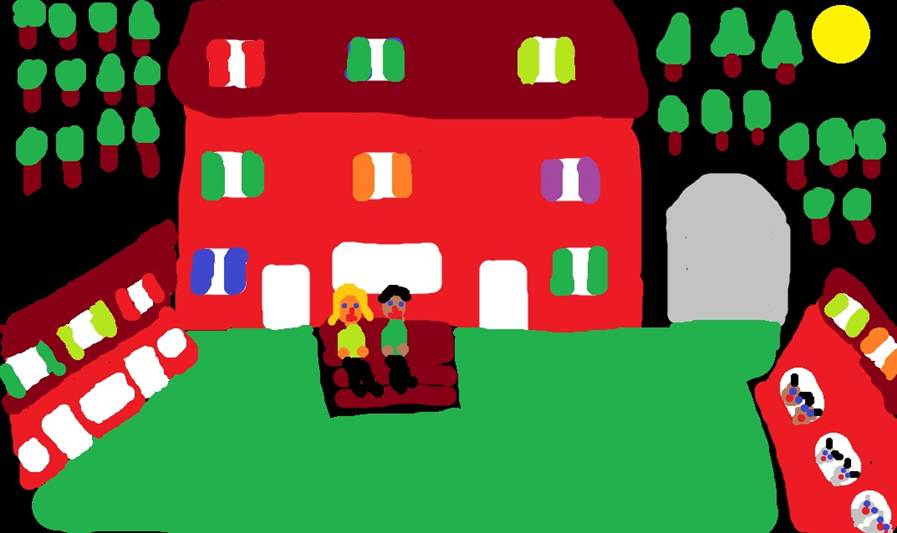
Olivier and Danièle’s planning session, by Julie and Zelim-Philippe
Olivier and Danièle were sitting on the steps of the old farm house, unable to sleep. Spring was in the air, it was a warm night as compared to the cold winter they had suffered. For a few weeks they had already been almost buried in the snow of the Taiga.
“You know what impressed me the most about the latest crisis with the Moral Atrophy virus?” asked Olivier. “The way it showed even to a non-biologist like me how humans, animals, and plants are all made of the same material, function the same way, and get ill from the same things.”
“And what impressed me as non-computer scientist are the plushbots and robots. We call them haproids or harpoids now, because they can have human, animal, robot, plant and even dinosaur shape. Haproids are the prototypes, harpoids are the real revolutionaries, because they communicate better, as on a harp. Anyway, they cannot only gather and communicate information, but they have a moral conscience as well.”
Olivier nodded. “Or at least an amount of knowledge that can stand for it. You know, the way you say about old people that they have a lot of wisdom?”
“And you understand now why I can’t agree with the fasco ‘Human lives matter’ approach, and the argument that ‘Plant lives matter’ should be enough, and that you shouldn’t have ‘Plant lives triumph’?” Danièle pressed on. “Because if you left it that way, humans would continue harming and destroying animal and plant lives at every step like these Pappbergerytes did. We need plant lives to thrive and triumph precisely so that humans and animals and a few dinosaurs, I suppose, can survive as well, and so that we humans with our evil super-strength do not end up destroying the whole earth.”
“That makes sense,” concurred Olivier. “But give the others some time to understand your way of thinking. I suggest you pick them up exactly where I left them after my presentation. They are angry about war and state terrorism before, and fasco terrorism even after the world revolution. That will open their eyes to the need for the true green revolution. They will feel genuine remorse about what we humans did to nature under capitalism. Then we can look further and try to find ways to really go back to the forest and think about how we might live there.”
“Of course, we shouldn’t think of flowers like humans without legs either,” Danièle continued as if she hadn’t heard him.
“That would be most demeaning,” he agreed and pulled her closer.
“After all, even big trees have at least one big leg and several roots that can serve as feet and they can march once they manage to extricate these,” said Danièle and then the two of them were ready to get up and go to bed, arms around each other.
Chapter 1. Let’s have smaller villages!
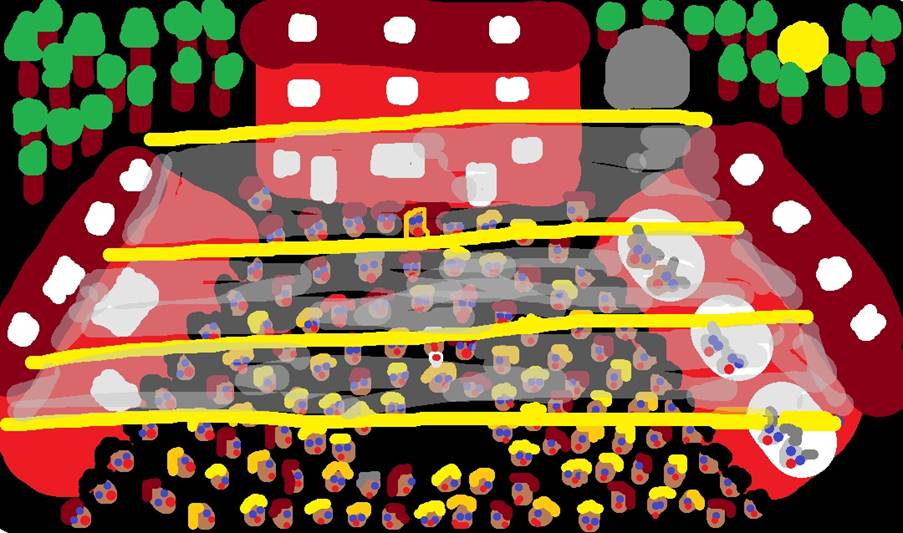
The example of Illyria, by Che and Georgette
The example of Illyria
It was a mild spring evening. They were sitting on the lawn in the quadrangle formed by the old farm house, the stables, the furniture and the clothes workshops, and the robot workshop. While the youth club was more comfortable, only about a third of the over 100 Illyrians could fit in there together. Even if they switched the third that sat in the meeting room every two hours, the two other thirds could follow the meeting only intraline. There was no other choice in winter, but now and for the next seven months, except for storm and heavy rain, they would be able to sit outside. For light rain or slightly cold nights, they even had a water-proof tarpaulin they could roll out in between the robot workshop and the stables. And talking about stables, the farm brigade could open their windows, so that cows, sheep, and goats could follow the proceedings even if it was past their bedtime.
“You will agree with me, comrades, that comrade Olivier, our little hawk, has pretty much covered the security issue, the past, present, and future of it, the damage already done, and what harm can still be expected from the underground illegal crypto-oligarchs and their mercenaries,” Danièle began the presentation of her university entry project, clearly proud of her boy-friend’s work. Something had happened to her older daughter, comrade Yvonne thought, and looked over to comrade Anton. “I agree,” Anton’s reply popped up in her brain as a bio-message intraline. “She is less cheeky, more secure. I think Olivier and her have recycled,” Anton always had to put that concept in, recycling geek that he was, “and tried for something new.”
“Therefore, we can now focus on returning to the forest and start with the basic entity of our lives now, the village. In the future, it will have to fit on a meadow by or even in a forest, with just twenty to a couple dozen houses like Illyria, the garden colony, and the manouche camp taken together, 150 residents maximum, but no larger than that. The agglo(-meration) of Aimeran which these days consists of three villages: Aimeran Nord, Ouest, and Sud, each with about 600 inhabitants would have to de-construct and disperse its houses much further.
The example of Aimeran
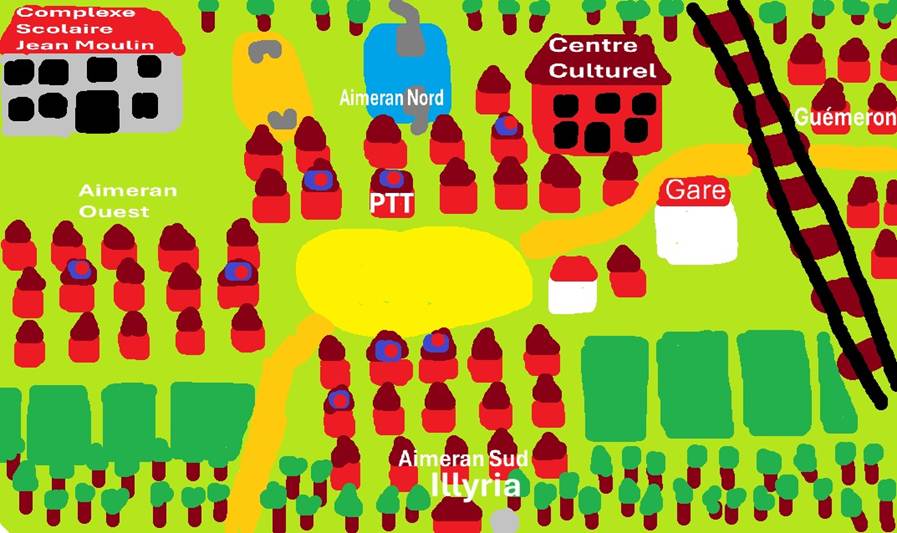
The example of Aimeran, by Bashir and Sevim
So, we could maybe have Aimeran as an example of what needs to happen to larger villages and small agglos in the countryside. The quarter in Saint Denis where our neighbourhood assemblies Casa Latina Russki Dom Peace Dove are located at number 76 rue de Lorraine could serve as the more difficult case of what needs to be done in a much more urban setting. In a recent referendum, the inner city of Paris has now proclaimed itself the agglo of a million trees. How to get there?
“I propose we leave that for the next session and focus on Aimeran first. How can we turn Aimeran from a small town with three large quarters into an agglo of Illyrias, let’s say a dozen small villages of 100-200 residents max? I invite your proposals…”
“Or rather those of the Aimeran citizens,” comrade Pierre, who was moderating, corrected comrade Danièle gently. “As if they knew you were interested in their future, the three villages, Aimeran Nord, Aimeran Sud, and Aimeran have held a joint assembly the other day and taken a number of, believe it or not, consensual decisions going quite far in the direction of your ‘Back to the forest’ programme, comrade Danièle. Comrade Che, you and comrade Georgette were there, will you tell us about them?”
“Yes, as a matter of fact, it was one of the first times that Illyrians were only there as observers. This was because of a decision we have taken on 14 February of this year. As a matter of fact, we have decided to start the move in the direction of ‘Back to the forest’ by pronouncing ourselves an autonomous village Illyria Garden Colony Manouche Camp.”
“You, senior comrades, were very afraid of comrade Danièle, it seems,” interjected comrade Marius, like Danièle only 13 years old, her half-brother as a matter of fact – more of that below –, and barely of voting age.
“Stop it!” said Danièle and lifted her hand in mock outage, but everybody else just laughed.
“Yes, so it seems, were the citizens of Aimeran,” Che said grinningly, “because when Georgette and I came, just a little bit late, they were already considering a proposal to either have nine villages instead of three or to gradually reduce the maximum population of the three existing villages to 150-200 citizens maximum.
The first proposal was rejected off hand. ‘That would mean too many small villages too close together,’ people said. All of the speakers agreed with that point and the overwhelming majority of Aimeran citizens was with them. Memory-bank that immediately, because it will help us in tomorrow’s presentation when we discuss getting big agglos like the whole city of Paris or even just Saint-Denis back to the woods, as you might say. Because they are next, and they know it.
“The first three speakers also criticised the second proposal. You should not force people to leave what in many cases is their ancestral village, ‘just to please the environmental lobby,’ one speaker put it to a lot of applause, with some people shouting: ‘Right he is, you would believe we were still under capitalism.’ Yet then the following speaker, it was our good friend, comrade André, already calmed the waters : ‘We wouldn’t do that. In fact, our proposal, from the citizens of Aimeran Sud – already minus Illyria, meaning we are only around 450 now –, is to simply wait for nature and the revolutionary purpose requirement to do its job. All we need is a stop on new people moving in, or if they do, only if others are moving out or have died. And as you know, we do not officially have a one-child policy, that would be much too Draconian a rule. Instead, we ask the families and young couples of Aimeran to invest thought and time into finding a really useful revolutionary purpose for any new child they contemplate. It could be babysitter for the younger siblings, mind you, the main thing is that the neighbourhood assembly agree to it. This organisation need not result in just one child per family immediately, but as a matter of fact it usually does. In fact, it has already. The average number of children in all of Aimeran is just 1.1 per family as of Year 19, as it is in Illyria as a matter of fact. In the whole of Île de France the average is even lower than 1 – 0.95. So we can estimate that in one generation, each of our three villages will only have 300 citizens. And in two generations, it will have reached the desired value of 150.’ There was applause from at least three quarters of the around 2000 people present.
“From then on, all the speakers expressed agreement with the general thrust of André’s proposal with some amendments only. Several speakers requested help from the village assembly in finding acceptance in a new village if they decided to move out, as that village may also have such a new residency stop. Others were worried about the social infrastructure of Aimeran. ‘Will there still be the school complex?’ Yes, even after the reduction in village size, it would still be able to enrol over 500 students from the villages around, including Aimeran Nord, Sud, and Ouest, Guémeron, and Illyria Garden Colony Manouche Camp. This meant that it definitely would still have a raison d’être for a long time to come.
“’The train station?’ Of course, although there might be one joint station Aimeran-Guémeron. ‘The post-office?’ No problem, it would be in the central square bakery share point, like before . ‘The cultural centre?’ Yes, the five villages would all contribute to the projects and conduct necessary material and hierarchy checks so that the fascos could not appropriate them. ‘The policlinic?’ Of course. There might even be out-branches in all five villages, with about three beds each, and a mixed doctor – nurse – support brigade each with the role of foreman rotating between them every day as in the rest of the economy, as well as the central policlinic with 20 beds and three mixed brigades. And in case of emergencies in one area, some of the other five brigades might deploy there.
“When the final vote was taken, 95% of citizens of voting age, meaning 12 years and older, accepted the proposal for a residency stop, yet with help for people wishing to move out or in and maintenance of the required social infrastructure. When the dissenting five percent were asked whether they could live with the decision, they said yes, even if one woman comrade broke out in tears and cried: ‘But only if you help us!’ An somewhat older comrade noted cynically that, anyway, this was probably a campaign, and there would be similar rules in place everywhere soon. ‘So, you might as well sweat it out!’ as he put it.
“Then I spoke out,” said Che, “because I could not suffer his sarcasm, and said. ‘Listen, you won’t have to sweat it, this is a three-generation, meaning a hundred year programme, in other words, you won’t feel the brunt of it, but your children and grandchildren will already see the benefits of it. There will be a lot more trees, better air, better soil, and better water quality. Animal, plant, and also human health will have improved considerably. We’ll live closer to nature and presumably be better and happier people. Second, the main rule it is based on, namely the revolutionary purpose rule, has been in place for over a decade already, in places like China for several decades even. And third, if you think that this means less democracy, or even dictatorship, consider this. Right now, in your brigade, how often does the foreman change?”
“At every shift,” the comrade shrugged. “Every day, or even once or twice during the day, should you feel like working two or three shifts.” He straightened his back. “I know what you are getting at. I am a Communist-anarcho myself. In the neighbourhood assembly, the chairman will change every week at least.”
“Meaning your turn will come every day at work, and once every seven weeks at least in the neighbourhood,” said Che. “But now the snag…”
“The snag is if I work at SNCF as I do and have 500 people at my workplace assembly and there are ten moderators who change every hour, my turn will come only every 50th hour. Meaning that often I won’t be moderating for one if not two or even three of the quarterly two-day meetings.”
“Same snag with the village assemblies,” Che interrupted him. “If your Aimeran Ouest village assembly stays at 500, that is. If it goes down to 150, you’ll be the moderator for at least one hour at every second one-day meeting.”
“The man nodded, visibly impressed. And then comrade Emmanuel who was with us, had the guts to throw in… What did you say, comrade Emmanuel?”
“I told him to get active in his trade union cell if he wasn’t already and push for SNCF to split up further, so he would get to be moderator there as well.” Now the comrade looked truly grateful and said. “I moved to Aimeran not long ago, and I always thought the excitement about you Illyrians was just that much hype, but jeunes camarades, you know your stuff. You call it the permanent revolution, don’t you? I shall remember that.”
“Hold it,” the third of those not quite satisfied made an attempt at rekindling the debate. “Will we have enough share points? Right now, we have five in the central market square, serving all three Aimerans and Illyria Garden Colony Manouche Camp and Guémeron as well: the baker, the butcher, the clothes shop, the household goods shop, and the electrical appliances and electronics shop, and of course, comrade Louise’s good-for-everything central share point. And then we have five more good-for-everything share points in each of the three quarters.”
“And all share points of course also serve as collection points for recyclables,” noted comrade Georgette.
“Otherwise, we would need larger trucks, but with our small pick-up recycling transporters coming several times a week, and our incinerators for any rubbish that remains we have pretty much overcome landfills, and road congestion and pollution as well,” Anton boasted proudly.
“Well, we shall keep the five share points at the central square obviously!” several people shouted. “Also for the touries.”
“And we can reduce the number of those in the three parts of the village to one or two gradually, as they get smaller,” comrade Louise, central share point holder, suggested.
“Don’t forget that we also have the workshops, three at Illyria alone,” said comrade Che. “The robot, the clothes, and the furniture workshop, and from each of them you can pick up or order things for free as part of the economic circuit, and we shall deliver for free via Logistique Yvelines or via Logistique Yvelines plus train if the order comes from further away.
“We also have a bicycle workshop at Aimeran,” added comrade Fabien, a driver at Logistique Yvelines, who had come as an observer from the garden colony, “as well as a garage and vehicle recharge one at Guémeron, where we can bring our tractors. Of course, we can also recharge them at home or at Logistique Yvelines. It is due South from here about 12 km and can also be considered a local workshop. I think these workshops will have to stay.”
“The recycling workshop in Guémeron as well,” added Anton. “We shall come back to that.”
Comrade Che
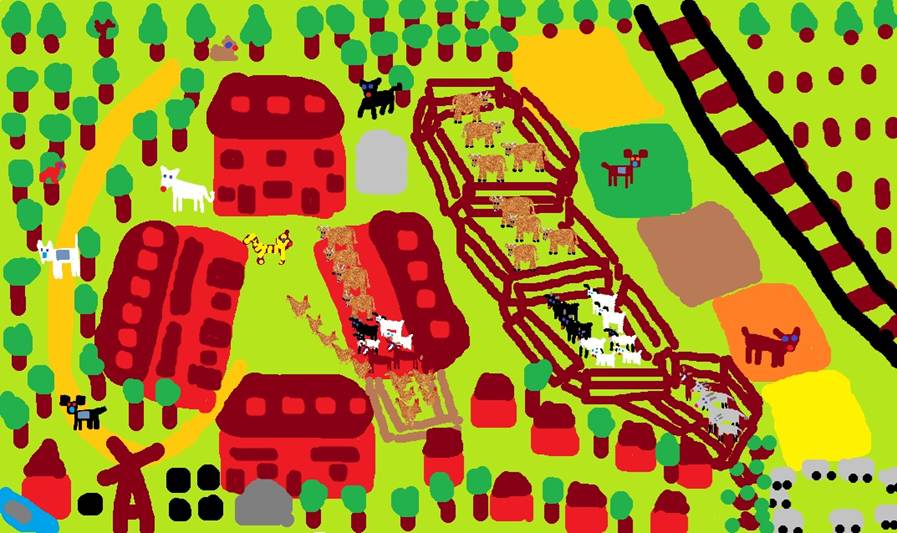
The cooperative of Illyria, by Marius and Jean-Luc
After the meeting, comrades Che, Georgette, Danièle, and Olivier still sat for a while in the youth club, because Danièle wanted to know more details about Illyria and whether it was maybe too big already “to pass as just a small blot in the forest.”
“I think we are small enough already,” comrade Che consoled her. “We have twelve cows at the moment, their milk barely covers our own needs. That is why we borrowed a bull and two of them shall calve this year. We shall keep twelve sheep this year. We’ll use all of their wool in the clothes workshop, and sell some of their milk to the fromagerie at Aimeran. The rest of the milk we can use ourselves. Same for our six revolutionary goats. Most of their milk goes to the fromagerie. A small part we use ourselves. The other day, they smashed a fence, but we love them all the more for being revolutionary. We have ten chicken. Most of their eggs we use ourselves, so we are considering getting some more and or allowing some of them to get chicks. We have six dogs, the Illyrian Recycling Hounds, named after the Moscow Recycling Hounds, and six dogbots called the Illyrian digital hounds. They take turns in guarding the perimeter of the cooperative. We have about a dozen cats, lots of birds, and some wild hares and squirrels jumping around. All of them are good for security and bio-wifi as you know. And we have three dinos, but we shall discuss those at a separate session, won’t we?
“We have four pastures, six grain and vegetable fields for bread crops, carrots, cabbage, lettuce, and other vegetables, a fruit orchard, a garden plot for the more labour-intensive kinds, and a greenhouse for winter veggies. That is not too much to ask, is it? Any surpluses, we bring to the market.
“We have our block energy works, consisting of some solar panels, a water turbine, down to the South-West at the stream in the forest, and a rest rubbish incinerator. We get most of our water from wells, although we still have a mains connection, as we do have one to the central electricity grid, just in case of emergency. And we are still connected to the waste water treatment centre South East of Guémeron.
“We might consider letting that overgrow, just as the train line if we go really wild 50-100 years from now, but for now, it is good to have and not too much of a burden on the environment either.”
“Comrade Danièle,” comrade Maurice, who was listening in with Lulu, interrupted his friend Che for a moment. “I fully understand that you want to run away from all the artificial stuff. I am the same, since as you know, I got almost killed by a poisoned mandatory omnibus vaccine based on all their Big Pharma synthetics at age one. Yet all of us are still used to civilisation, even the younger ones that already grew up at Illyria. It is better to lose the habit gradually and with a safety net, trust me!”
“You know, I’ve got two dads, comrade Anton, who wants to recycle everything and produce as little as possible, and comrade Misha who can’t have enough democracy,” said Danièle. “Maybe that is why I am so impatient.”
“Of course, it can be tough with two exacting dads,” said Olivier soothingly. “But remember, I have got two as well. Comrade Patrick is my nominal dad, because mamon,” comrade Marianne, “and he will never part, no matter how much they cheat on each other. He has made comrade Natalie with Francine, and mamon has made me with comrade Aslan, my real dad. And yet comrade Patrick and mamon still hang together, and sometimes they still even go to bed together, says mamon. Anyway, comrade Patrick, being one of the editors of l’Huma newspaper and media channel, wants me to be a great writer and sociologist, and comrade Aslan wants me to be a perfect security expert. And now you call me a little hawk!” And he pulled a grimace pretending to be really offended.
“But you know what,” said Danièle, tears of laughter as well as envy in her eyes. “I may even have three radical dads, because comrade Danton may be my real dad. And he is a turbo-deconstructionist.”
“I have heard that story,” comrade Che grinned. “Everybody got suspicious already in Year 8 . You looked exactly like him and called him Dato before you could even say mamon and papa. But that wouldn’t be a punishment either, would it? He is one of the smartest guys in Illyria and in Paris even. I mean, Ponts et Chaussées allows him and comrade Léon to work on the deconstruction-reconstruction of the whole of Paris, that should tell you something.”
“But there are other geniuses in the brigade,” Danièle objected. “Comrade Martine first of all. She is a top material science expert, and has developed the methodology for material testing that workshops use all over the French lands. And there are rumours that she slept with comrade Danton and with comrade Robespierre as well, although she is Léon’s girl. Maybe that story has just spun out of control, as in comrade Danton is now supposed to have slept with everybody,” Danièle defended her father figure bravely. “And there are comrades André, Tim, Babacar, and Nasir in the senior deconstruction-reconstruction brigade, and comrade Léon as well, he is an ace. And there is the junior brigade, comrades Anton, Maher, Karla, Rosa, and Cédric…”
“Yes, but still, how come you are the only Illyrian to call him Dato?” interrupted Che. “That seems like a joke between the two of you. And I have observed you. To this day, you hug him exactly like you do comrade Anton, almost more affectionately. I think deep down you call him papa too.”
“But that would make mamon a witch!” moaned Danièle.
“Not a witch maybe,” concluded Olivier. “But a beauty with many suitors. But don’t worry, you are a beauty too.”
Danièle’s family trees
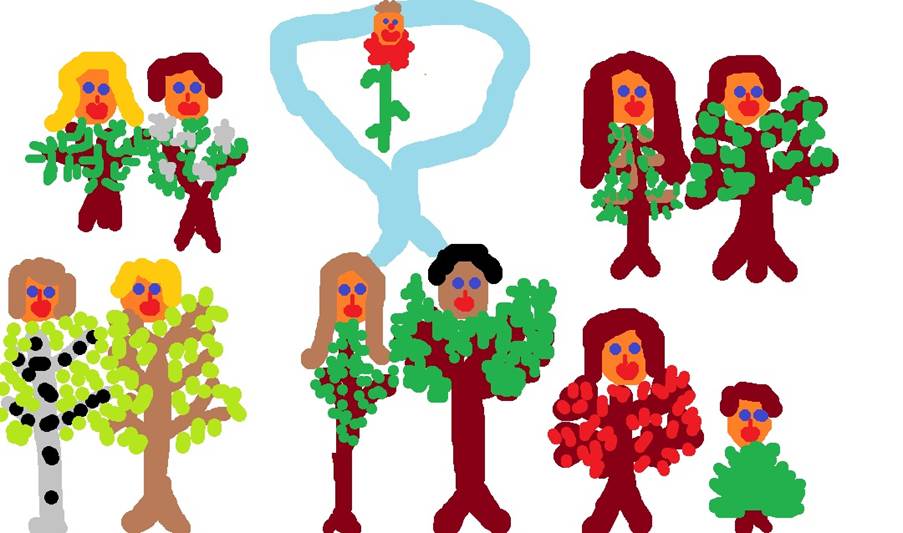
Danièle’s family tree, by Odile and Zamir, from top left to bottom right, comrades Monique, Anton, Yvonne, Misha, Jean-Luc, Marius, Danièle, Olivier, Odile, and Little Jean-Michel, and up in the cloud, Danièle and Olivier’s baby to come, Flore
In Year 8, comrades Monique and Yvonne had told comrade Danièle, there had been a bit of a tug-of-war over her. “I have a kind of a memory of that,” said Danièle. “I was sitting on your lap, mamon. I was very happy, because you were happy, but then you said you wanted to go away. I remember I cried.”
“Yes!” Yvonne laughed. “But I did not really want to go away. I just wanted to move with you from the old farm house to the guest room in Mamie’s,” meaning her mamon’s, comrade Camille’s apartment above the furniture workshop.
“Because you were fed up with me!” said comrade Marius – it now seemed maybe only Danièle’s half-brother, as he was son of Anton and Monique. “Because you hated me already back then.”
“I did not!” pouted Danièle. “And I don’t hate you now. You are like my twin brother.” Marius and her were both born in the same Year 7, and maybe from the same father, comrade Anton. “We just have different views on animals. I want the animals to be our brothers and sisters. You want to play God and create a wonder-animal that we humans can then exploit.”
“I do not want to play God, I shall ask the animals at every step of the way,” Marius replied proudly. “After all, what did we rediscover nature-speak and nature language for? And I don’t want to exploit them, I want us to live together with this wonder-beast, wonder-cattle or wonder-animal, call it what you like, as friends and comrades. Remember, they will not only be non-voracious, milk-giving, wool-bearing, meat-yielding, egg-laying, load-carrying, plough-pulling, and stand guard, but cuddly as a cat to boot.”
“Well, be that as it may,” Danièle said, with a resolute stroke of the arm through the air that she had adopted from comrade Cato. “We can discuss that later. I remember that we all cried when mamon and me left, papa,” comrade Anton, “comrade Monique, mamon, I, even you, comrade Marius…”
“I recall that!” nodded Marius. “I felt very bad. Remember, I thought you were leaving because of me.”
“Buffaloshit,” said comrade Misha. “It was because Danièle’s mamon, comrade Yvonne, was coming to live with me. I was new here in Illyria, I needed help.”
“I recall, I liked to sit on your lap and hug you,” nodded Danièle. “You were just as nice as papa, I thought. But then I was also always happy when papa came to the youth club and I could play with him again. He is a great ecologist, papa is. He looks at everything as a recycling expert. He thinks: How could we find new uses for this thing, or if that does not work, how could we take it apart so that we can use all or most of its parts in new things?
“Then, in Year 14-15, Marius and I were already in Troisième du Primaire, meaning 3rd class of primary school, and even young comrade Odile had already entered primary school, comrade Cato arrived from Berlin. He used to be papa Misha’s girl-friend, and now she, eh, he was just his pal, but mamon wasn’t jealous, at least as far as I could tell.”
“Your mamon and me got along fabulously,” said Cato in a deep voice that at times sounded just a little bit hoarse. “Then I grew a beard, remember that?”
Danièle nodded bravely. “I remember, comrade Marius said, ‘See, when comrade Cato does it, it’s a great feat of humanity, and if I want cows to be a bit smaller and bear wool, it’s a crime against animals.’”
“Ho, ho,” said Cato. “Did you really say that, comrade Marius?”
“I certainly did not!” said Marius, red in the face and seized comrade Jean-Luc by the hand. “I am LBGTHQIA myself, after all.”
Everybody laughed. “Then we moved to the garden house, but I only stayed there sometimes. Most of the time, I lived with comrade Olivier in his mamon’s apartment.”
“Yes, because he is your potector,” said Odile, and no one wanted to correct her for this cute mistake at that moment.
“On our first night there, I buffaloed you, remember!” Olivier said, “almost like the other night,” and comrade Danièle got red in the face.
“Comrades Danièle and Olivier, like all of us, have been very impressed by the return of the buffalos, which finally happened in Year 18, but had been planned a long time ahead of course,” said Peter Gar or Pierre le Gars as he was known in French.
“That was also when I came to Illyria,” comrade Carla, comrade Misha’s mother smiled over her whole face as she remembered. “I was so fed up with the agglo of Berlin deconstructing so slowly, and so glad to see comrades Misha and Yvonne, and the three of you…” She was referring to Danièle, Odile, and little toddler Jean-Michel. “I remember you had the 1st of September rally, like every year, commemorating World War II and other capitalist atrocities. It featured street theatre, and you, comrade Danièle, were playing a Russian Communist in the Imperialist Interlude, from 1992, the end of socialism, to 2021, the year of the world revolution. In the sketch you were complaining that ‘At this stage, Russia has as little to with Communism as has America.’
“I laughed so much I had to cry, and remembered my university work on perestroika and how the reforms had all come apart and ushered in morbid capitalism. For a moment, I thought you had put in the line for me as a jibe.”
“Of course not,” comrade Danièle shook her head. “Although I might have meant it as a teaser, but we had actually put it in for the Black Block. Remember these black-clothed guys with hoods and masks that caused trouble at rallies? Comrade Jean explained they were only pretending to be anti-fascists, but in fact they were Zionists. Worse than that, they might even be fasco saboteurs.”
“They were,” comrade Olivier emphasised. “Glad you remembered that, comrade Carla. I want to put that into my paper.” Comrade Olivier was just putting the final touches on his university entry project, the second task along with the baccalauréat examinations every French secondary school student has had to complete since the revolution in order to qualify for a course of study at university. “One reason more you won’t be able to call me a little hawk any longer.”
“There were great ecological banners at these rallies as well,” remembered Danièle. “We painted them at the youth club here in Illyria or in Saint-Denis. In Year 16, it was ‘Plant lives matter and should triumph’, in Year 17, ‘Slaughter equals murder’, in Year 18, ‘How much tech do we need?’, and last year’s, Year 19, was ‘Next time we should ask animals and plants for permission.’”
“And we shouted, ‘Vive la harpe!’ ‘A bas les fascos, vivent les animaux!’ Everybody loved that!” added Julie.
Chapter 2. Break up the cities and agglos!
The example of Casa Latina Russki Dom Peace Dove on 76 rue de Lorraine, by Faroukh and Sarah
Josh and Jason
“The five of us are members of a deconstruction-reconstruction engineering brigade affiliated with New York University,” comrade Jason tuned in from Greenwich. “Neighbourhood assemblies call on us for expert opinion on anything from transforming a street into a park, garden colony, or pasture, deconstructing a high rise, or organising a village assembly. Just like they call on your brigade at Ponts et Chaussées. As you remember, one of the first votes the neighbourhood and village assemblies took after the revolution was on cars. Neighbourhood assemblies brought together a minimum of two and a maximum of seven immediate neighbours, village assemblies a larger neighbourhood or small borough. Right after the revolution, the maximum size for a village assembly was 2000 people. Of course, it has come down considerably after that, I am sure we’ll come back to that. Without the pressure from the car lobby, there was hardly any New Yorker who wanted to hang on to his or her fuel-guzzler. The only thing they were worked up about was the price of public transport. In some regions or former states you might say, the assemblies decided to give people who drove their car to the next gas station a voucher for at least a year of free travel on public transport for giving up their car, then to be extended until the time that the public transport network was really extensive enough to cover all of people’s needs. We New Yorkers and the assemblies in many other East and West coast states immediately voted for life-long free transport. Nowadays, where food, clothes, household goods, and indeed most goods are free in the economic circuit, this does not seem like a big thing to us. Yet back then, it was a leap of faith. We even had it approved by city and state-wide referendums.”
“When you say we, you mean the people…?” asked Danièle.
“Yes, of course, I mean many assemblies, not only the immediate neighbourhood and village and workplace assemblies, as well as the wish of individuals as expressed in surveys which our New York universities conduct constantly just like your Université de Nanterre economics and statistics department. And then the referendum came to clarify our wish once more.”
“And, sorry to butt in, you call regions states, but these states did no longer have any government, did they?” asked Olivier.
“Of course not, young comrade, we abolished those first thing along with the municipal and federal government just like you did in the French lands as well.” Jason laughed. “We went there with banners and posters, shouted ‘Out, out, out!’ , ‘We are the people!’ until they noticed that their last hour had really come and went home, except for the eternal right-wing rebels. Those the militia had to arrest. We did it all by the book, don’t worry!”
“O.k.,” said Josh. “You have talked enough for now, comrade Jason. We got rid of the cars except for functional ones like taxis, ambulances, fire brigades, militia cars, and small delivery vans. We wanted none of these huge containers anymore that were blocking the highways around New York. Yet we allowed some other functional vehicles including cranes and tractors that we thought we might need for deconstruction and survival. Now what? We did not think of returning to the woods immediately, although I must say the yearning was alive in us already back then, but we definitely wanted to regreen the cities and get rid of the ugly skyscrapers.”
“Not only because they were ugly, but because they were symbols of oppression,” interjected comrade Jesse.
“Absolutely!” nodded Josh. “And even for sound security reasons. They were threatening to sink the island of Manhattan.”
“Just like in Paris!” complemented comrade Danton. “In fact, we should never have built any buildings higher than five floors.”
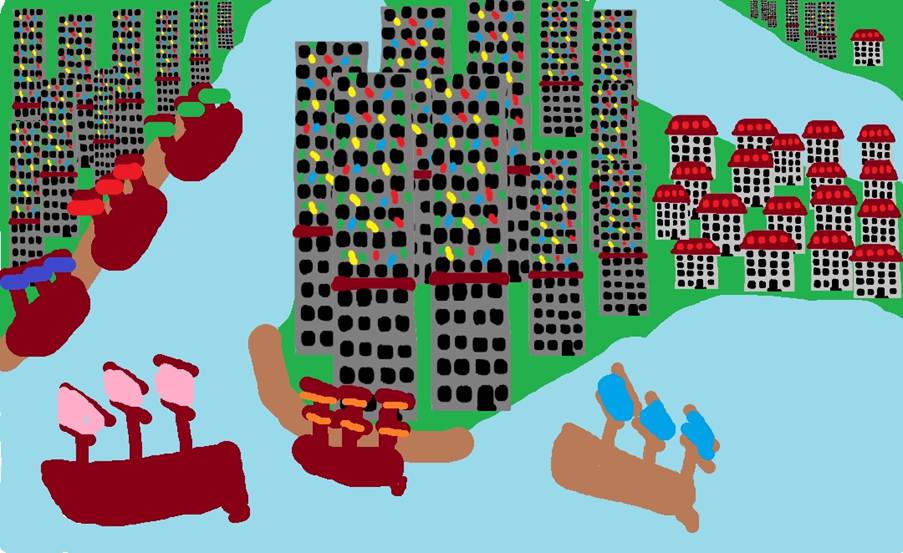
Large agglos deconstructing: New York, by Maher and Karla
“Same in New York city!” said comrade Malcolm. “Therefore, the neighbourhood and village assemblies easily agreed to that rule. And that was less of a problem than you might think, because over half of the buildings on Manhattan Island had been government and corporate offices. Well, we had closed all of these down. The workers’ assemblies of the branch companies were splitting up into smaller enterprises. Back then 2000 was the maximum, but the ideal upper limit we considered already back then to be 49, seven brigades with seven members each with their foremen rotating daily. So, worker’s assemblies usually very quickly came around to splitting up into units of 500, then 200, then 100, then 50, same way that you now want to do it with the small rural towns or large villages around Paris.
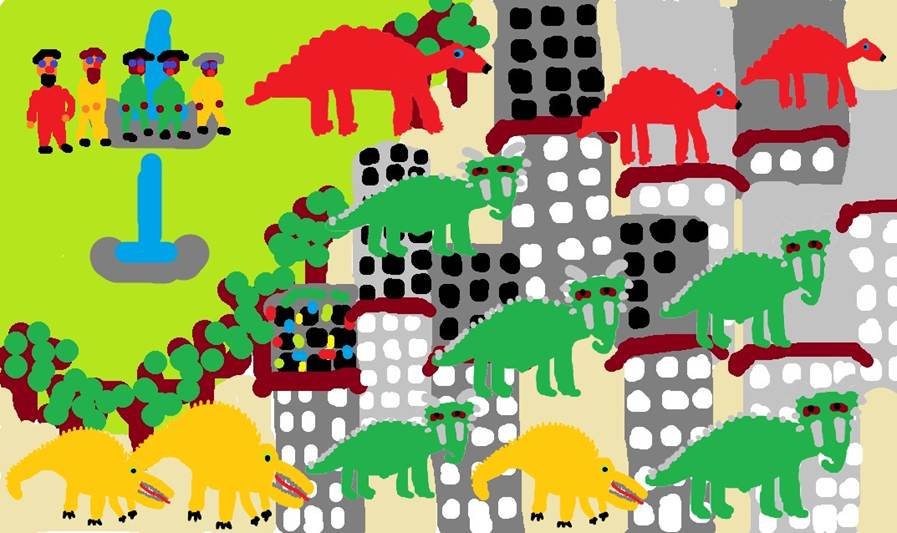
Dinosaurs further deconstructing New York, by Malik and Mao
Comrade Danièle was glowing with pride. Wow, the smart-looking American comrades already seemed to have listened in on yesterday’s conference. They were taking her seriously!
“So, we made a plan. Comrade Martin, named after Martin Luther King, is not there today. He is up in Chicago mediating in some ‘dispute between ghettos and burbs’, as we call it, we can tell you the story later if you wish, maybe when young comrade Tim will present the whole story of deconstruction-reconstruction. Comrade Martin calls it the New American dream, on how to proceed with deconstruction along the lines you Parisians have formulated as well.
First, pull up the tarmac, keep only one lane, two lanes at most of cobble stone and similar quaint pavement for public transport, delivery vans, taxis, functional vehicles, all electrical, of course, none without permission from their home village assembly. Second, plant grass and flowers, and later on bushes, trees and even veggies in every free space. And third, deconstruct huge buildings to a maximum of five floors or ground level plus four as you express it here in Europe.
“We revolutionaries call that plan our hundred year project, the reactionaries poke fun at us and call it our thousand year pipe dream.”
“I admit I call it a thousand year plan,” said Peter Gar. “But that is not to poke fun at the revolution, but because it is difficult.”
“Of course,” said Luis. “But with the Lord’s blessing and all of us working hard at it we may accomplish it in 500 years, don’t you think?”
“We think so,” said Josh. “Let me tell you about some of the main obstacles we have run into, and later on, we can compare our notes with what you comrades have found in Berlin, London, and Paris.
Obstacle number one has been the contradiction between creating space and saving time by using controlled implosions, on the one hand, yet minimising pollution on the other. Lately, the comrades dinosaurs have been helping us with their dance. You know the idea of that better than we do, since you discovered it. Dinosaurs and other large animals, such as buffalos, or even large cows can move their feet to the rhythm of the innate oscillations of the building to be deconstructed which will then crumble more slowly and more softly than it would using implosives. Of course, you have to facilitate the work of the dinos by first letting our comrades plants and bacteria munch on the building.
Obstacle number two to deconstruction has been fasco sabotage, the anti- or we’d rather call it – the demolition league being one of them. Obstacle number three has been the struggle between ghettos and burbs comrade Malcolm was talking about. Both are vying for attention, and the élite don’t want to give up their seats.”
Misha
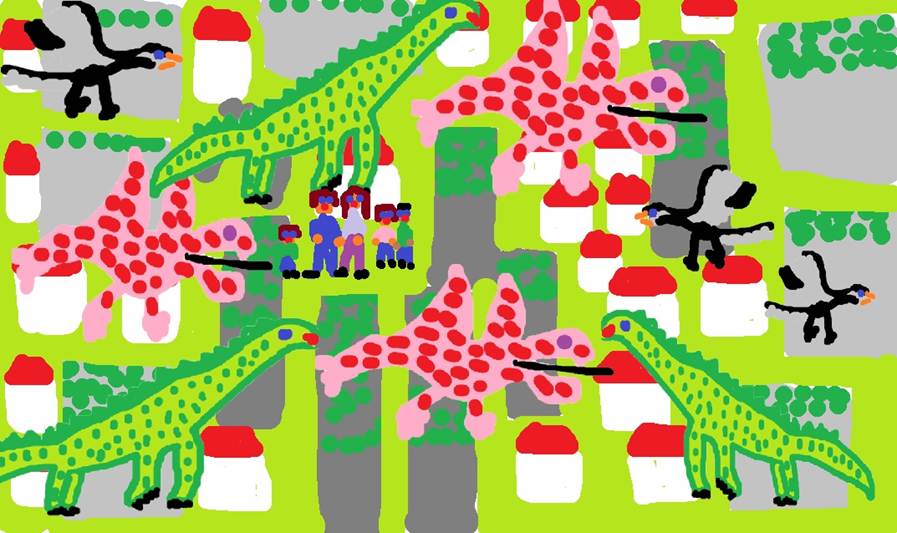
Misha in Berlin Deconstructing, by Zamir and Odile
“We’ll get back to all three obstacles as we discuss the Berlin, London, and Parisian cases as well,” said comrade Jean who was moderating. “Comrade Misha, you have the word. Do you have a thousand year plan for Berlin as well?”
“In a way, although we have formulated it as a two-hundred year plan with three long stages of about sixty-six year each and a number of substages in each. The first substage, the abolition of private cars and fuel-guzzlers went very fast, just like in New York. Yet maybe only because Berlin is a huge metropolis, with plenty of public transport – trains, busses, subways, trams, streetcars, you name it, they have got it –, to substitute for the cars. People had experienced increasing difficulties driving and parking their vehicles over the last few decades before the revolution anyway. Pedestrians were complaining about the noise and the exhaust fumes. Cyclists were complaining about frequent accidents because car drivers did not care. The green movement was also very strong in Berlin as in most other big German cities. So, over 99 percent of car owners obediently drove their car to the next garage or filling station and took their free transport voucher. The situation was different in the countryside. There many people often continued driving their fuel-guzzler until militia stopped them and gently persuaded them to give them up.”
“Same in the ex-U.S., and you are putting it mildly. In our case, militia sometimes had to shoot at the tires, because illegal drivers were trying to get away, and once or twice the illegal drivers even fired back at militia,” reported Jason.
“How come spontaneous militia and drivers still had fire arms?” asked Tim.
“Those that the drivers had were illegal, since the village assemblies had voted for the abolition of arms. And they had abolished money, of course. The fire arms that were circulating were either left over from pre-revolutionary times or procured from crypto-merchants and underground workshops. And the militia were still allowed to have stun guns. Remember, that was before the discovery of harmless red stun beams and shields summoned just by willpower. Any person trained in them can protect him- or herself with a red shield, and if possible stun an aggressor with a red beam for half an hour until spontaneous militia come. And we may employ bronze beam to incapacitate the aggressors’ vehicles and heavy guns. Our kids learn to use all three of these methods at school like children all over the world.”
“We had our version of the struggle between ghettos and burbs,” added young comrade James, Tim’s North American cousin from the prairies. His father had left Europe as a young man already. “Only in our case it was between farmers and trappers, especially the richer ones, and Indians. Both groups had kept some private vehicles without registering them with spontaneous people’s militia. Yet for some reason at first only the Indians got into trouble for it.”
“Yes,” said Misha. “We had some cases like that, especially in the conservative rural areas of Bavaria, and similar areas. And militia always stopped the poorer farmers. Fortunately, in Berlin people accepted the no-car life style without any difficulties. So, now we had reduced our traffic volume by over 95%, allowing only public transport and functional vehicles, as well as small delivery vans and taxis on Berlin roads. All of them needed permission from the village or kiez assemblies to even be allowed to register and then to enter certain areas.
The next step or part stage rather was pulling up the tarmac. The idea was first to check out all the underground pipes and cables and remove those, such as broadband that we no longer needed. After all, we were moving towards 100 percent intranet and bio-wifi. Then we would add compost, fertilise the soil with grasses and wild flowers, and gradually replace the larger part of the roads with small parks or even vegetable gardens. Some kiezes even turned larger squares into cow pastures, at least those that they did not use for market stalls. Of course, there were no longer any super markets and shopping malls, those we had dismantled, just small share points.
“In each neighbourhood and kiez assembly, we now got stormy debates on how each individual road was going to look like. Was it going to have pedestrian walkways on both sides, or was it enough to have one? Should it even have a vehicle lane, and if so, did it have to be cobble-stoned or could it be just a dirt road? Should the street hold on to its electrobus or tram, and for how long? What to have, a park or vegetable gardens? If the latter, should the individual households on the streets run their plot as part of a garden colony, or should households form a cooperative and work them together? How many playgrounds to have? How many areas to reserve for market stalls? How many ground floors for share points and other workshops? And so on, and so forth. At first, Berliners thought that they would spend only a sixth of the 200 years finishing the regreening of the streets, but we are already in Year 20, and there are still plenty of problems.
“Concurrently with the regreening, and then reaching until the end of the second and even the third period, neighbourhood and kiez assemblies planned to solve the problem of deconstruction. Berlin is built like New York and Paris, on sandy soil, and we should not have built highrises here for safety reasons alone. Moreover, high office buildings serve to practice exploitation. That is why, after the revolution, we immediately converted all of them into apartment buildings, no ifs or buts.”
“But people, and especially children, old and sick people should not live above the sixth floor!” Danièle butted in.
“Absolutely right, sweetheart,” and Misha looked fondly at his adoptive daughter. “And moreover, all apartment buildings, big or small, have served to perpetuate the class structure of capitalism, since they come in various categories, luxury, comfort, average, poor, and miserable.
“We need to deconstruct them, no ifs or buts. In the country side, the size of the old farm house at Illyria, with just one floor above the ground floor and a roomy attic should be the absolute maximum size allowed for a house.”
“I for one call the old farm house the skyscraper,” noted his dad, Peter Gar.
“And right you are, papa!” Misha retorted. “And in the city it should be no higher than our apartment house on 76 rue de Lorraine in Saint-Denis housing the neighbourhood assemblies Casa Latina Russki Dom Peace Dove, that is four floors above the ground floor, five floors American style.
“On this point again, the debates in the Berlin kiezes are raging to this day. At first, most village assemblies adopted an exemption to the five floor rule for historical and other quaint buildings. Well, almost everybody went along with that. The assemblies reached consensus.
“Yet then some cocky devils, most certainly some ex-capitalists and fascos among them, requested that the rule extend to buildings close to these landmarks. In other words, there could be an ugly modern building with seven floors close to a historical or quaint building with six floors, and it would not face deconstruction. It enjoyed protection along with the more valuable building. This is although we have nanobots who can bring in chemicals and escort plants and bacteria to the place where they are needed to munch up the metal or plastic pipes and the concrete with a precision of one nano-millimetre and less.
In principle, we want to get rid of concrete block buildings and return to bricks, yet there has been a lot of argument. After all, we want to recycle as much as possible, even ugly, old concrete. So, because of all these obstacles to real deconstruction, we expect stage two to drag on to Year 100 at least. In parallel, according to our three stage planning, stage two will already be underway. In stage 2, we want to demolish, or rather build down more buildings with quiet, energy-saving, and environment-friendly methods like plants – algae, ivy, moss, lichen, and similar –, harmless chemicals, bacteria, such as concretum manducans for concrete, ideonella for plastic pipes, and leptospirillum for metal pipes, beams, and finally, the advance of the dinosaurs and other large animals and their dancing. Exactly like in New York.
Already now, we always start with soft deconstruction where the building workers manually remove radiators, bathroom, and kitchen fixtures, window and door frames, ledges, carpets, plugs, pipes, and cables to the extent possible and recycle them. Even concrete blocks can be recycled into flower pots, as we know from comrade Georgette’s thesis. We only resort to demolition or comrade Léon’s quiet, energy-saving, and environment-friendly implosion method as a last resort.
And then once we have spaced and spread out the buildings a bit more, we can maybe pass to a last stage. In that stage, we shall reduce the maximum size of the buildings further, keeping intact as much of the quaint landmarks as possible. Yet average buildings should shrink to a maximum of three floors, meaning ground floor, first floor, and attic like in the countryside. That will require another major effort at overcoming the differences between town and countryside. That is our programme in Berlin. Now, how is the situation in Paris?”
Jeremy and Basty
“I am ready to go,” said Danton, “but why don’t you say a few words about London first, Jeremy and Basty?”
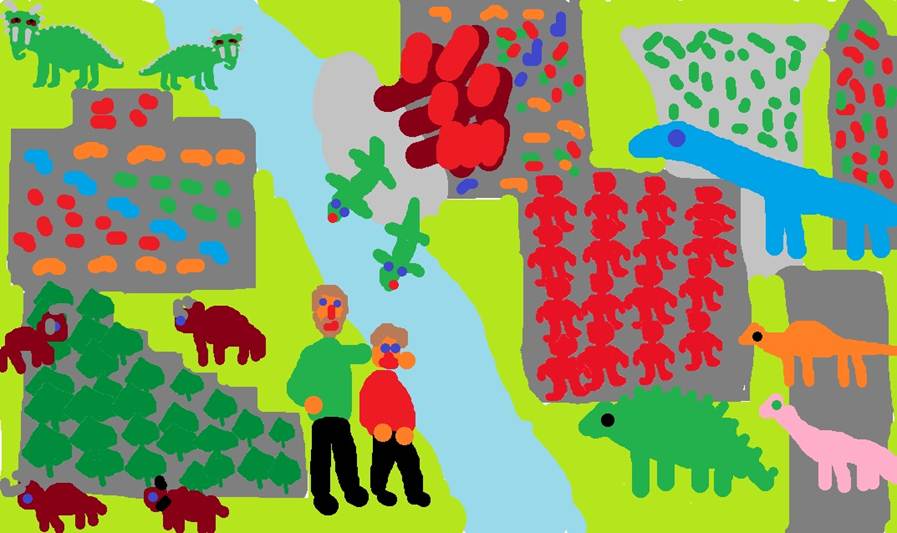
Jeremy and Basty in London deconstructing, by Cédric and Charolaine
“Yes, listening to you, comrade Misha, I had the impression I was hearing a report from revolutionary 7th heaven. The American comrades mentioned fasco sabotage…”
“I mentioned fasco filibustering at least,” interjected Misha. “There has been a lot of that in Berlin as well, along with some spectacular cases of demolition by the supposed anti-demolition league, especially around Potsdamer Platz and around Treptower Park, the Allianz tower. You will remember comrade Yvonne’s presentation on comrade Cato’s ordeal fighting prejudice and ex-capitalist milking of transgender.”
“Yes, but we have had lots more fasco filibustering in London,” continued Jeremy. “And in the City, where buildings are close together and imploding one, even with gentle methods bears major risks for all the others, it had a certain ring of truth to it. So, deconstruction was delayed to a ridiculous extent. And what about the class struggle, ghettos versus burbs, comrade Misha, have you really had none of that in Berlin? We have had plenty in London, and to this day, some areas still look like slums, be it that the buildings are not that high, while others still look like private resorts.”
“And they are run that way, too,” added his son, Basty. “With fences all around, and crypto-currency shops and underground workshops hidden in the basements.”
“Look, at this point let us not get into the issue of fasco sabotage from the underground and how we may provide security for the revolution,” said Jean. “Comrade Olivier has just given a major presentation on it and we may have to return to it later, in light of the latest news from the Taiga where the fascos seem intent on poisoning the water. We don’t know any details yet. For now, remember comrade Danièle’s central argument, she wants to bring back the forest and for us humans to arrange our lives at the edge, in the very middle of the forest, or even in the trees.”
“And I want us to discuss how to get there!” added Danièle. “So far, I learnt it will take at least two hundred years in the urban agglos. What else?”
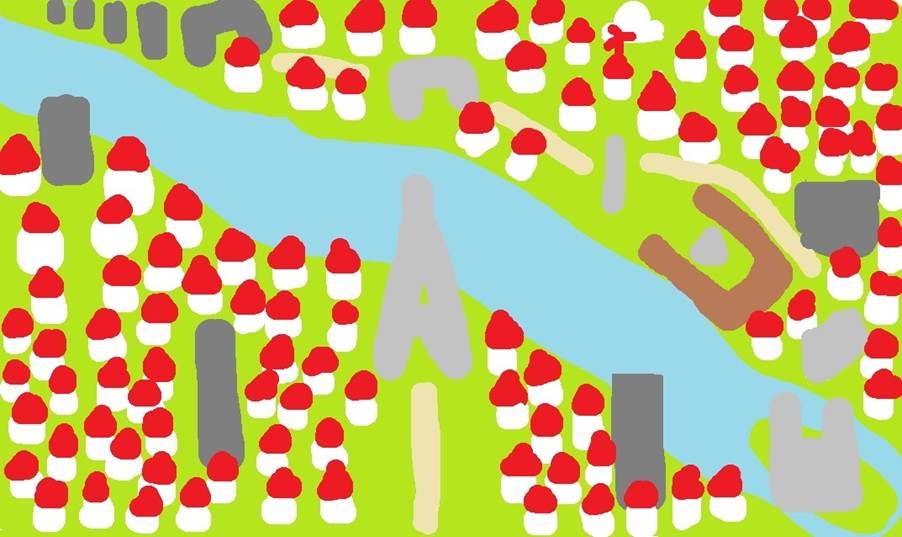
Deconstructing Paris, ca. Year 100 of the Revolution, by Rosa and Josip
Comrade Danton
The Paris deconstruction-reconstruction brigade: the seniors, Léon, Danton, Martine, André, Babacar, Nasir, and Tim, and the juniors, Anton, Maher, Karla, Rosa, Josip, and Cédric, by Colin and Cécile
“As you know already, we have accompanied deconstruction-reconstruction in Paris for the last twenty years,” comrade Danton began. “We think the major challenge is not deconstruction, but dispersion. Dispersion might be the third stage that the Berliners were talking about after deconstruction and the initial spacing out or spreading out.
“The crypto-capitalist mafia – and we do have one in Paris as well, don’t worry, comrades Misha, Jeremy, and Basty –, the crypto-capitalist mafia protects buildings, for instance, by associating them with historical landmarks. We revolutionaries have to win the arguments in the neighbourhood and quarter assemblies and reach consensus. Natural deconstruction will take place if the place is no longer as jammed full of people and cars as it was in the last stages of capitalism before the revolution. People will move out, and no new ones will move in. Then we can start cleaning up their capitalist mess. And of course, we have had spectacular explosions or attempts at explosions here as well, of the Tour Montparnasse, Parly 2, that was a shopping centre near Versailles, and in La Défence.”
Chapter 3. Deconstruct and Disperse!
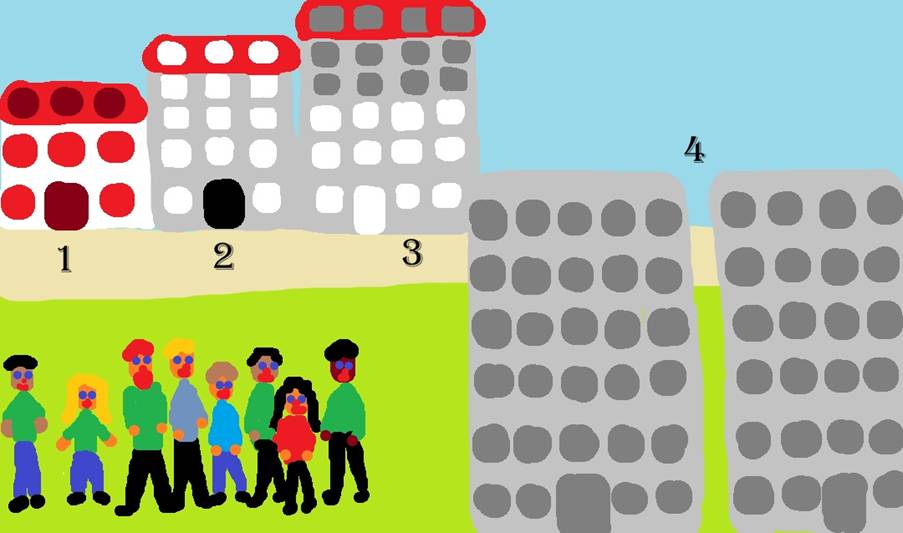
Planning a two-hundred year project, by Zelim-Philippe and Julie, from left to right, comrades Olivier, Danièle, Danton, Tim, Cédric, Maher, Karla, and Babacar
“So, what do you think, darling Danièle…,” Danièle was moderating, and Olivier again noticed the current passing between the two of them. Yet it was not sexual, that would have given him pangs of jealousy, it was more of a deep understanding like he had it with his natural parents, comrades Aslan and Marianne. Hence, Olivier concluded, Danton must really be her papa, and he had to say, Danièle was the better girl for knowing it. All the overexcitement and touchiness, even vis-à-vis comrade Marius, was like blown away. “Do you me want to tell them about the compromise deconstruction plan, or leave it for later?”
“Tell them now,” Danièle said. “But before you do, let me briefly explain why we are spending so much time on deconstruction-reconstruction whereas my university entry project is actually about going back to the woods. The reason is simple. We cannot go back to the forest without quitting the cities, and we also cannot simply let the cities stand and rot, because they would take up too much space in most regions. We also cannot ask the march of the trees to stop somewhere and leave a whole smouldering cesspool of pollution untouched.
“The second reason is that we will want to marry modern technology and return to nature to a certain degree. Some of the following modules are going to focus on particular achievements of technology we might want to hold on to such as trains, at least some electrical vehicles, necessary electrical appliances, computers, and robotics, and maybe solid houses rather than tents, yurts, straw huts, or tree houses. Remember comrade Lénina’s five axes, from technology to nature, from science to magic, from planning to economic circuit, from democracy to anarchy, and from emphasis on security to gradual rehabilitation of repentant fascos. In that sense, some of the Parisian infrastructure may still be of use.
“Therefore, in this spirit of marriage and compromise, we shall pursue the idea of a 200 year rather than a 100 or a 1000 year plan, where Year 1 to 67 will be deconstruction of roads and ugly, unneeded, and outright toxic buildings. You know pretty much what that stage entails, because we are already in the middle of it.
“Year 67-135 will be further deconstruction and what we call spacing or spreading out of buildings. That stage in particular will require even more careful deconstruction, because we might have to take down only every second building in a row, and deconstruct the second from five stories to three. Papa, comrade Anton will inform us of the recycling possibilities already at our disposal, as well as even newer directions of research.
“So as to move in the direction of loosely connected villages of 200 inhabitants at most, year 135 to 200 will see further dispersion to agglos and the final overcoming of the division between town and countryside. Comrade Léon will say more on that later. Back to you, comrade Danton!”
“Merci, ma chérie. Before we start our walks through Paris, please look for a moment at the picture above. There are four types of buildings to consider. Building one will be alright even in stage three of dispersion where we overcome the last differences between town and countryside.”
“Or at least, it will already amount to the Dublinification or Dublinying of Paris,” comrade Peter Gar threw in. “Dublin has traditionally had mostly 2 floor houses, only very few tall buildings. And we have either already demolished, for the most part, the monstrous highrises in the International Financial Centre or the moss, algae and bacteria are already eating them.”
“The Dublinification of Paris,” grinned Danton. “Merci, comrade Gars, I like that, because aside from coming down in height, deconstruction also means that smaller buildings will proliferate in the whole extended région parisienne, which may indeed double in territory as a result.
“D’accord then, building two although quite possibly already deconstructed, will have to lose two more floors. Building three still needs to give up one floor even by the old rule of five floors, or ground level plus four. And the two buildings numbered 4 are ugly and unhealthy. We should take them apart, have harmless chemicals, bacteria and plants eat them up, or implode or bring them to a fall in their entirety by dinosaurs dancing or stomping, doesn’t matter, but they need to go. The technicalities I leave to comrades Léon, Tim, and Cédric. For now, we shall do the planning aspect.
“We have divided the whole of Paris into twenty super-agglos corresponding to the pre-revolutionary arrondissements. The seven of us plus Olivier as a security liaison shall begin our walks today in the first arrondissement. As you may know it consists of four part agglos already: Vendôme, Palais Royal, Halles, and Saint Germain l’Auxerrois, meaning basically the Louvre and the Tuileries.
“Starting with the last, not much to do there in terms of deconstruction. Yet you’ll have to pass there. The Louvre these days is part art, part Branch Museum of capitalist atrocities, and every child from the whole of the French lands should spend one or even several days there at least once during their school years to learn about the importance of hierarchy checks and what happens if we don’t practice them.”
“Place Vendôme, where we are now, is already a market square, and while we have kept it cobble-stoned up to now, we might propose to the village assemblies around it to transform it into a park, what do you think?” Everybody agreed, and the march moved on to Palais Royal and Les Halles. “Most buildings in these quarters are considered historical monuments, and there is not much we can do about that now.”
“Not now, but in the future, when the rest of the French lands is green again we might wake up, and ask, do we still need these memories of feudal atrocities?” asked Danièle.
“You are right, and I can imagine a solemn celebration where dinosaurs dancing in the rhythm of the oscillation of these buildings will bring them down in a dignified manner,” proposed comrade Cédric to general applause.
“Same goes for the Quartier des Halles,” said comrade Babacar. “My parents told me it was worse under capitalism. There were fancy shops inside, but the African street vendors, who also did barter back then already, were chased whenever they tried to stay somewhere for any length of time. I think it should just be a large green field with wooden stalls and maybe some nice-looking barn-type hangars at the sides to take refuge in when it rains. It should be a place where everybody can offer things for free as part of the economic circuit, share, and barter to their heart’s content. You know, more like an African village market.” They all applauded again.
“To be run by the neighbouring village assemblies concerned!” recorded comrade Maher who had taken over the moderation.
“And maybe approved in a city-wide referendum,” suggested comrade Tim. “In case the Parisians get sensitive about their centre ville!”
Comrade Karla giggled. “Why don’t you make it a referendum all over the French lands? Paris belongs to all of us.”
And on that jocular note, they moved on to the second arrondissement.
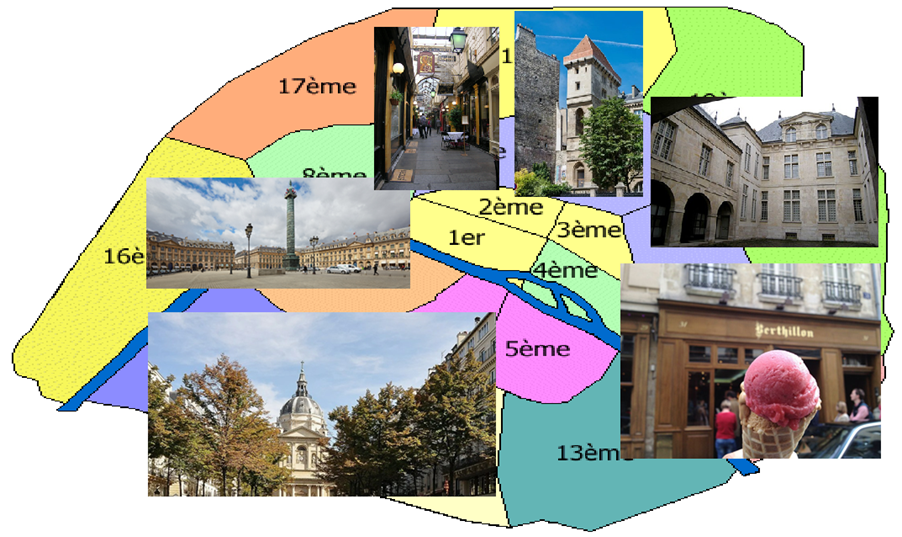
Examples from first to fifth arrondissements: Place Vendôme to be greened, as well as quaint buildings to be maintained
“There is another distinction that may help you decide what to do with particular buildings,” explained Danton. “Some are clear marvels of architecture such as, in the second arrondissement, the Passage des Panaromas and the Tour Jean sans Peur. Others must be kept because of the collections they contain such as the Bibliothèque nationale, the Perfume museum, or the Paris Food museum, or the arts they are dedicated to, such as Opéra and the Variété theatre. Some destroyed buildings we might even want to reconstruct. In fact, we already did so with the Théâtre de Bourgogne.
“Same situation in the Troisième arrondissement where the village assemblies chose to keep most of the old aristocratic or bourgeois city castles some of which also house grandes écoles, in other words grand schools or technical universities, such as the one for material sciences, Arts et Métiers, where comrade Martine received part of her training. There is the Musée des Atrocités de la Chasse – you heard right, it used to be called simply the Museum of Hunting. Then we have the Hôtel de Donon which used to contain an art collection by a private capitalist, now it is just an architectural memorial, used for several family apartments. There is also the Picasso Museum, the Doll Museum, the Museum of Locks, the National Archives, the Hôtel de Saint-Aignan which houses the Jewish Museum, the Musée Carnavalet art museum, and the Gaîté Lyrique, which is a music theatre. Some other buildings in the Marais are also architectural memorials and deserve to be kept.
In the 4th arrondissement, for instance, this applies to the Hôtel de Ville, the Centre Georges Pompidou, the Bazar de l’Hôtel de Ville share point, the Berthillon ice cream share point, the Chapelle dorée in the Saint Gervais church, the Hôtel Dieu – that is an old hospital now Branch Museum of the Medical Atrocities of Capitalism –, and several more noteworthy mansions. They include major tourist attractions, such as the Hôtel de Sensand the Hôtel de Sully. You may know the Rue des Rosiers and the Lycée Charlemagne because of the Harry Potter festival which takes place there every year. There is a Museum of Magic in this area as well. Our friends, the buffalohumans have demonstrated their magical transformation from human to buffalo state and back, as well as to grasshopper, when they were visiting here. Other dedicated buildings in the 4th are the Maison de la Photographie, the Marché aux Fleurs or flower market, all free in the revolution, the Memorial to the Shoah, the Polish corner with museums dedicated to the lives and works of the writers Boleslas Biegas and Adam Mieckiewicz, and the composer Frédéric Chopin.
In the 5th there is the Panthéon, the Musée de Cluny, Sorbonne University, the Institut du Monde Arabe, the Jardin des Plantes, the Musée Curie and other historical and functional buildings to be maintained as well as many quaint buildings people live in, in particular in the Quartier Latin.
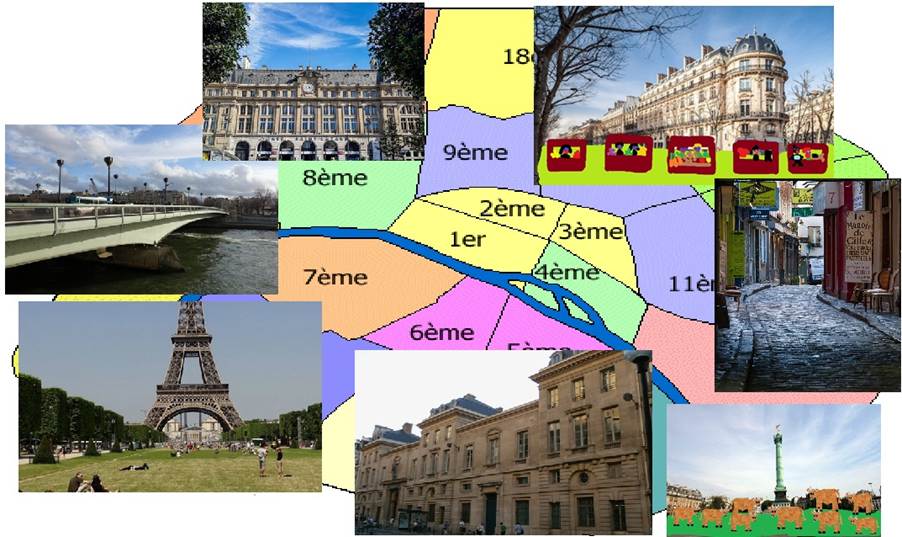
Examples from 6th to 11th arrondissement: The Deconstruction-Reconstruction brigade’s school Ponts et Chaussées, Champ de Mars, Pont de l’Alma, Gare Saint Lazare, regreened Boulevard Haussmann, artists’ retreat Faubourg Saint-Antoine, and the cow pasture on the regreened Place de la Bastille
In the sixth, the main highlight of course is our grand school Ponts et Chaussées, to be maintained for its use-value, although it looks a bit austere. There are also beautiful bridges, Pont Neuf and Pont Saint-Michel, the pre-revolutionary Académie française – now called Académie révolutionnaire, honouring scientists and artists from all over the world –, old-fashioned Parisian coffee places like the Café de Flore, the Hôtel Lutetia, one of the few examples of a pre-revolutionary hotel – as hotels no longer exist, it is now a guest house –, the Monnaie de Paris or Branch Museum of Monetary Atrocities of Capitalism with a section dedicated to post-revolutionary crypto-currencies, other money substitutes such as fake vouchers, tokens, and underground workshops, the church Saint Germain des Près, and the Comédie française.
In the seventh, there is the park Champ de Mars as an initial regreening hub, as we call it, the Tour Eiffel, and the Hôtel des Invalides, now also a Museum of Pre-revolutionary Atrocities of War and Conflict.
In the eight, we may mention the Gare Saint Lazare, one of several Parisian long-distance stations that should be maintained even in a deconstructing agglo to uphold long-distance communication, the Champs Elysées, the Arc de Triomphe, the Hôtel Georges V, the Palais de la Découverte where they used to keep the time capsule enabling time travel into the past. Now, thanks to comrade Sylvain’s, Jean-Saïd’s and other comrades’ research, we have the time tunnel that can even carry us into the future and back. There is of course the Place de la Concorde, where so many revolutionary rallies start and finish, the Grand and Petit Palais, the fabulous art museums, and the Madeleine, as well as the beautiful Pont de l’Alma.
The 9th used to be the quarter of big department stores. The Galéries Lafayette and Printemps are nowdays galleries of sharepoints. The Boulevard Haussmann, built to facilitate the movement of armies and police through Paris to quell unrest was one of the first Paris avenues to be transformed into a park, and lately a garden colony. It also has a permanent fruit and vegetable market all along its route.
In the 10th, noteworthy buildings are the Gare de l’Est and Gare du Nord stations still in active service, of course, the church dedicated to Saint Vincent de Paul, one of the religious originators of simple sharing, and the Place de la République where many demonstrations start to this day, moving on to Bastille and or Nation.
In the eleventh, the Cirque d’Hiver has been kept although it features more respectable revolutionary theatre these days, as well as Place de la Bastille, another example for successful greening, nowadays even with cows grazing on it.
Part of Place de la Bastille is also located in the Twelfth, along with the park Bois de Vincennes and Château de Vincennes, as well as the beautiful artists’ colony on Faubourg Saint Antoine.
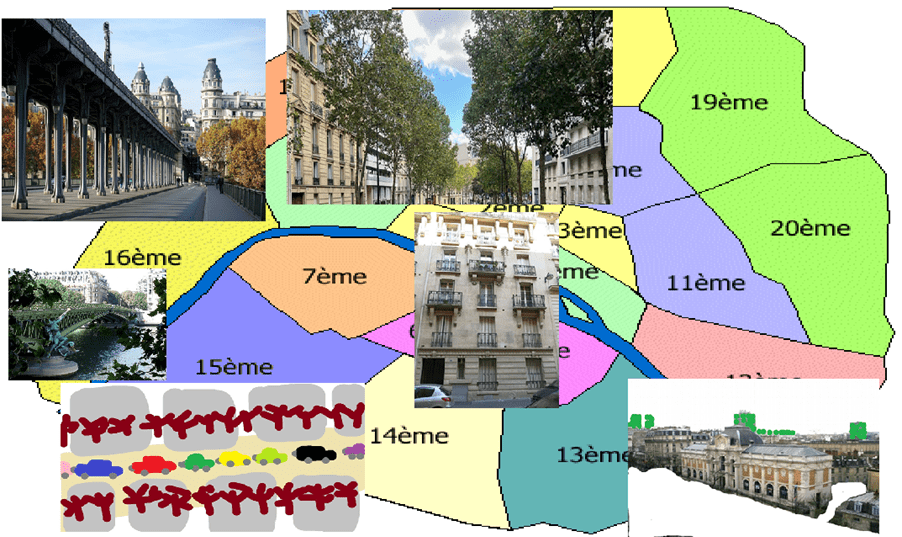
Examples from the 13th to 16th arrondissements: Gobelin manufacture, Lenin Museum, Boulevard de l’Enfer, part of the Museum of Capitalist Atrocities, beautiful Bir-Hakeim and Pont Mirabeau bridges, and classical versus ugly buildings on avenue de Iéna
In the Thirteenth, you can still visit the old Gobelins Manufactory now part of the Museum of Capitalist Atrocities of course. Mind you, some of their fasco new underground workshops are run in exactly the same exploitative ways they used in the 18th and 19th century. On the picture, taken in the snow, you can also see highrises deconstructing with the algae and bacteria method in the background. Place d’Italie was one of the first major squares to be regreened along with Nation and Concorde.
In the fourteenth, we may admire the Catacombs, the modern Gare Montparnasse, which had to be restored after the fasco bomb attack in Year 8, and visit the Musée Lénine or Lenin Museum. It even features the apartment he stayed in with Nadezhda Krupskaya and her mother when fleeing from the Tsarist police from 1909-12. There is also the Musée Jean Moulin, dedicated to the anti-Nazi resistance fighter just like our school complex in Aimeran, the old Observatory, the Boulevard Montparnasse we regreened as well as the Boulevard Raspail. Part of the latter, however, we now call the Boulevard de l’Enfer capitaliste (Capitalist Hell Boulevard), because it allows you to hire an electrical vehicle so as to experience traffic congestion as you faced it every day before the revolution. As you exist the museum, you can for a brief moment breathe in exhaust fumes as they used to reign in Paris under late capitalism.
In the 15th arrondissement, there are beautiful bridges such as the Pont de Bir Hakeim and the Pont Mirabeau, the Museum of Television, also a part of the Museum of Capitalist Atrocities, the parc Georges Brassens, named after the famous popular singer, and the exhibition centre at Porte de Versailles, a major protest site in 2021, year of the world revolution. You guessed it, we have also turned it into a branch museum of capitalist atrocities.
In the sixteenth, the avenue de Iéna can serve as a hub to help us distinguish between truly classical architectural monuments and cheap imitation. The latter we may deconstruct without any qualms obviously, thereby spacing out the agglo, preparing its spreading out and dispersion as well as finally eliminating the difference between town and countryside.
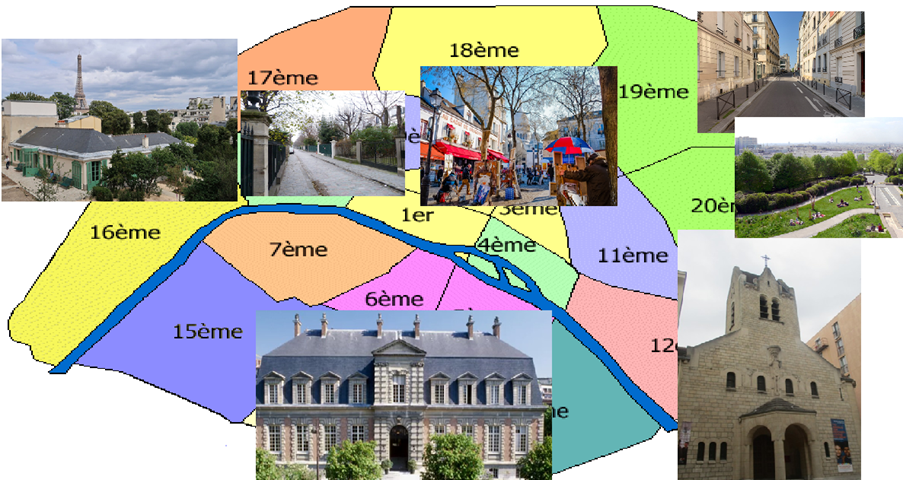
Examples from the 15th to 20th arrondissements: Institut Pasteur – quaint functional building, Maison de Balzac in the 16ième – example for the whole of Paris, Cité des Fleurs –beautiful but for the capitalist fences, Montmartre, rue de la Villette, Notre Dame des Otages, and the Parc de Belleville, pioneer of regreening
Also in the 15th, we have the Institut Pasteur where our Illyrian and Casa Latina Russki Dom comrades Fabienne, Michel, Maurice, René, Kaltouma, Assad, Karima, Pauline, and Murielle are doing their research on natural medicine, bio-terrorism, medicine in underdeveloped region, medical nanobots, the social aspects of revolutionary medicine such as the mixed brigade consisting of doctors, nurses, and support personnel to get and remain on an equal level, and mental illness under capitalism and its remnants in Communism respectively.
The Palais Chaillot, old UN building and Château de la Muette, headquarters of the infamous imperialist OECD are now also branches of the Museum of Capitalist Atrocities, so is the Louis Vuitton Foundation. The Pavillon de l’Eau by contrast is an old memorial to city water management. The Maison de Balzac, the writer Balzac’s modest little old house is a wonderful model on how we want most of Paris to look again 150-200 years from now.
So would the Cité des Fleurs in the 17th, if it were not for the many capitalist fences. They are a reminder of the Résistance against the German Nazis, but they are out of place now and are at least in part protecting former élite families. Don’t worry, we shall pull them down. This village is not far behind the Arc Triomphe but before you get to the La Défence disaster zone.
In the 18th, the village assemblies decided to keep Montmartre, Sacré Cœur, Moulin Rouge, and Pigalle more or less like they were, although regreened and with some ugly and historically worthless buildings deconstructed.
In the 19th, we have the Buttes Chaumont and the Parc de la Villette as models of regreening, as well as the rue de la Villette almost as picturesque as Faubourg Saint-Antoine. When comrade Jean and other working-class residents were asked to move out there to make room for the élite, that was one of the triggers for the revolution. And there is the Musée du PCF, Museum of the French Communist Party of course, at number 2 place du Colonel Fabien. It stands as testimony to one hundred years of dedicated struggle beginning with the inception of the PCF at the Tours Congress. Then it died and survived in battle during the Nazi occupation and Vichy. Later came its harassment by the neo-Vichyites under late capitalism until its self-dissolution in the wake of the revolution. In an exemplary fashion, the party yielded its place to the truly democratic neighbourhood, village, workplace and other organisational and movement assemblies. These take all their decisions consensually, do not suffer hierarchy, and insist on the permanent rotation of all positions of authority. They will hopefully never have to surrender to the capitalists, bourgeois politicians, and fascist eminences anymore.
To conclude our 20 walks through all twenty arrondissements, we remembered the victims of fasco terrorism at Notre Dame des Otages. Look at the ugly apartment house next to it! It will have to go. Then we strolled over the beautiful Père Lachaise cemetery and finally rested at the Parc de Belleville, another early model of regreening the city, bringing back the trees, and creating resorts for the proletariat. Ultimately, this has ushered into our project of deconstructing the agglos and eliminating the division between town and countryside as has been a demand of the Communist movement since inception. So far for the planning, the picking and choosing. Over to you, comrade Anton, for the practicalities.”
Comrade Anton
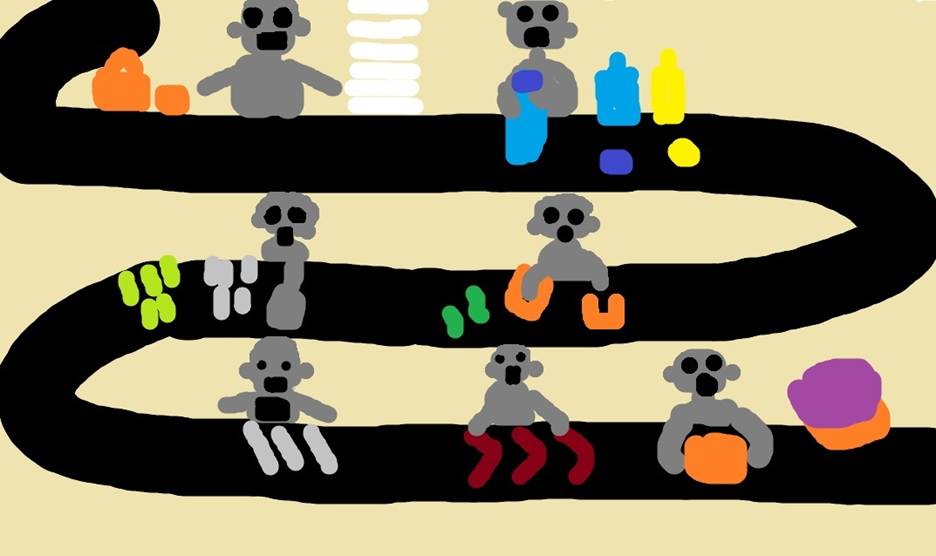
Old-fashioned humanoid robots busy with our recycling, by Josip and Rosa
“Merci, comrade Danton. Especially, the soft deconstruction comrades Léon, Danton, and Misha have talked about is a matter of recycling. When you hear recycling, you probably think of the nice green or red transporters that come twice a week and look clean like a taxi or one of Logistique Yvelines’ slick delivery vans except they have holes with flaps on them. There you can sort your rubbish according to whether it is paper, plastic, glass, textiles, metal, small electrical and electronic appliances, or compost. You can also get advice on how to deal with things that have all these mixed or that are hard to get rid of or to part from for other reasons. A different transporter may come once in a while to pick up larger electrical appliances when they need to get sorted out. And there may be a certain amount of unusable rubbish. That will go into the rubbish or rest rubbish incinerator to feed the Block Energy Works along with the solar panels, the small windmill, and the small water turbine. Wood may either be burnt for energy as well. Or, if it is good wood, it may be recycled as well into further uses.
“Most non-experts think that this is where the story of rubbish ends. Yet actually, that is where it starts. There are general recycling workshops, and even specialised recycling workshops for each of the eight categories. Let me show you a video from our general recycling workshop at Guémeron, which has six sections, as well as from some specialised ones further away.” And Anton sent it to their brains as a bio-video and also to their intraline devices to watch or at least to keep a record of. “You can see, it is unpleasant work, sorting out all this stuff, and this is why our harp comrades’ robot arms replace the comrades who used to slave there. The robots can sort paper and plastic, take metal or plastic tops from glass bottles, clean packages and rinse cans, take apart devices, household utensils, for instance, knives with a plastic handle, small furniture, separating wooden from metal, textile, and upholstery parts, and so on. And they can often do it much better, more carefully and with more patience than we humans can.
“Comrade Danièle and I have had a discussion about this already. She agreed with me that the workshop in Guémeron and similar ones will have to stay, at least for the foreseeable future, although she rightfully calls them capitalist left-overs. There are two important distinction between their capitalist recycling and ours though. The capitalists recycled in quality categories and these categories then not only determined their price, but also the types of buildings they would be used in. Let us take building materials, steel, concrete, glass, and so on as examples. The very best steel, concrete, and glass would go into their corporate and banking headquarters, the second best into elite apartment buildings, the third quality into government buildings, the fourth into apartment buildings for the general population, and the fifth and last into social infrastructure such as public swimming pools.”
“The swine!” exclaimed Peter Gar who seemed to hear this for the first time.
“Same for the electrical and electronic devices. Prestigious, high priced brands got the cleanest recyclables, those at the lower end of the price-quality spectrum the bad stuff. The very worst stuff landed on the landfills. I read a statistics in Revolupedia saying that before the revolution only 9% of plastic got recycled at all, let alone put to good use.
“Of course, these multiple, you may even say hierarchical categories put quality and safety at risk…”
“They also violated principles of social equality…,” interrupted Bashir,
“…and ecological environment-friendliness,” added Danièle.
“Exactly. As you know, the revolutionary village assemblies have forbidden land-fills. So, you can imagine what we have had to do. Let’s go through the categories again. We have radically expanded the uses of recycled paper. Before the revolution, the capitalist corporations still printed their bills on all-new paper, while the unemployed, social aid and basic pension recipients already received all their correspondence printed on cheap recycled paper. We have instituted a ban on new plastic production until multiple use has been made of existing plastic, same for synthetic textiles. And we are trying to replace the use of recycled plastic and of synthetic textiles wherever possible with recycled steel, wood, and new or recycled cotton, wool, or other natural fibre. This so that, hopefully, we won’t have to produce any plastic or synthetic fibres anymore ever.
“We clean our glass and metal left-overs much more thoroughly, reuse them as long as possible, and recycle them several times.
“And as for the construction materials, equipment, appliances and devices, we or rather our android robots take them apart much more carefully. This as a matter of fact was the second distinction we cannot stress enough. Under capitalism, recycling got done by cheap proletarian slaves, now we use first-class robots developed and produced by the same proletariat but now well-educated and trained. So, we clean the construction materials, equipment, appliances and devices much more thoroughly until their parts that get put back into new buildings, renovation, or new equipment, appliances, and devices have all passed all the necessary material checks. Remember, any producer, consumer or user brigade, any individual, the village assemblies, university research institutes, as well as survey respondents can launch a material check at any time. And these material checks make certain that all materials, goods, and things conform to highest unified world-wide quality standards at all times.”
Comrade Léon
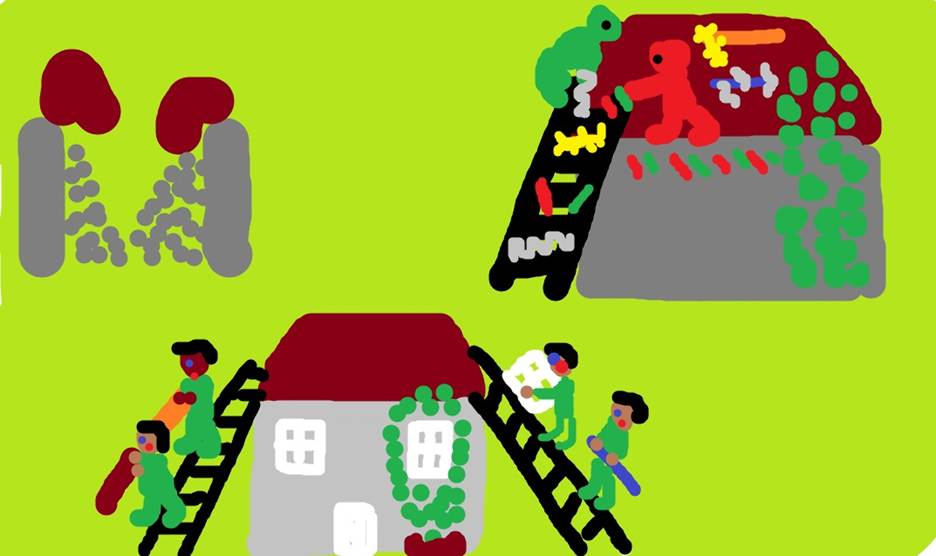
Methods of deconstruction, by comrades Maher and Karla
“Merci, papa, for your honest testimony, and now may I ask you, comrade Léon, if recycling is really so crucial for quality, social equality, and environment-friendliness, and that includes air, water, and soil purity, should we even use methods like demolition and implosion which destroy the original materials and cause lots of dust? And even deconstruction by harmless chemicals, plants and bacteria might be dodgy, as all of these make construction materials unfit for reuse, or did I understand that wrongly?” Danièle asked the first question.
“And if I may say something, I doubt that even cleaning the recyclable parts of the equipment, appliances, devices, and so on thoroughly will get them all as clean as they need to be,” her friend, comrade Julie, seconded her. “We might be better off abolishing them altogether and going all deviceless. After all, we want to go back all the way back to the woods, and we have intranet and bio-wifi now, don’t we?”
“I think, comrade Julie, sweetheart, your ‘May I say something?’ needs to be treated like a hierarchyleak,” Julie’s father, Danton, spoke up quickly, partly out of concern for sure, maybe also to give his friend Léon time to think. “Who is moderating, by the way?”
“Me,” said comrade Inès. “Should we run a hierarchy check, comrade Julie?”
“Not necessarily!” said Julie. “Yet I want a complete answer, even if it is late already!”
“It is not as complicated as you may think, young comrades,” said Léon. “Although I think, we should postpone the matter of how many devices to keep if any to later sessions. For now, I shall just focus on the deconstruction angle. We realised from the beginning that implosion and even the use of the small, hand-held, solar-powered, and quiet drill that most neighbourhood used to pull up the tarmac before their houses and on their parking lots causes dust. This is why we made a schedule for deconstruction of roads and squares not by quarter, and not even by block, but house entrance by house entrance, making sure to always leave time until air quality around the block recovered to then let the neighbourhood assemblies at the next entrance do their drilling, or if they were separate buildings as on rue de Lorraine, at the next building. Same principle for the country highways. We did them stretch by stretch, always leaving time for villages, pastures, fields, and forests around to recover.”
“Even if at times that gave the fascos the inroad to block the deconstruction,” noted Georgette.
“Exactly, even at the price of some sabotage like the one you witnessed in the Belgian lands, but our environment was worth it, we think,” comrade Léon nodded. “It is now Year 20 of the revolution and we are happy and proud to say that the number of roads in the French lands that is still tarmacked is negligible, less than one percent. The majority of them are field roads or some may call it dirt roads again, only in the village and agglo centres did we use cobble stones or other forms of natural and quaint pavement.
“On the other hand, we are still in the process of deconstructing over 50% of the buildings that we either need to implode, that is the least desirable method, as you said, comrade Danièle, or soft-deconstruct piece by piece. This means taking them apart fixture by fixture, block by block, cable by cable, pipe by pipe, and construction beam by construction beam. That is of course technically, qualitatively, ecologically, and economically the most desirable method. The difficulty concerns the intermediate methods, that are chemical, plant or bacterial methods, with or without nanobot assistance. To dispel any confusion, we use these only where the building materials were either bad to begin with or have rotted to an extent that make soft or piece-by-piece deconstruction impossible or useless. We also may use them in cases where we, and that means the neighbourhood assemblies in question with the advice from us deconstruction-reconstruction engineers, where we have decided to leave floors one to five, or ground floor plus four floors intact, and to deconstruct only those that are above level 5 or 1+4 as you wish.
“In stage two and three from Year 66-200, when we reduce the maximum admissible level further to just 3 levels, or ground floor + level 1 + attic as is common practice in the country-side already…”
“Or in the Dublin town houses, remember Dublinification…,” Peter Gar reminded everyone.
“That is right, thank you, Pierre le Gars. In these cases, we shall again be put before the choice to pull down the whole house, if it is rotten to the core. Or if the building substance is still good, we may do soft deconstruction. Or if the building substance is so-so, we might do chemical, plant, or bacterial, maybe nanobot-assisted partial deconstruction. Nanobot assistance helps us concentrate and stop the work of the chemical, plants, and bacteria at the right place and at the right moment. And we do this not by killing the plants or bacteria but by gently escorting them to another area.”
“You mean, even if the building substance is only so-so, you may still leave half of the house standing?” Comrade Annie was defensibly alarmed.
Comrade Léon laughed. “That sounds more negligent than you think, comrades. You are a senior comrade, over 60, comrade Annie. Please, all of you senior comrades, consider the houses that you have lived in over your whole lives. Do not judge them by the rent you paid, because capitalist are well known to demand exorbitant prices even for cheap junk. Try to consider the houses on the basis of their building materials. Were they any good?”
Annie and the other senior comrades pondered the question. One by one except for one or two who had briefly stayed in truly classical buildings in the centre of Paris, or genuine old farm houses still constructed out of bricks or stones admitted horrified that “we have stayed in cheap concrete block houses all our lives.” “Even the old farm house at Illyria is only part old bricks!”
“You can recognise the complete junk from the way they show brittle or wet patches even through the paint,” Léon continued, satisfied. “Yet sometimes, as we said, they get maintained in the revolution just because they are located right next to a historical landmark. In the beginning, you may remember, we revolutionary engineers suggested deconstructing a lot more buildings and reconstructing them from natural materials such as wood and stone, or at least more solid ones such as bricks.”
“So, the anti-demolition league has been a worse enemy than we think?” asked Danièle.
“Much worse, especially if you consider that they delay deconstruction-reconstruction not for the benefit of the citizens or the environment, but to perpetuate housing inequality and urban congestion. Dissatisfied people are more likely to fall for their reactionary propaganda. And then at times they exploded or at least threatened to explode buildings themselves, even huge towers, just to destabilise the revolution it seems.”
“So, what is the solution?” asked Danièle. “Demolish everything, but that would create lots of pollution, deconstruct the agglos gradually, but that will perpetuate the class struggle, or maybe let the agglos decompose, and just move back to the forest?”
“We can’t demolish everything, that would create too much pollution, and be a huge waste of material, which is partly recyclable, as we said. And we also cannot simply leave the agglos to themselves to decompose. As you said already yourself, comrade Danièle, there are too many of them, and they take too much space. You do need to deconstruct-reconstruct, or you could say rehabilitate them, like we do our ex-fasco criminals,” said comrade Tim, whose sister Melanie happened to be a prison or rehabilitation worker.
“You probably would not even be able to regrow the forest, because it would be stopped by too many agglos,” added comrade Danton soothingly as he saw Danièle cringe. “You do not want the march of the trees to stop at the limits of the agglos, do you, honey?”
“No, of course not, I know,” Danièle shook her head, yet her eyes filled with tears. “But I just realised again, the return to the forest is going to take forever, probably.”
“No,” said Léon in another attempt at consoling her. “Think of the three periods. It is Year 1-67, and we are demolishing the totally unneeded, ugly, and outright toxic buildings as proposed by Fridays for the Future and other environmental organisations and the village assemblies. We are also reducing the building size to only five levels or one plus four levels above ground level, protecting the five floors to be maintained by a strong ceiling and soft-deconstructing everything above that level. In Years 67-134, we shall demolish buildings that have turned out to be of worse than average quality, and we’ll deconstruct the rest to 3 floors, or ground-floor+ first floor + attic as in the country-side, also using preferably soft deconstruction and taking recourse to chemical, bacteria and plant-based methods with nanobot assistance only when the material is so-so already.
Before we conclude for today, allow me to say a few more words about my favourite stage, the third stage from Year 135-200. We might call it dispersion. By deconstructing ever more houses in the agglos and interspersing them with gardens, and even fields and pastures, we are gradually equalising agglo and country-side already. In the third and last stage, we’ll give this dispersion a last push, by comparing population densities, and trying to move some of our by then smaller houses, only 3 floors high just like in the countryside out into the countryside to villages that can stand a few more inhabitants, and at the same time reducing population density in the agglo.”
“You want to deconstruct the whole houses and build them up elsewhere?” asked Olivier, rolling his eyes in mock surprise, mostly to help Danièle stop crying.
“Well, yes, using soft deconstruction. After all, they will be a lot smaller already, and the building materials should be better than average, since we’ll have deconstructed the really rotten ones already. In a way, comrades Danton and Anton, that will be recycling as well, won’t it?”
“It certainly will be,” nodded Danton. “Don’t paint it black, comrade Danièle! You are just stressed and overtired now. Let’s sleep over it, and think of all the optimistic notes in our talks.”
“But we’ll need too many trains and vehicles to transport the material,” sobbed Danièle. “That will block the march of the trees.”
Chapter 4. Trains, vehicles, or beams?
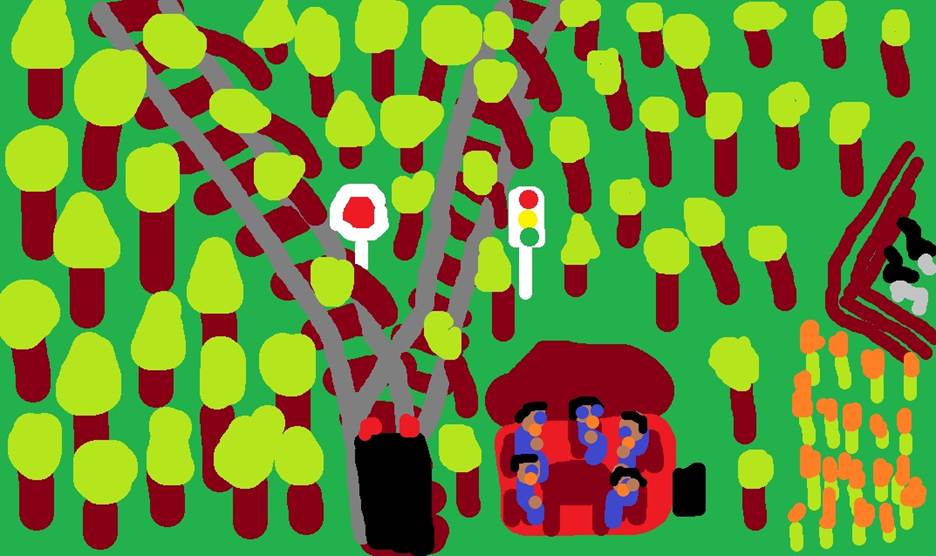
The point setters, by Emmanuel and Laurence
“No, overcoming the differences between town and countryside won’t stop the march of the trees, on the contrary,” comrade Zafira who was moderating, started out next evening’s session which had to take place in the youth club, with live attendance switching every two hours as in winter, as it was raining outside. “Neither will this rain. It will be good for the trees, and for our harvest. Comrade Emmanuel, you were going to tell us something about marrying the trains to the march of the trees, or to the return to the forest, whatever you want to call it. Comrade Fabien, you were going to argue that a small amount of small transporters, all-electrical of course, will help and not hinder growth of the forest and facilitate our life in it. Jean-Saïd will explain how the yellow transport beam may soon take over most of passenger transport and make an enormous contribution to a successful march of the trees, regrowth of the forest and our return to the woods. Go ahead, comrades!”
Comrade Emmanuel
I would like to plead for upholding the SNCF, which we nowadays abbreviate SFCF or sometimes OFCF for Société or Organisation française des chemins de fers, and also the subways, trams, and large and small electrobusses in the agglos, not only for convenience’s sake while the agglos are being deconstructed and the forests expanded or regrown via the march of the trees, but as an element of our revolutionary democratic organisation as well.
These days the SFCF and also the local public transport enterprises are organised by station or more precisely by point station. Sometimes an important point station is not even close to a passenger and freight station. At other times, on the contrary, its range overlaps with several stations, for instance, within the former city or agglo of Paris. Such a station or point station is actually the optimal size for a workshop with one, two, or three brigades of seven members, for example. While point men, information agents, and building and repair workers are associated with a station or point station, locomotive drivers, train engineers, and conductors are attached to a specific train. Yet like sailors with their port, they will always identify themselves with the station or point they hail from, for instance, Aimeran-Guémeron, Versailles-Chantiers, Paris-Montparnasse, and so on. Apart from brigades and workshops, there are regional SFCF organisational assemblies. While the comrade at the Aimeran village assembly the other day was right that these regional assemblies are still large, over 500 workers at times, instead of 200 or 50, there are two factors that tend to reconcile the workers with these large assemblies. First of all, the point stations and local stations tend to be smaller and ensure self-management much better than large stations. In the eyes of most workers, they satisfy the self-management criterion already. On the other hand, surveys among SFCF workers bring out that the larger regional assemblies allow their participants to get a better grasp of how our train network works as a whole. They are sort of auxiliary debating clubs, not to be taken too seriously. There are Communist, beg your pardon, red trade union cells at most point stations and passenger and freight stations as well. Yet, so far, according to the state of my research, none of them have objected to the regional meetings.”
Comrade Annie drew a grimace. She was an enthusiastic trade unionist from her time at Amazon, precisely because trade union activity had been forbidden in the pre-revolutionary American logistics giant. “This sounds fishy all the same, comrade Emmanuel! Don’t tell me there is a committee of regional chairpersons or a hexagon-wide meeting of representatives! Then we’d have to conduct a major hierarchy check!”
“Well,” comrade Emmanuel blushed. “I may have to look into it.”
“At ÉdF, we also have coordination meetings of the village grid, the inter-village local grid, the regional – meaning Yvelines, the Région parisienne or Paris region grid, the Île de France grid, and the hexagon grid workers,” admitted Alain, block energy works engineer. “I don’t go there, but comrade Pierre sometimes does.”
“Mon Dieu!” said comrade Annie, for the first in a long time using her old favourite exclamation, be it slightly unorthodox among fervent Communists like all Illyrians were. “Comrades, aren’t you ashamed of yourselves?”
“I only go there if drawn by lot. It only happened five times in twenty years so far. Don’t worry!” comrade Pierre hastened to calm her.
“Any other utilities that need a hierarchy check? Water?” asked comrade Jean.
“Water is decentralised,” replied his lover, comrade Rashida, mother of Jean’s sixth son, baby Tahir, born in Year 19. Rashida had just started a major research project on water in the revolution, centred on its role as a store of value. “Not only decentralised, but autonomous. Every farm has its own well or wells, every village or every second has its own sewage treatment plant, ours is in Guémeron. And as Saint-Denis and Paris are starting to really deconstruct and disperse, it will be the same there.”
“The question is, why do people still form these centralising committees?” comrade Annie was still shocked by the news. “We have the intranet after all. A bio-message to the next SFCF point or station, and on through the nature chorus. With birds, bees, trees, fish and moles and thousands and millions of alternate routes to choose from, a message will go faster than a bullet train.”
“The SFCF colleagues I talked to seemed proud of their meetings,” mumbled comrade Emmanuel.
“But not the cynical comrade the other day, whom we had to convince even to go along with the dispersion of Aimeran,” sighed comrade Che. “Let us know, comrade Emmanuel what you find out, d’accord? These hierarchical meetings at OFCF may be a major undetected sabotage line by the fascos.”
“And we already have the underground logistics stations to worry about,” said comrade Rim, who had taken over the moderation from comrade Zafira. Moderators at the meeting of the Illyrians, in case you wondered in the light of what just transpired, change every hour and we typically choose them by lot. The reason not to go house by house and apartment by apartment is that then there might be clusters of moderators belonging to the same apartment and household and holding similar views. No one may serve more than once every evening, or even more than once a week. “Yet before we pass the word to comrade Fabien who will tell us more about road logistics and its effect on the march of the trees and return to the forest, let us have a show of hands: Who thinks that in light of what we just heard, the violations of self-management at SFCF, but also and mainly because of the truly green thrust of our revolution, in other words because we want to go back to the woods, we should reduce traffic by rail?”
Only very few comrades raised their hands. Apart from comrade Danièle, it was comrades Olivier, Julie, Zelim-Philippe, Natalie, and after a moment’s hesitation, Jean-Saïd.
Comrade Fabien
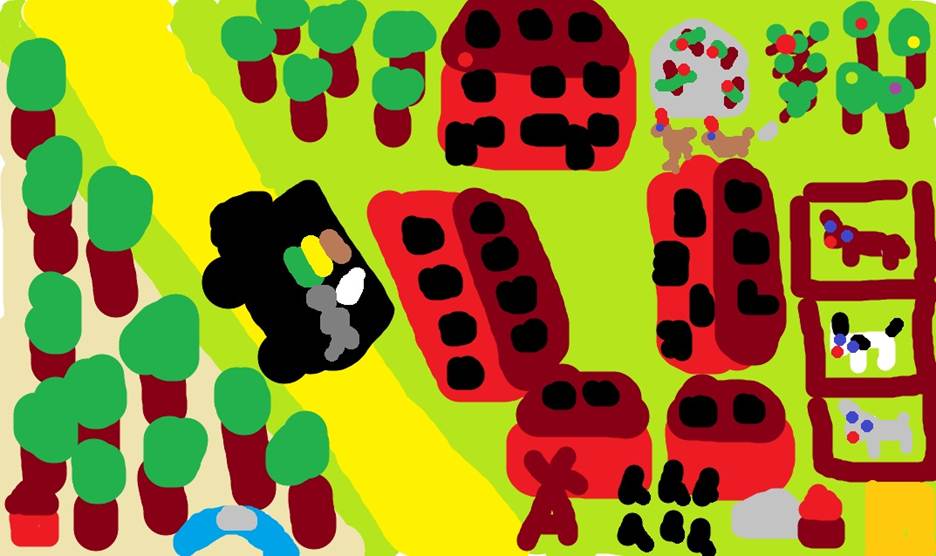
The ecological work of Logistique Yvelines, by Cédric and Charolaine
Comrade Danièle, interpreting the result as a lack of enthusiasm for true ecology and her project of back to the woods in particular, began to cry again. “Look,” said comrade Fabien. “It is another 200 year project that we should harmonise with the first and second stages of deconstruction, and the third stage dispersion plan for the buildings. Let me explain why I think the ecological thrust can only benefit from upholding the present amount of rail and vehicle traffic, all electrical of course, at least for a while still.
“We have totally parted with the replacement of the rail by giant highways. In fact, we’ve already said that we have replaced the highways to 99 percent by field or dirt roads. On the other hand, we have resolutely expanded rail traffic, not necessarily the main axes, North-South, East-West, North East-South West, and South East-North West, but the many small lines to link up as many villages with a train as possible. Sometimes, this was impossible. Anyway, we have to transport goods from the workshops to the next train station if they are destined for a long-distance delivery. In these cases we use a local logistics enterprise. Be careful, our revolutionary logistics organisations are called enterprises, although they are by no means capitalist. Enterprise is just an old-fashioned French word for workshop that we use quite often in logistics. They will pick up a good from a local workshop, bring it to another workshop, to a share point, or to the market, or as I said, if it is a long-distance transport, to the closest train station. Or, the other way around, if it arrives at the station, our vehicle will pick it up, bring it to a local market, share point, another workshop or cooperative if it is a piece of equipment or an input, or to any household, farm, or cooperative if it is a household item. No more big container lorries, as I said, anyway, they would not be able to pass through the narrow field roads. We just keep small transporters no larger than a pre-revolutionary Peugeot model, and all electrical of course. Only requirement, its home village assembly must approve and register it. And that, you can imagine, entails a more serious material and environmental compatibility check than we have ever had under capitalism. Moreover, our village assembly of Guémeron, Aimeran, and surrounding areas have all committed themselves to reducing and under no circumstance increasing the number of functional vehicles – private vehicles, let alone fuel-guzzlers we have forbidden altogether. This is a very serious indication that we want to go resolutely in the direction of true green. It entails that there will be no return to an expansive road network ever. Nor will we keep up the train network, unless a consensus of surrounding village assemblies in an area deems it beneficial to all humans, animals, and plants in the area.
Logistique Yvelines’ drivers and vehicle maintenance workers go to work with knowledge and enthusiasm. In return, they receive all food, clothes, household goods, toys, school materials and books, small and large furniture, small and large electrical appliances – the latter sometimes upon application to the neighbourhood assembly –, robots, haproids, plushbots, and other required devices for free via the economic circuit. Logistique Yvelines, that is our name, gets all its vehicles, repair tools, charging stations and so on for free as well from our partner workshops. The workplace assembly decides the question of suppliers who will then link in turn with their supplier enterprises, who will then link with theirs, and so on. In short, there isn’t any need for money anymore throughout the whole wide local, regional, continental, and global economy. And that means that greed will no longer enter the picture and force us to produce more and more, just so we can consume more and more.
And this also means that the forests will be able to grow back, and the trees will be able to march. And in hundred to two hundred years, if all goes well, we shall have the whole of the French lands, those areas which are not required for agriculture, covered by thick forests again. Small roads and single track trains may even pass under the canopy of trees. Only around villages and stations need there be a bit of a clearing. And if we then decide to take down all the railroads and eliminate even the last functional vehicles, we will be able to take this decision as well.
Comrade Jean-Saïd
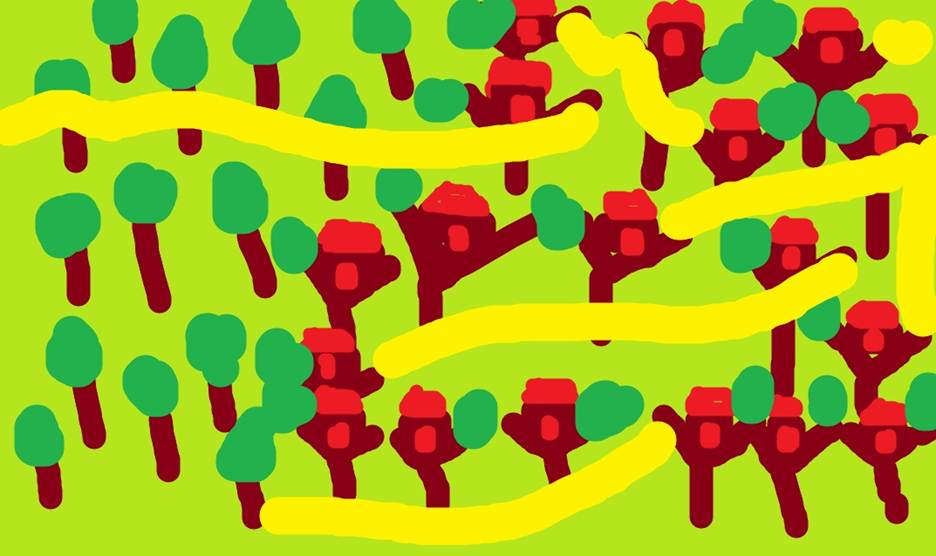
The danger of too many yellow beams, by Jean-Saïd and Natalie
“I still think rail and roads will cause too much pollution and bother the animals and plants. Can’t we all travel by transport beam?” asked Danièle.
Jean-Saïd grinned. “All of us humans and quite a few animals, yes, but we cannot possibly transport all our goods that way. At the moment, we already do not have our own transporter but use one by Logistique Yvelines. Think about the amount comrade Aini takes to the market on any day – fresh produce, home-made honey and preserves, eggs, sheep and goat’s milk to be delivered to the fromagerie, in other words the cheese monger, flour to the baker, home-made cider to the share point cafés. She also takes prototype robots from our robot workshop, model furniture from our furniture workshop, and clothes from our couturier workshop, lots of them made from our own sheep wool and in successful years even from cotton from our own fields to the appropriate market stalls and share points, and so on. Yet remember, to save energy, we would have to wish for all of these goods to disassemble into molecular state, then to reassemble them at least a kilometre away on the Aimeran market square.”
“The quality might even suffer,” interjected comrade Maher.
“That, and if everybody transported their goods by beam, there might be a build-up of electro-magnetic radiation after all. After all, we would then be using our willpower not only to disassemble ourselves, but quite a lot of other things as well. Or we might decide to go back to one of their fasco methods, like the golden beam which transports you and your goods intact but uses a lot of energy, or the yellow beam plus yellow extra-energy grenade which is already more polluting than our wind-and solar-powered rescue and emergency airplanes, or even worse, their hate beams. They even made comrade Olivier and me test them while we were their captives. They now enable the fascos to disassemble which they weren’t able to do on their golden beams, and not always on our yellow beams plus their yellow booster grenades. Yet these brown beams still demand a lot more energy than our yellow beams. Moreover, they are negatively loaded with hate and evil wishes.”
“But after all, we won’t use these golden beams, yellow beam plus grenade boosters, let alone hate beams,” objected comrade Natalie. “If we just travelled by will power which means on gamma rays of 100 Hz maximum, you told us, on our yellow beams and always in a disassembled state, there should not be any negative effect at all, should there?”
“Yes, no negative effect at all. If we keep it to that, it shall be alright, and we will still be able to take minimal baggage, let us say, a small backpack,” explained Jean-Saïd. “ We’ll be able to disassemble and reassemble that without any energy effect at all, don’t worry. Yet as long as we shall have the desire to send goods long-distance, we shall need electro-vehicles, trains, and boats. We did not even mention ships yet.”
Chapter 5. What about harpoids, appliances, and workshops?
Old-fashioned revolutionary robots and their skills, by Guillaume and Renée
“We are just launching a new campaign where every child in the French lands will receive a grow-up-with-you harpoid with many skills as well as a plushbot to do homework on,” Danièle started out the following evening’s session. She had summoned new courage. Young comrades Olivier, Julie, Zelim-Philippe, Natalie, Jean-Saïd, as well as Bashir, Sevim, Karla, Maher, and even Maher’s and Jean-Saïd’s papa, senior comrade Jean had promised to always take her side from now on, “so as to make it easier to find a consensus,” as comrade Jean-Saïd had put it, smilingly.
“What do you think, comrades,” Danièle asked the plenary. “Will these new devices delay or further our going back to the woods?”
“Delay, we will still need metal, minerals, rare earths, and other raw materials, we’ll need mines and workshops… If we are careless, the metalmongers will triumph,” eleven-year-old Zamir spoke first.
“Further, because interacting with the harpoids just like the return to the forest will help us overcome the nefarious practice of private property,” suggested comrade Salma and when everybody looked puzzled, she continued. “Let me explain how. First of all, everybody will get a pair of devices, one large haproid – later on, when perfect, harpoid –, and one handy plushtop, and be entitled to them for the rest of their lives. That will take the fear of loss and the jealousy from us. Second, harpoids are things, yet they have knowledge, learning skills, and moral dignity like up to now only humans, plants, and animals, in other words living things seemed to have, and did not even get to enjoy under capitalism. And you do not own things you can respect.”
“True,” everybody murmured. “Salma, you are right!”
“I’d also say further, because we can even let the harpoids help with our recycling, and won’t have to rely on far-away workshops and industrial robots anymore,” offered Josip. “The robot brigades have the project already underway, don’t worry!”
“That sounds fascinating!” said comrade Alain. “Tell us more!”
“We shall, but before, let me just briefly explain how the grow-up-with-you harpoid – or up to now it has been a haproid, as it is just a prototype –, and the plushbots function.
They both have built-in intranet-receptors or -modems, and just as with the old androids and humanoid robots, the microphone picks up sounds, the camera records visual impressions, and the hands, feet, and fingers or equivalent extremities of the various human-, animal- or plantbots register tactile sensations. And as the whole outside of the haproid, except for the retro-robots – which are thin recycled metal –, is made of bio-tissue, it will also react to the touch. Yet, in addition, our haproids are also nostroids that register and reinforce smells, and in case of them being flower-shape, to give out the pleasant odour of the kind they represent. They cannot render tastes yet, but we are working on it. It would be great to have a cooking tigerbot with a red apron in the kitchen, wouldn’t it?
“Anyway, to start with, the haproid has all the skills the old retro-robots and humanoids used to have. It can do household chores, such as swiping surfaces, vacuuming, cleaning the dishes and help with cooking and baking, for instance, beating the eggs. Of course, from there it is only a few steps to making the pie.
“Just as the old-fashioned robots, humanoids, and animalbots, haproids can help with homework, and also, given sufficient memory and the appropriate apps, university research in the whole spectrum of subjects from architecture via musicology and nuclear physics to zoology.
“They also are great entertainers, they can play hide-and-seek, board and card games from chess to patience, they can play music and dance. And the newer soft-skin versions will come to bed with you and cuddle you.”
“I gave comrade Danièle a buffalo bot a few years ago for Christmas. She takes him to bed every night, especially when I am not there to buffalo her,” said Olivier. “That can be considered an early harpoid or at least haproid already, can’t it?”
“It certainly can, and as a matter of fact, comrade Danièle has a return gift for you as a thank you for your excellent presentation on terrorism as the epitome of capitalism. Don’t worry, it is her idea, we’ve only executed it for her. Danièle, will you give it to him or should we?” asked Josip.
Yet Danièle was already next to him and guided the gift towards Olivier rather than give to him since it was almost her size. Only in the last moment did she remove the cardboard screen that was around it.
“Oh, wow, comrade Danièle, it is a tree, a marching tree at that, it uses its roots as feet just like the real ones, and judging from the leaves… oh, Danièle, it is an olive tree,” and as Olivier seized the haproid by the branches, the little fellow began to play a jolly tune, and allowed Olivier to whirl first him, then Danièle and him, and finally even Danièle’s buffalo bot around the floor.
Buffalo- and Olivetreebots dancing, by Malik and Mao
“Yes,” said Josip, “and it will grow a few centimetres every year from now on until you tell it to stop.”
“And along with all the skills, household work, homework or in your case, research, entertainment as you have seen, and soft sex that we have already mentioned, haproids, soon to be full harpoids can also perform a variety of practical tasks, such as gardening and agricultural work, including planting seeds and seedlings, watering, weeding, and trimming, applying organic fertilisers and pesticides if needed, plucking fruit, and driving a tractor, reading meters at the block energy works, operating the loom and the sewing machines at the clothes workshop, holding up parts, while the furniture makers put together the furniture, help the carpenters with cutting wood, and the upholsterers with stuffing seats and cushions. What else? They can paint, wall-paper, and decorate walls. Bref, they can do basically all the chores we Illyrians do in our socially necessary labour time. Yeah, and of course they will be able to do professional recycling. Yet before we demonstrate how our new series of robots do all of that and more, a few words on why the grow-up-with-you harpoids don’t have to be recycled so often. Comrade Rosa, you explain!”
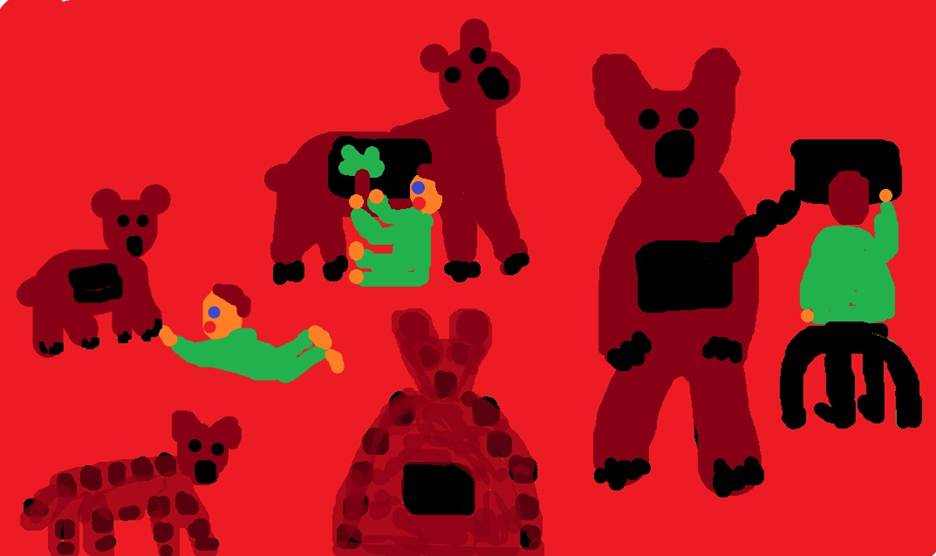
Mechanism of the grow-up-with you robot, by Josip and Rosa
“Merci, Josip. As you can see on the lower part of the picture, they not only have expanding bio-tissue on the outside, but an expandable metal skeleton such that, if let us say, Little Fabien gets a baby bearbot today, it will be a full-size bear cub when he is four, and a full-grown bear when he is age 17.
“In fact, we shall give it to him soon, for Easter maybe, we are just putting the final touches on its mechanisms.”
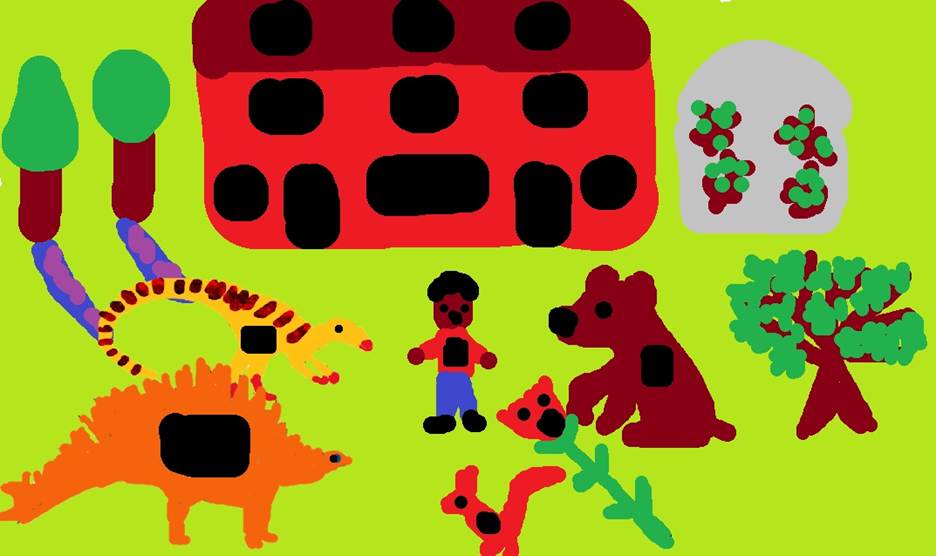
The full First Harpoid series, by Julie and Zelim-Philippe
“D’accord, that is the moment to introduce the full series then. Olivier, the Treebot, will you get in line, please? Because he is part of it, you see?” There were enthusiastic shouts of wow. The line-up consisted of a baby Loricatusbot and a baby Compsognathusbot, both native to the French and the Russian lands as well as to a number of other regions. Their live models had arrived only recently via the time travel tunnel, which is why their harpoid versions appeared to be coming out of a time tunnel on the Illyrian lawn as well. Then the baby bearbot earmarked for young comrade Fabien turned out for an early show. Next was a humanoid, designed to look like comrade Bouna, five years old, who had asked for a humanoid grow-up-with-you robot and fast, since he was the main computer and robot specialists among the 4th generation revolutionaries. And finally, there appeared Danièle’s and Olivier’s olivetreebot, a squirrel, and a rose.
“We wanted to make it a red robin and a carnation, but we had trouble with the functionality. After all, our haproids, looking forward to be full harpoids need functional arms. The squirrel arms and rose thorns are sturdier than the robin’s legs and carnation leaves. Here in this video you can see the whole brigade do recycling together with comrades Olivier and Danièle… Young comrade Bouna’s look-alike is a robot, of course.”
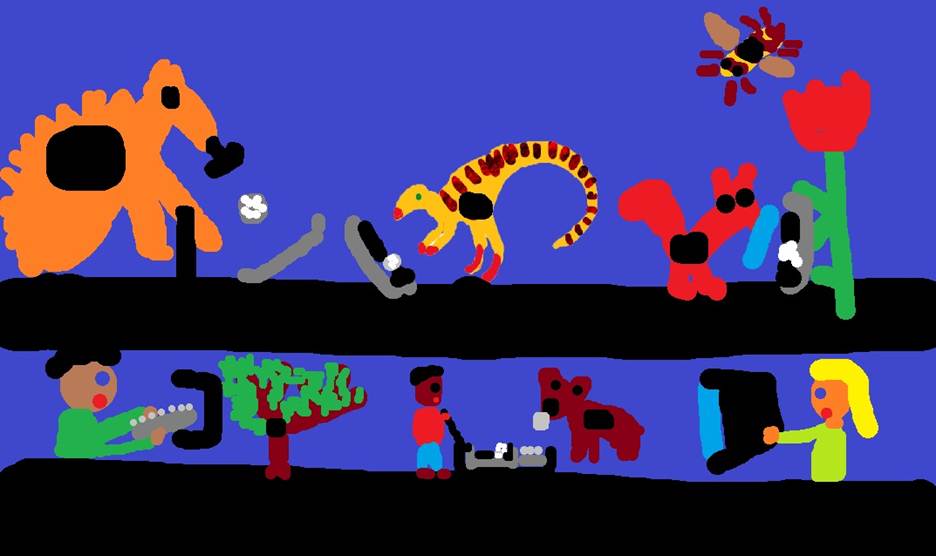
Harpoid recycling skills, by Bashir and Sevim
“In case Rose breaks down, let the Beebot fly in. It is also very capable.”
And for gruelling deskwork – the plushbots, by Jean-Saïd and Natalie
“In principle, you could do typing also with the more voluminous harpoids. They all have a screen with a pull-out keyboard that you can either use standing, with a cable, or even disconnected via bio-wifi transmission, so that you can sit down anywhere around it to type. And of course the harpoids can store lots of data as well. However, some of them are too big to travel, others like the rose too narrow for the screen and pull-out keyboard. Therefore, we designed a second series of so-called plushbots, or you might call them travelbots or schoolbots as well.
“The reason for calling these modern laptops plushtops will interest you the most in this ecological context. As you know, the intranet no longer travels via cable or between metallic wifi towers, but all humans, animals, plants, and dinos as well as intranet-capable robots, devices and materials can serve as natural wifi towers. The waves our data travel on these days are very low frequency like the neural or brain waves information travels on in human and animal bodies, and as well as in intranet-capable devices and materials. Their highest frequency is 100 Hz for the gamma waves, that is 50 million times lower than 5 G pre-revolutionary intranet.
“For that reason, they no longer get as warm as pre-revolutionary devices and you can couch them in plush and fluff, from natural fibres of course, rather than lots of metal or plastic.”
“How much electricity do they use?”
“A lot less than the pre-revolutionary devices as well. While they needed to be recharged every 24-48 hours, our harpoids and plushbots only need to be plugged in or put on the leash every 52-76 hours. The bigger ones have solar panels even, and the smaller ones have dynamos.
“So, what do you say, comrade Danièle? Do you mind taking harpoids along on your journey back to the woods?”
“Well, they look beautiful, the bio-tissue skins look very natural, and it is amazing how they can take their likenesses apart and even integrate the parts into new harpoids already. Still, they are not alive. They are not like human, animals or plants. They won’t talk back at us, bite, or moan. If we smash them, they’ll just fall apart gracefully. I am afraid we might reach for the easy solution and rely on them too much and ignore the real humans, animals, and plants.”
“And you forget, the fascos might infect them with hatebots,” interjected Le Petit Pierre from the garden colony, budding robotics expert.
“Let’s leave the fascos aside for a moment,” said Jana, self-management expert, as rotund and intense as ever. “They annoy me too much these days. Yet you said, young comrade Danièle, we might rely on the harpoids and plushbots too much, and neglect the living beings, the humans, animals, and plants. I understand this fear, and we must of course avoid falling for that trap. However, don’t we have the principle of mixed harp brigades, where there must be at least one real human, one animal, one plant, and one haproid, pardon harpoid in every brigade? And we might add a rule that if we sum up over a certain number of brigades, for instance, on a farm, at a workshop, or in a class at school, the numbers of the four groups, humans, animals, plants, and robots must sum up to be equal.”
“Excellent idea, comrade Jana!” comrade Patrick, Jana’s old friend and protector from the pre-revolutionary days clapped enthusiastically.
“But what about the real dinosaurs then?” moaned Jean-Wadi. “We went to the past and brought them to Lake Chad first. They were so nice and helped us enormously with storing water, serving as bio-wifi towers and fighting the fascos. Also on later occasions, they were always easy to talk to. They have a memory of pre-civilisation humans who could converse with the animals and they are willing to help us do so again. It would be a shame to leave them out.”
Chapter 6. Dinosaurs are o.k.
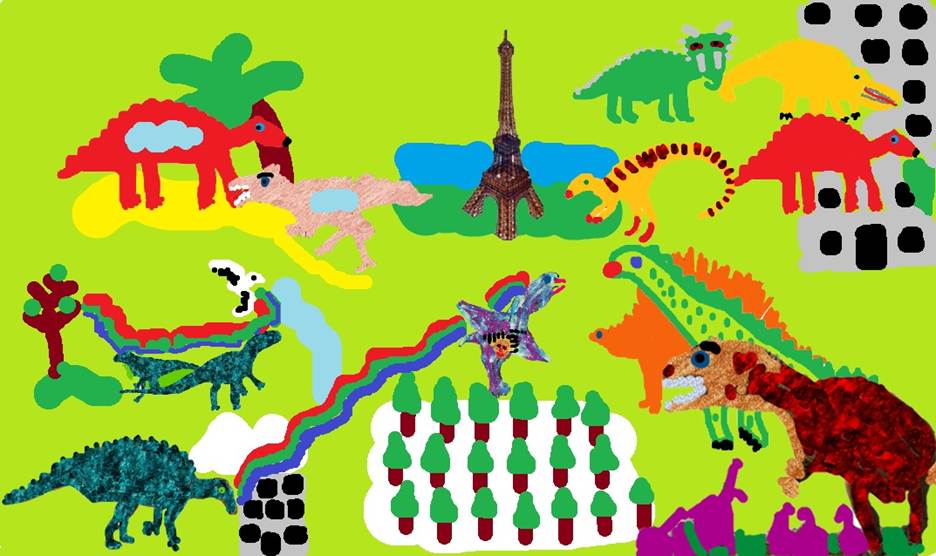
Beneficial effects of a return of the dinosaurs, by Jean-Wadi and Zafira
“You poked fun of me because I seemed to be afraid of our comrades dinos because of their size,” comrade Danièle shook her head. “But that wasn’t it. In order for time-travelled dinosaurs always to be welcome in the present, we need to adopt my proposal of letting Plant lives triumph, otherwise we won’t have food for everybody. And the march of the trees needs to complete and the deserts must regreen, because otherwise there won’t be enough space even for the already contemporary wild animals to roam. Can’t you tell the comrades, comrades Malik and Mao, how much space buffalos need to roam?”
“Huge spaces,” comrade Malik nodded. “The whole of the prairies and even some parts of the foothills of the Rockies. You are right, comrade Danièle! And nobody ever called you a coward.”
“Let us recapitulate the positive and negative sides of a return of the dinosaurs,” suggested Marie, who was moderating. “You know, let us do it slogan-style, as if we were going to have a global rally about the dinosaurs.”
“Dinos are friends of the Africans – they store water!” said Dileita.
“They are friends of the Europeans – they are bio-wifi towers!” added Jean-Wadi.
“They are friends of the Parisians – they help us deconstruct-reconstruct!” continued Cédric.
“They are friends of the Siberians – they help us catch fascos!” noted comrade Dolun, from Evfrat.
“Not only of the Siberians. They helped us Chechens and the Palestinian comrades stop them as well!” Olivier’s father, comrade Aslan supported him.
“They are models for the dinobots, which have many more uses!” comrade Josip chimed in as well. “Kileskus, Tyrannosaurus, Compsognathus, Megapno, all of them!”
“They can teach us nature-speak and nature language,” Julie brought up another idea.
“And they are friendly characters,” said Zamir. “It would be a shame no longer to have them around. I mean we only have four at Illyria at the moment, two Loricatos – that is a West European Stego –, and two Peukilopleurons, that is not too many.”
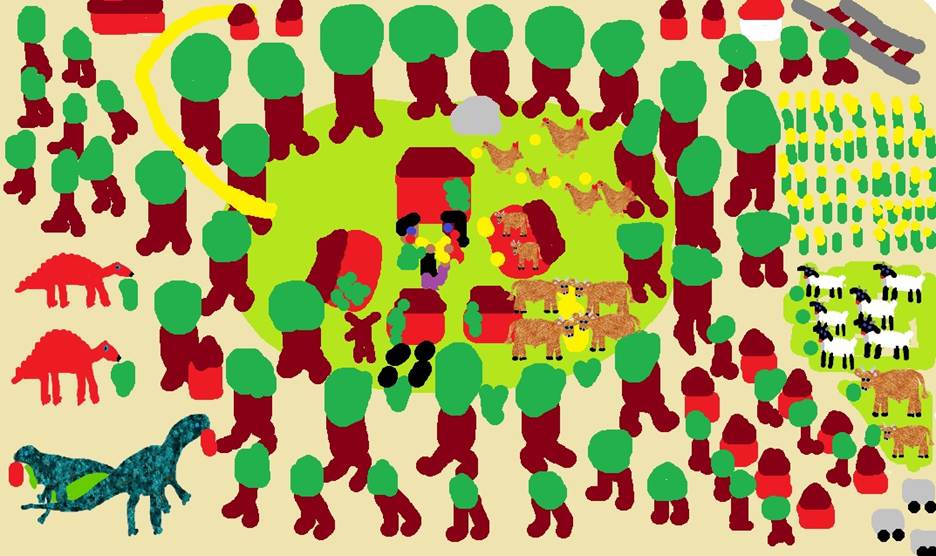
Food for everybody – food for all, by Bashir and Sarah
“D’accord, we came up with at least six very positive effects of the dinosaurs on our common environment. Now to the negatives, comrade Danièle?”
“They eat too much. They upset the already precarious balance between the harpists – meaning human, animal, robot, plant assembly participants. Mind you, humans are almost as bad as dinos, they eat meat and plants, while dinos tend to be either carnivorous or vegan. Yet they also tend to be a lot bigger than humans, that means they’ll need more of both.”
“It’s all a matter of planning,” advised Hisham. “If you know precisely what every harpist and harpoid needs, food, water, current – or rather soon harpoids will need only sunlight –, no problem. Consider comrades Bashir’s and Sarah’s picture.”
“In some settings, some of them may take up too much space,” admitted Cédric. “You couldn’t use an Europasaurus for a dinosaur dance to deconstruct a building in the middle of Paris, probably.”
“But in La Défence, why not?” countered Babacar.
“They may scare the other animals and some humans as well,” added Julie.
“Only if you bring them in out of context,” argued Zafira. “In other contexts, such as the desert, they might help us regreen the planet. They store water, they digest, they are excellent fertilisers.”
“They might revolt,” worried comrade Denis, senior security expert, father of Jérôme.
“Oh, papa!” his son laughed. “That is just so much capitalist horseshit. Remember the old sci fi horrors about vicious robots? If they were so worried about those, why did they try to knock out the moral imperative in our devices?” The moral imperative required the device, be it laptop, phone, robot, haproid, and in the future, harpoid or plushbot to announce for every material, thing, or action, whether it was apt to cause harm, whether any village assembly or referendum had forbidden its use for being easily weaponisable, for having failed a material check, whatever. Finally, if it was allowed, what the best practice was for its use.
“True!” mumbled Denis. “But there were also horror movies about vicious dinosaurs or even apes or even flesh-eating flowers and lianas.”
“That is because the capitalists-metalmongers made them,” insisted Zamir. “They projected their greed and other bad character traits onto the poor animals and plants. Animals and plants only eat when they are hungry or threatened.”
“Of course,” said Julie. “That is why I said some humans and animals might be afraid of the dinos, emphasis on might. Yet that may be because we humans stopped communicating with the animals and plants when we started our feudal and capitalist rampage. And after all dinos are animals, so are humans. If we continue meeting in the harp assemblies and discuss and plan things thoroughly, we’ll all become consummate harpists and won’t have to be afraid of each other any longer. And comrade Danièle with her ‘Plant lives triumph’ concept will make sure we get it right and there is enough food for everybody. Don’t you think, comrades?”
Chapter 7. Harp assemblies triumph
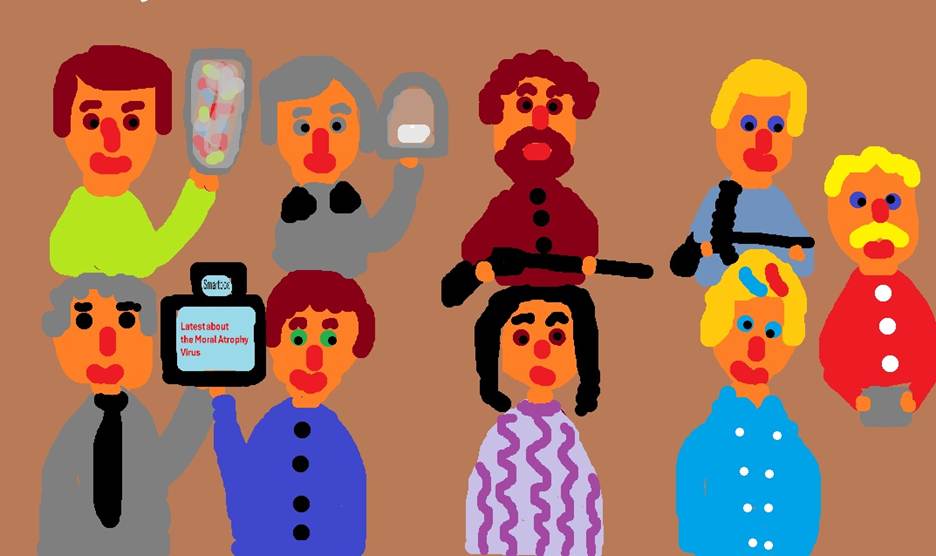
The latest line-up of the fascos, from top left to bottom right: Reinhart Fischer, Fritz Schneid, Ronald Gunpump, Stephen Kocho, Tino Kryptolla, Edouard Stérilé, Arnaud Arrolle, Anne Maréchal, and Marion Le Pen, by Olivier and Danièle
“So, you would not believe it, but the German fascos remaining at liberty, Fischer, Schneid, Kryptolla, Gunpump, and Kocho have managed to find new French associates and founded a new gang, the Pericles group. The needed a second banker, given that the American crypto-bankers – Robert Capito, Mort Buckley, O’Hanley, and Hooley – won’t play ball with them, and their Austrian buddy Tino Kryptolla is in house arrest. And now they have found one in Édouard Stérilé, crypto-banker and disciple of Vincent Molloré, the reactionary media tycoon. Remember, Molloré had merged European Empire with Le Figaro and was trying to make people think that its crypto slaves were presenting serious criticism of the revolution. Instead, his channel just spilled cheap invective.
“Édouard Stérilé does not even pretend to have a serious news outlet. He leaves European Empire to struggle on half-heartedly. A recent survey has revealed that many of its journalists and support workers are ready to switch to the revolutionary camp. Instead Stérilé has founded an entertainment channel called Smartbox which works intraline. So, now the underground capitalists and fascos seem to want to use that to corrupt us.
“There is another recent entrant to the fasco camp, a certain Arnaud Arrolle, ex-politician, so he must be at least 50, who says he wants to do local activism and is looking for supporters. He is rumoured to be behind the recent massive theft of vehicles in order to spread the Moral Atrophy virus.
“He in turn has two women associates, Anne Dalgo, who claims to be a true green, but argues that a return to the past like that will be only possible if all strangers as she calls them are thrown out of the French lands, and immigration from foreign regions, especially Africa, Asia, and South America is stopped entirely. And his other lady, Marion Maréchal is clearly related to the Le Pen clan and according to her self-presentation on Smartbox wants to roll back the time to 2021 and start the clock again with new elections. ‘Throw out King Emmanuel, his Macronie and the EU bureaucracy and see what happens then.’ How exactly she wants to roll back time is hard to understand. After all, people and their children and even grandchildren have had the taste of freedom. There are constant hierarchy and material checks. There is self-management at the work-place. There is permanent discussion of school, university, and workplace matters in brigades of seven members maximum with the fore(wo)man or brigadier rotating daily. Neighbourhood assemblies of seven households maximum with the chair(wo)man rotating every week discuss issues concerning the neighbourhood. Workplace plenary assemblies of, wherever possible, 50 participants maximum do strategic planning and accounts at the workplace. Finally, village assemblies of, wherever possible, 150 participants maximum, with the moderator brigade changing every hour at least, discuss matters and take decisions via consensus only. On matters of extended local, regional, continental, and global significance, anyone may call a referendum. It will need a minimal quorum to take place. Then there will be a campaign for at least two weeks. And the final vote will have to show a clear majority, if not full consensus on the decision to be taken. Whenever even a single individual at any assembly raises a new topic or presents new arguments concerning one already decided, the discussion and search for consensus will have to start again. People are accustomed to equal respect of needs. Nowdays also animals and plants may expect to have their needs taken seriously. We have long seen the end of money. These days all goods are produced, allocated, and distributed freely via the economic circuit. There are excellent education and working conditions for everybody. Schools and universities, like workplaces, are hierarchy-free. Teachers, teaching assistants, lecturers and professors rotate between brigades or are integrated in mixed brigades with pupils and students. There is a balance of socially necessary labour time and creative work. We design our equipment not only to facilitate work, but to make it enjoyable and varied as well. Robots take over all boring chores. And we have been striving for true ecology. After the revolution, the revolutionary assemblies immediately decided the end of cars, the end of big agglos, and are now working on the perspective of humanity returning to live in small villages, in tree houses in the forest or at least close to nature. Yet Stérilé’s, Dalgo’s and Maréchal’s delusion, like dark hope may well spring eternal.”
Harp assembly at Tigr
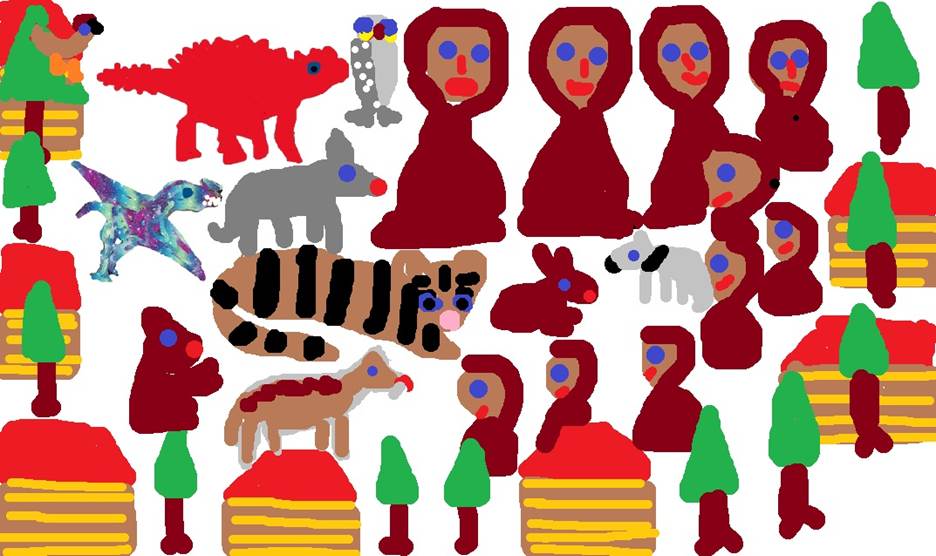
The Harp assembly at Tigr, by Maurice and Lulu
“So, we have arrived in Tigr,” reported Danièle. “We, that means Jean-Saïd, Natalie, Alexandra, Jean-François, Olivier, and I. It is -16 degrees as compared to +20 in Illyria when we left it ten days ago. There is a hap assembly in progress, sorry, hardly any robots present except very few old intranet android phones and our plushbots. However, there is a real Stego, a real Kileskus, an owl, a wolf, a Siberian leopard, a bear, a Siberian deer, a Siberian hare, and a Siberian husky. And our human comrades Khatan, Chokon, Dolun, as well as young comrade Kustuk, his mother, comrade Ekolune, and his friend Sargi. The two young comrades are studying bio-chemistry and ecology and have done soil, air, and water quality measurements as well as examinations of tree health in preparation for the upcoming tree marches to regreen the Taiga. Comrades Botur, Nurgun, and their sons Delegey, and Botur Jr. again did not shun the whole long journey down South from the Arctic circle to see us.
“And we are all horrified. We now know what the new gang of fascos, they call themselves the Pericles group sprayed and poured into the streams in the vicinity of Krasnoe Pole, Evfrat, and Tigr. Remember comrade Natalie’s report during comrade Olivier’s presentation? It is White Phosphorous!
“Phosphorous was used under capitalism as fertiliser, and as such was more or less harmless for the plants. However, true ecologists warned back then already that if used in excess, it can affect shoots as well as older leaves with a toxic effect and harm fertility. In other words, even if our trees get to do a march, it might well be their last.”
“We’ve seen it in Leitir Ceanainn. Even the very first spring leaves already came out old, brown and wrinkled,” comrade Peter Gar interrupted excitedly. “Maybe the white phosphor was already in the fasco Moral Atrophy virus? By the way, I can see the avatars of a few African comrades. Do you have the MA virus in Africa as well?”
***
“Comrade Danièle, so good to see you. You were with the Sumut harpoid flotilla,” comrade Dileita exclaimed intraline from the Desmond Tutu cooperative in Djibouti. “I remember you quoted Greta Thunberg, the famous Fridays for the future activist: ‘I shouldn’t be here, I should be at school.’ And now you are in the Taiga!”
Well spotted, thought Danièle. The African comrade had a point. She was not that good an environmentalist after all. She had even taken the train and not the low-frequency and environmentally less noxious yellow transport beam. Comrade Natalie had warned that in case Danièle was pregnant – as a matter of fact, she Natalie, was already in her third month with a new ecologist, comrade Lino –, it would be a good idea not to risk disassembling the foetus. It had not been a waste of time though. They had put together an instructional video of tree marches in various world regions, starting with the one at Novgornyi and at the Lenin kolkhoz near Moscow.
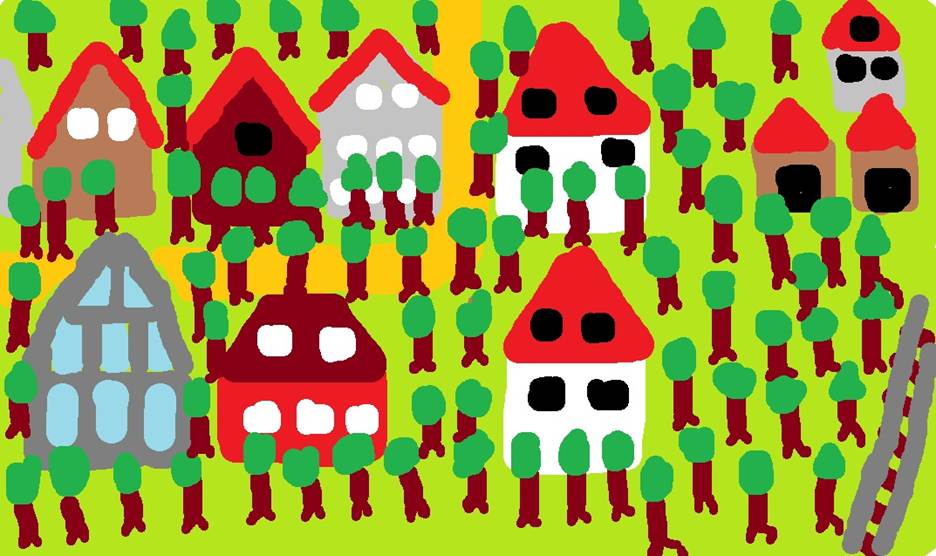
March of the Trees at Novgornyi, by Jean-François and Aleksandra
At Novgornyi, the march had been very slow so far, at most one kilometre a year. That was not much faster than the speed at which new forest would grow even without any trees extricating their roots and marching. Yet because there were quite a few trees in the area already, comrade Tanya explained, the speed might be sufficient. “However, you are right, comrade Danièle,” she concluded her report. “There are still a lot of problems with dispersing the regional agglos, deconstructing ugly highrises and other concrete monsters, reducing the size of apartment buildings to 1+4 and then 1+1+1 as well as spreading them out and separating villages and houses by parks, vegetable gardens, parks and fields.”
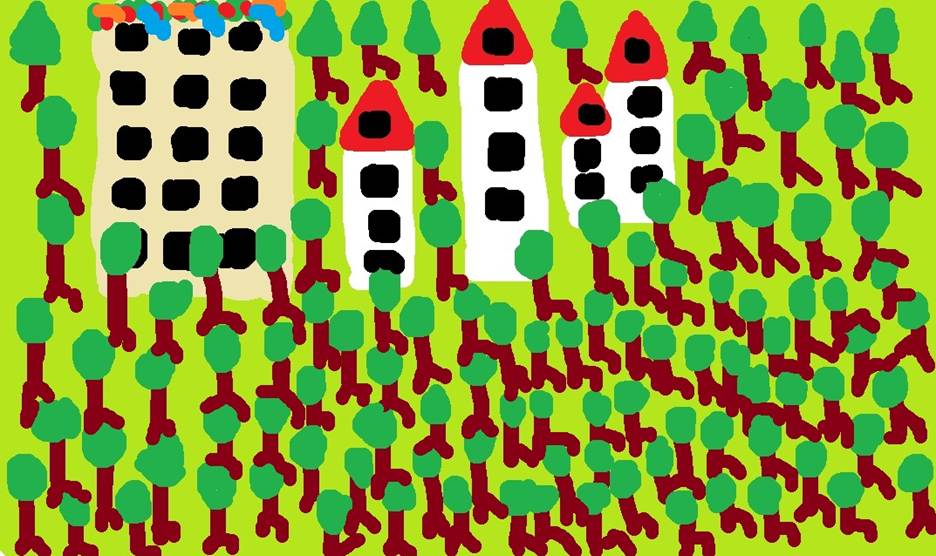
March of the Trees at the Lenin kolkhoz, by Jean-François and Aleksandra
Around the Lenin kolkhoz, the pace had been faster, about six km a year, 500 m a month, comrade Dima noted. That was because their local comrades, the Moscow Recycling Hounds had made a commitment to their village assembly to make the local trees help reclaim the area around Moscow agglo for natural beauty in one hundred years at the longest.
And they had heard comrades Jérôme’s, Sergei’s and Misha’s presentation about the Pericles group. However, now the return of these fascos with a new terrifying sabotage attempt had put the whole project into question.
***
“Phosphorous should not even be reintroduced into the economic circuit as a fertiliser,” demanded agronomist Francine. “Neither should nitrogen or kalium. The revolution produces a sufficient amount of natural, biological, and organic fertilisers. Natural means they are produced in a natural way, with simple tools and using human hands. Biological means, we make them from 100% or all but 100% natural ingredients without any artificial additives. And organic means we make them from plant and animal materials. They do not harm the plants and make the food taste better as well.”
“Yes, and while comrade Danièle is right that Phosphorous may not be the worst thing that may happen to a plant, it is definitely toxic to animals and humans,” added comrade Maher. “50-100 mg, let’s say 1 mg per kilo of body weight, is the lethal dose. Yet even before that, even at low doses, it can sometimes cause your gums to swell, your teeth to fall out and lead to phossy jaw, or necrosis of the jaw which causes intense pain, decay of the jaw bone, and deformation of the mouth.”
“And your bones may start to glow green and white in the dark as they die!” added comrade Fabienne. “White Phosphorous can also lead to brain seizures, liver, and kidney damage.”
“And the fascos can weaponise phosphor very easily,” added her partner, comrade Michel, bio-terrorism expert. “Even small quantities of white phosphorous immediately react with oxygen on contact with air, and ignite easily. This makes it a perfect weapon for our enemies who are desperate at the moment without many production facilities or even hiding places at their disposal.”
***
“I am afraid they have got Stephen!” Ronald Gunpump shouted as he and Reinhart Fischer entered the makeshift hut the six fascos had built by the river where some of them had already camped last time . “I hope you realise what bad news this is. He is one of our best security experts. Without him we’d be sunk in the wilderness. He is the better shot than all of us put together! We were hunting in the forest, Reinhart, Stephen, and me. We had spread out and were following some deer. Would have been nice if we had been able to grill it for supper. Then all of a sudden, I heard something like a scuffle. Stephen did not shout, obviously he did not want to betray us, so we did not know exactly where to follow him. His bio-messages are vague. ‘Going North-East!’ Any idea where the revs might be taking him?”
“Yeah, of course,” said Fritz Schneid, yawning, trying to dry his clothes and warm himself by the small fire they had lighted in the centre of the hut, with a make-shift chimney above it for the smoke to escape. “That would be the village of Tigr, so called because the villagers keep a Siberian tiger as a pet. Reinhart and I know the way there, but can it wait until tomorrow? I, for one, am totally exhausted.” The others looked at him aghast. Only Reinhart had the slightest sign of a smirk on his face. Then he sighed. “O.k., let me explain it to you. It is -20 degrees outside during the daytime, and it will probably cool down to -25 degrees or less during tonight still. Second, it would take days or even a week or two to get there on foot without a proper guide. The last time the Siberian tiger who lives there pointed us in the right direction.”
“Well, can’t we go by beam?” asked Édouard Stérilé. “Now that we have developed the brown transport beams, we won’t need the high-energy golden beams and not even the yellow grenade boosters for their yellow beam.”
“Yes, we shall try the brown transport beam, of course,” Fritz Schneid nodded. “Anything else would be madness. Yet that is only the first problem. Once we get there we’ll have to reassemble. Remember you have to disassemble and reassemble when you travel on a brown beam, it is like their revolutionary yellow beam in that way. What if they spot us while we do it?
“Second problem, remember that at this stage of the revolution, there are no more permanent militia stations, as all militia brigades are spontaneous. Even the militia records the villagers keep decentralised on their intranet phones, or nowadays in their brain apps or plushtops. There are seven izbas in the village of Tigr. Stephen might be held in any one of them. It won’t have a militia star on the door.”
“Think about the good side of it,” said Arnaud Arrolle. “It won’t have bars on the window either.”
“Let’s bio-message Stephen and ask him which hut he might be in,” proposed Ronald Gunpump, and received an answer soon enough.
“I have managed to lift myself up and take a peek out of the window. I am wearing handcuffs and foot chains, but I am not tied to my bed or anything. They have built the village around a square it seems. I can see a house close to my left and houses on the opposite side, but nothing to my right, or rather, there is something as well, but it seems further away.” “The houses are aligned North South, and West East as far as I recall,” said Reinhart.
“Alright, so, I think I must be on the South West, South East, or North East corner. If it were North West, I’d see more to my right,” ventured Stephen, but Fritz Schneid shook his head.
“Can’t you see, messieurs, it is hopeless, he does not know whether he is on the East-West or the North-South axes, and moreover, since he is wearing foot chains, we’d have to free him of these first, before we can hop on a return beam. They are bound to spot us.”
“Well, I think, you Boches are just lazy bones or cowards,” said Édouard. “Arnaud and I are going.”
“So am I,” said Ronald Gunpump.
“Well, we’ll come with you, but it won’t be easy,” said Reinhart. “Let’s douse the fire though, before we go, so the place can’t burn down. Too bad, we don’t have a lock for the tent, or do we? Just a small baggage lock will do, I suppose, as long as it is solid. The Siberians don’t steal, but we want to keep our phosphor and MA virus syringes out of the reach of wild animals, don’t we?”
Édouard produced a lock obligingly and once they had fastened and locked the door flap, even left the key with Reinhart, “Since you are the chemist, after all!”
Then they rapidly summoned their brown beams, disassembled and got on them which made all of them very angry and red in the face. This is because brown technologies like the fascos use, produce lots of hatred.
They landed in the deep forest about 100 metres from Tigr. “We told you it wouldn’t be easy,” Reinhart bio-messaged Ronald, as they fought their way through the snow to the sledge path into the village and then crept as close to the huts as possible as they could get.
“We’ll have to sneak onto the square, then we can show ourselves briefly, and you tell us if you can see us, o.k.?” Ronald bio-messaged Stephen. As soon as they lifted themselves up, they already received a response. “You are coming at me from the diagonally opposite corner.”
“D’accord,” bio-whispered Arnaud with the very hard to detect delta wave. “Are there any people in the room with you?”
“No, but there seem to be people sleeping in the next room, probably children, I can only hear a very light snoring.”
“O.k., buddy,” asked Gunpump. “We are here, all five of us. What do you suggest us to do? Break open the window?”
“Under no circumstances,” objected Stephen. “You’d wake them up instantly. “Just come in, stun them with red beam, you know, the revolutionary beam, just for half an hour, that way they can’t blame us for harming children. I’ll be standing up, waiting for you. Just two of you need to come in. One can open my foot chains and the other my handcuffs. If you can’t open them, use their bronze beams. I don’t like our brown beams myself.”
“And then we’ll all have to run out the way we came,” said Reinhart. “Already summoning the brown transport beam in our minds. Sorry, comrade Stephen, no golden or yellow beams with grenade boosters available! We’ll have to disassemble, but please, let us try to get away as fast as we can.”
“D’accord. Who’ll go? Let’s roll a dice!” proposed Arnaud. And he dexterously threw one up on top of his left hand. “One and six. Let me know who thought of these numbers!” Ronald said he had thought of 1, and Reinhart 6. They quickly ran across the square keeping as low as possible. Then Ronald and Reinhart went in. The other three crouched on both sides of the door to help them if they ran into trouble, or hopefully, run with them as quickly as they had come in once they came out with Stephen. They could hear light snores at first, then the snoring stopped, apparently Ronald and Reinhart had been successful in stunning the sleepers. Then there were two squeaks as of unoiled doors opening, then again nothing.
‘Why two?’ wondered Fritz via bio-message. ‘Maybe there are three rooms, and they wanted to make sure they are undisturbed by stunning those in that room as well?’
‘Exactly,’ came the answer from Reinhart. ‘We are now in the room on the left, untying Stephen. Get ready, we’ll soon make a quick exit. Follow us on our heels as closely as you can. Don’t dilly-dally, promise?’
Édouard was about to roger that, when a young voice, as of a teenager still gaining his voice, sounded directly behind him. “Aren’t you Monsieur Stérilé, Chief executive officer of Smartbox? I am Jean-François, son and nephew of the infamous neo-Vichyite gangster, Jacques Henriot, or maybe the none less famous François Aliot, and in any case son of Béatrice Meunier, also a very bad motherfucker of a Vichyite gangster. I have wanted to chat with you about your new entertainment channel and whether it would show a documentary about my famous gangster relatives. What brings you to Siberia?”
“I might ask you the same!” scoffed Édouard, more pleasantly surprised than anything else to hear native French in this remote corner of the woods. At that moment, first Stephen, then Ronald, and then Reinhart burst out of the house. Stephen had trouble keeping upright. Ronald lifted him up and tried to make headway as fast as he could carrying him on his arms. Luckily, the space around the houses was a lot less snowed in than the woods around, yet still he broke in deeply as he was carrying a double load now.
Chapter 8. March of the Trees
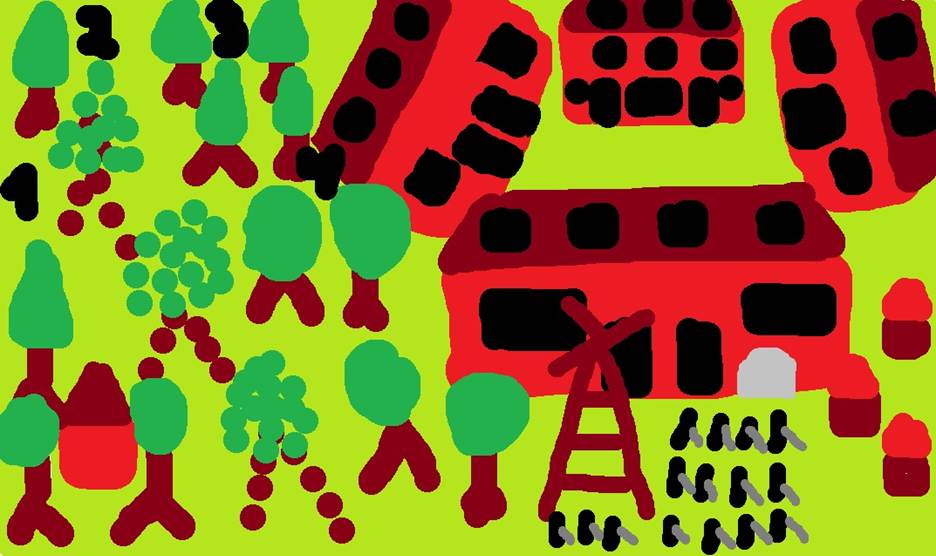
Illyrian Trees Marching, by Che and Georgette
“At Illyria we have tried a relatively fast march of the trees, around one kilometre a month instead of one or six a year. That means about thirty metres a day, which has allowed some of the trees around Abram’s cabin to move up to the robot and the furniture workshop in 1-3 days at most. This is why comrade Georgette and I have drawn the marching trees in a pointillistic fashion, to indicate the relatively fast speed of the movement. It does not mean that the trees had to disintegrate to do the march.
At that speed, if the trees advanced in a broad front of about 10 km in breadth, reclaiming 10 square kilometres of wood would take about a year, 100 square kilometres 10 years, and 1000 square kilometres about one hundred years. That would still be much too long for most of us to witness a significant expansion of the mixed forest, let alone be able to significantly improve our life-style and return to live in the forest.
Meanwhile in Tigr…
“Beam it!” shouted Reinhart, and then in a strange move seized Édouard by the shoulders and whirled him around, so that he was on the get-away path behind Ronald and Stephen rather than Reinhart. Édouard could see the beam materialising in front of him and Ronald and Stephen scramble on it. Both of them already seemed to crumble before his eyes. Another brown beam appeared next to him, and he could feel Arnaud behind him and hear Fritz shout from further back, “Get on it, you idiots, let’s get the hell out of there.”
Yet what about Reinhart? However, as he found himself on the beam, crumbling, and no longer quite able to see what was happening around him, all the more so as it had started to snow again, Édouard Stérilé felt himself gripped by an intense hatred of Reinhart Fischer. His fault if he got himself arrested by the revs. Why had he pushed himself out of the way and dragged Édouard in? Politeness, mon oeuil! Those Boches, or let’s call them by their real name, these Neonazis weren’t polite. Maybe he wanted to defect? Although that seemed unlikely since he had developed many of the weapons the counter-revolutionaries were using these days, first and foremost, the MA or Moral Atrophy virus which came in a live virus and in a computer version. In the former, it caused flu and nausea in humans and animals, and wilting in plants. In the computer version, it knocked out the moral imperative consisting of the do no harm, constant hierarchy and material check, and best practice principles. The idea to use white phosphorous to add necrosis in animals and plants, and infertility in plants had also come from him, or maybe Fritz Schneid and he had developed it together.
Now he would have to concentrate. This was the moment, where his whole body had disassembled, and now would come the scary point where he would feel almost nothing, then nothing at all. Not to worry, the other day he had already travelled all the way from the French lands to Rekavoi, as they called their hut, or some may call it yurt on the river, and he was getting used to it. Now he felt himself reassembling already, a slight bump and he landed in front of the tent, and the entrance with the lock on it that Reinhart had the key of.
The other four were looking expectantly at him and then further, since Reinhart had not appeared yet. “Well, I suppose we’ll have to wait for M. Fischer, because I don’t have the key.”
“Isn’t that it?” Stephen Kocho, although he was still wobbly from his captivity, spotted it first. “His eyes must be good,” Édouard thought, no wonder he was such a good shot. And lo and behold, the key was in the lock, as if by magic. Or could Reinhart had forgotten it there? Yet Édouard seemed to remember him pocketing it. Anyway, what did it matter? He turned it and opened the flap for himself and the others to enter.
“Let’s get the fire going as quickly as possible,” he heard Ronald say behind him. Then Ronald’s voice died down from shock, while Édouard and Arnaud almost fainted. The tent, which had been so neat and tidy when they left, with the cases with MA syringes and white phosphor in back and their pots, pans, cooking utensils and sleeping bags around the fire was a picture of devastation. The boxes with the poison in them were gone, as in vanished. The rest of the place had been searched, methodically, not upset by a deer. Yet not the slightest attempt had been made to put things back into place. The revs had gotten what they wanted and left.
“Looks like spontaneous militia were here before us!” Stephen noted drily. “You should not have gotten through all the trouble to get me.”
“I told you so!” Fritz Schneid almost cried, whereupon Ronald Gunpump almost jumped at his throat. “You are making it appear as if a few cases of vaccine…” Did he really believe the white lie that MA was a live virus? “…And white phosphor were more important than my friend. You quit disparaging him now, or else!”
Arnaud had woken up from his lapse of consciousness and croaked, “Looks like M. Fischer has defected on us! After all the trouble we went through spreading his concoction in the French lands! Borrowing vehicles, bribing lads to drive them.”
That had been his own thought before, thought Édouard. “This can’t be. The weapons and the ideas how to deploy them are mostly his.”
“Well, I had a hand in it as well,” Fritz Schneid modestly recalled himself. “So did Arnim Pappberger before the revs forced him into retirement, and Vera Langsaal before she defected.”
“Vera Langsaal, that might be the connection,” mused Arnaud Arrolle. “Cherchez la femme. Look for the woman.”
“I don’t believe it,” Stérilé was still shaking his head when Ronald and Stephen had already prepared coffee or black tea for everybody and they were sharing a few heated cans of soup. “Let’s bio-message Anne and Marion! Maybe they have heard something?”
“I think you should get out of Riverois or whatever the place is you are at a.s.a.p. L’Humanité has just reported that Siberian revolutionary brigades have made a major find of weapons and weaponisable material, and that you, Édouard and Arnaud, and a few Germans pretending to be Americans or Englishmen seem to be behind it. I think you should beam back here and then separate as quickly as possible. As individuals you’ll be much harder to track,” said Anne.
“Tell us where you’ll land and we shall be there with new village ID for you,” added Marion.
***
“High time we got out of that ice hole,” Arnaud stretched his arms and legs as they got off their beam at balmy +10 degrees somewhere to the North of Strasbourg. Anne and Marion were already standing in the moonlight waiting for them.
“Here, Arnaud, you’ll be Arthur Avanta from Trocadéro quarter, rue Kléber, Paris. Édouard, you’ll be Étienne Fécondet from Rue Vernet, quarter of Lido. In the old days, you’d have called that close, so you could be friends and travelling together. You can say you were revolutionary barter correspondents for your respective villages. You were in Siberia to make a delivery contract for wood. No, let’s say, honey, that sounds more innocuous. Anne and I are your partners. Her name is Adèle, I’ll be Marianne. You Ronald, will be called Ronald Bär, travelling together with your friend Stefan Eis. You are tourists. And you Fritz need an even better cover. You’ll be called Willy Schal and have red curly hair. Here are some dye and conditioner to make that happen. Adieu, German friends, we might never see each other again.” Édouard drew a face as if to say, ‘And even then it will be too soon.’ Yet the three Germans had already disappeared into the woods without even a ’merci’ to Anne and Marion for having arranged their new cards.
March of the Trees at the Siberian triangle
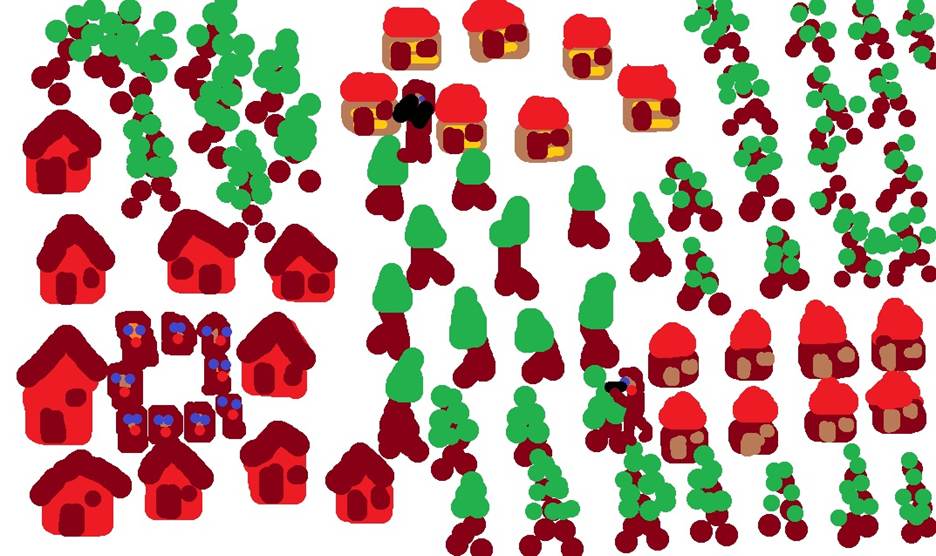
March of the trees at the Siberian triangle, by Jean-Vladimir and Adilah
The Siberian triangle formed by the villages of Krasnoe Pole, Evfrat and Tigr is like the triangle of cooperatives in Palestine, consisting of Red Palestine, Palestinian Refoundation, and State of the Reconciliation, except that it extends over a much larger area, several thousands of square kilometres as a matter of fact. What in the Palestinian case are the divisions between Palestinians and Jews the two groups are trying to eliminate via mixed brigades, in the Siberian case is the problem of overcoming huge distances. The snow and ice lasts from about October to May. People can only travel either by dog-sledge, airplane – nowadays small rescue and emergency planes functioning on wind- and solar power backed up by batteries – or, these days, also via transport beam.
“Hi, we are Yassir and Yitzhak from Red Palestine, Benzion and Muhammed from Palestinian Refoundation, and Khaled and David from State of the Reconciliation. We are now trying to bring in some better soil to distribute in between our cooperatives, which we shall then fertilise with lots of dinosaur manure. We have also sown seeds for some fast-growing olive and palm tree varieties. Imagine how nice it would be to have a large forest at the centre of the triangle of cooperatives in Palestine, like in Siberia. From there, trees need only march in all four directions and make the West Bank of the river Jordan fertile again.”
“Thank you, comrade Yassir. ’At what speed?’ you may ask,” Danièle took over for one of her favourite questions. “We have hesitated a long time over this. The marches at Novgornyi, the Lenin kolkhoz, and Illyria as you can tell from the pictures took about one kilometre to a dozen kilometres at most a year. At that rate, we will be dead, and most of our children and grandchildren will also be old or dead already before we’ll observe any significant change. We all agreed, not only our Siberian comrades at Krasnoe Pole, but also we at Illyria, the comrades at the triangle of Palestinian cooperatives, and also our comrades out in the Amazone and the Congo that this would be much too slow a pace. Comrade Mamadou, what did you decide?”
March of the Trees from the Congo
Congo trees marching, with comrades Omsinbaba, Seth, Noah, Mamadou, and other African comrades, by Jean-Wadi and Zafira
“We Africans plan for an intermediate speed, 50 km a year,” answered comrade Mamadou. “For the distance of two thousand kilometre that trees would have to march to significantly encroach upon the Saharan desert, or at least establish a link from the border of the rain-forest to the major oases, this would mean at least a forty year march.”
“Well, that would already be a lot shorter than 1000, 600, and even a hundred years,” said Pierre le Gars.
“And along with the Sahel, we shall also want to regreen the Nile valley, so as to improve people’s livelihood in the Sudan,” added comrade Égale, his partner. “That will go even faster.”
Amazone Trees marching
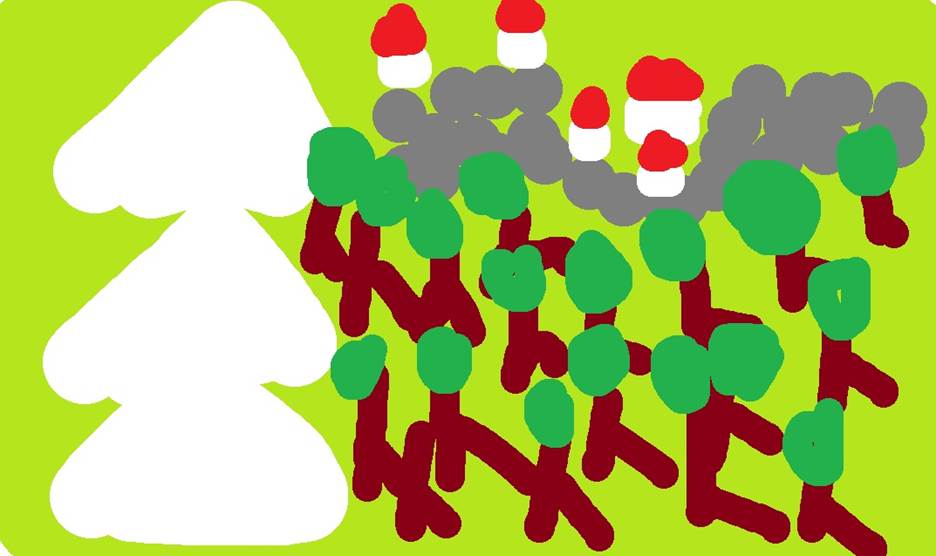
Amazone Trees marching to the Sierra and the Pampa, by Jean-Fidel and Lénina
“In the Amazone, scientists have calculated, this speed can be beaten because the soil is more fertile, the air more humid, and the trees have already more experience in marching,” reported comrade Jean-Fidel. “It could be doubled to 100 km a year, meaning a staggering 8.5 km a month, up to 300 metres a day. If sustained and if it could be adapted in our surroundings as well, such as the French lands, Siberia, Northern Africa and Palestine, it would mean that within ten years, which is well within all of our life expectancies, we could see the French mixed forest returned, Palestine regreened, a significant part of the Taiga regrown and expanded, the Sahel and part of the Sahara reconquered, the Amazone forest reaching into the Pampa and the Central American rain-forest rejoined with the Amazone.”
“And we might try to regrow the Indian jungle!” comrade Raj spoke up from India.
“And cover China with beautiful forest as well again, not only Bamboo for capitalist exploitation,” added comrade Junfeng.
“Of course, the exact speed will not only depend on the location and the resolve of the trees, but also on the kind of tree they are, the kind of soil, the weather, and the presence or absence of fasco sabotage. Some of our experts warn us that our impatience might tempt us to reach for environmental toxins such as synthetic fertilisers. It might even tempt us to treat trees too much like humans and give them neuro-transmitters that the fascos might then tamper with. Therefore, we decided to go for this super-fast solution at first only in some places and on an experimental basis only. Yet should it work, we are ready to expand it, because otherwise we won’t see any tangible results at all for more than three generations.”
Brown Cells
“Don’t be fooled by the videos of their silly parting ceremony you are receiving via bio-wifi!” Reinhart, clearly relishing his better knowledge, told the revolutionaries about Stérilé, Arrolle, Dalgo and Maréchal’s latest sabotage plan. “In fact, they will continue cooperating even with the hated Germans. They had decided on that already in Siberia before I left.
“The new concept is neither the Pappbergerist focus on weapons production and armed conflict, nor the Uberyte fasco mafia centred on logistics stations, sport studios, cheap amusement centres, and private policlinics. All of these depend on money, crypto, vouchers, token, whatever floats their boat at the moment. Instead, the French want to counter our concept of red cells with brown cells, especially in the trade unions, which will then raise demands for the return of hierarchies.”
“Oh, wow, that is like these travesties we already discovered at the railroads and the other utilities,” Emmanuel was understandably excited. “It means that my project on the trade unions is not going to be boring theory either.”
Comrade Laurence’s nightmare
“Both the brown cell and the mafia plans sound benign compared to what they might still have up their sleeves. The other night, I had a horrible nightmare. I dreamt that the fascos had convinced us that the trees were using up too much oxygen for their marches and we needed to ration air.”
“That is nonsense,” laughed Emmanuel. “Plants breathe in CO2 and exhale oxygen.”
“It was a nightmare, not a biology lesson,” Laurence explained. “They wanted to force us all to carry oxygen tanks, which we could replenish from central deposits in the larger agglos. Aimeran they even deemed too small. We would have had to go to Versailles, Chartres, or Compiègne at least. That already would contribute to a revival of the agglos of course.
“And in the end of the dream, a war broke out between the French and the German lands. Remember from history lesson, a war like there used to rage in the Middle East over oil supplies before the revolution. I am glad to be awake again.”
“She is right,” From his prison cell, Reinhart looked earnestly at the bio-feed of the third of the Illyrians assembled in the youth club, and the avatars of the other two-thirds floating around them since it was another rainy evening. “Believe it or not, I have heard about plans like this as well. Gunpump, Kocho, and Schneid are involved… Don’t worry,” he continued when he saw Natalie’s and Danièle’s scared faces before the drab background of their train compartment. “It will take them a while to set it up. Just think of the number of air tanks they would need, big ones as well as small ones.”
Chapter 9. And for when the tree house villages?
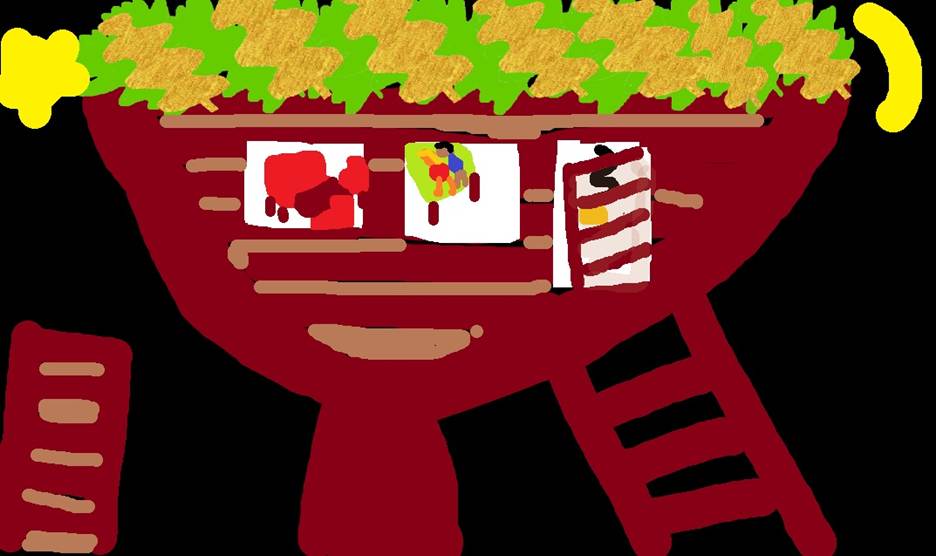
Tree house at Illyria, by Zamir and Odile
“Welcome back, comrades just returned from Siberia!” It was the final evening of Danièle’s presentation, to be dedicated to the question of tree houses. “For when do we want to have these tree houses? It will depend at what level of technology we want to have them, won’t it? Do we want to return all the way to the primitive communism of the stone age or do we want them as a luxury at the present or at an even higher level of technology?” Comrade Anisah, herself expert on primitive communism as a model for revolutionary organisation was moderating.
“Look, we could have an intermediate solution, izbas,” proposed Peter Gar. “Like Volgo, the Volgotitan proposed.”
“There is no reason to object to a return to tree houses,” Danièle argued. “We have the intranet. Truth told, we do not need the plushtops, haproids, and harpoids anymore, except maybe as toys, for school, university and other academic and some cultural purposes. In our tree houses we won’t need refrigerators, washing machines, and other electrical appliances anymore, except maybe some lights and other small devices that can function on solar, so we won’t need any electricity connection.”
“What if you need to do laundry or dishes, for that matter?”
“I’ll go to the stream nearby.”
“What if there isn’t any stream close by?”
Comrade Danièle pondered the question for a moment. “Well, until we have springs and lakes again everywhere, you might still need some houses on the ground, with running water, as well as toilets and other appliances and for storage.”
“Storage!” nodded Jana. “You are absolutely right to mention that point, young comrade Danièle.”
“I learnt it from you, Mamie!” said Danièle.
“Already now we have problems with storing fodder for the animals, and flour, vegetables, preserves, cider, etc. over the winter. Only the old farmhouse has a proper basement, and all our attics, even those above the stables are inhabited.”
“Houses as such are no problem if there aren’t too many of them. If it gets really cold in winter, we might want to seek refuge there, even the animals.”
“Look, there is an even worse problem,” said Maher. “I listened in on your calculations, and it turns out that the march of the trees to regreen at least some of the earth’s deserts, restore the mixed forest in Europe and North America, and the Taiga in Siberia will last from ten to fifty years at least, didn’t we agree on that?”
Danièle immediately looked like she was going to cry again. “But you see, I can see another problem linked to that,” continued Maher. “I am a chemist, not a biologist or agronomist, but those trees that will march will have less strength and time to grow taller, isn’t that so, comrade Francine?”
“Absolutely,” said Francine. “Look at all the trees around Illyria, there is a definite trade-off between height and range.”
“And especially between height and strength of the stem and of the major branches,” added Abram, ex-oligarch from Ukraine, who had studied forest-keeping at a late age. “Only very old and strong trees combine both. We’ll have to raise a special kind of trees for tree houses. They should not only have a big trunk, but a big fork base between the out-reaching branches, so you can fit in your tree house snugly in between them and have maximum space combined with maximum stability. You can see this principle observed in the tree houses we already have in the garden colony, especially at comrade Arthur’s and Huguette’s and comrade Misha’s houses.”
“Well,” comrade Danièle shrugged. “Isn’t that evidence that it can be done?”
“Yes, but there may still be a trade-off between the march of the trees and the spread of the tree houses,” Francine said.
“Which one should we give preference to?” asked Anisah. “Let us have a quick show of hands.” It was a hundred percent for the march of the trees. Not even Danièle, Arthur, Huguette, and Françoise, comrade Murielle’s mother, or anyone from comrade Misha’s household voted for a quick stake in tree houses.
“Well, that was a clear vote,” said Francine. “Merci, comrades, because this is a matter of international solidarity as well. After all, it will be a world-wide revolution of the plants and animals going on in all four continents, South and North America, Africa, Europe, and Asia. Together with the trees, the bushes, grasses, and flowers of these regions, the wild animals of these regions will multiply again as well, although in some cases we might even have to rebreed individual species.”
“Rebreed?” Danièle flinched, Marius grinned.
“Any other idea, sweetheart sister, or do you want to have the Taiga without snow lions? Right now they only have snow leopards and snow tigers, and even of those there are precious few yet.”
“And we have seen them at Tigr,” nodded Danièle. “They are gorgeous. For once I agree with you, comrade Marius, we may need to rebreed some.”
“Remember, comrade Ramón’s son Francisco and his friend Gunter were breeding pampa wolves,” interjected comrade Lénina. “It’s revolutionary technology.”
“Yeah, but papa Ramón is not the best reputed revolutionary,” countered Danièle.
“That’s not sure yet,” said Jean-Fidel, who knew him well and was related to him via comrade Claudia and comrade Miguel, whose uncle Ramón was. “Last thing we know is that he is working on his memoires. Maybe he’ll be able to set everything right again.”
“He may be like my papa, comrade François, or my uncle, comrade Jacques,” suggested Jean-François. “A good gangster, but having repented, an even better revolutionary.”
“But wait,” said Bulan, Alain’s pal who had taken over the moderation from Anisah. “For when the tree houses then? I mean, didn’t you tell us comrade Abram that we have an old oak grove in the vicinity here, to the South-West from Illyria?
“Yes, we do,” said comrade Abram. “Twenty years from now, they will be tall and strong enough to take tree houses four times as big as those we have now at Illyria. Right now, ours are two by two metres, wouldn’t you say, comrades Arthur and Misha?”
“So, in twenty years we may already have an experimental tree house colony?” asked comrade Jean. “Well, that’s fabulous, isn’t it?” Comrades Raoúl and Josetta, comrade Évita’s parents, and Inès and Danton, her buddy, Little Ramón’s parents were also overjoyed. “That means that little comrade Évita may come more on less on time with her university entry project and license degree research on that subject. Tell us more, comrades Abram and Francine. How many tree houses will we be able to have?”
“Oh, about eight, I think,” said Abram. “Maybe ten!” he hastened to add when he saw the disappointed faces of the Illyrians. “Look, if we have nine, we can rotate their occupancy among three apartments, houses, or trailers at Illyria, garden colony, or manouche camp respectively. The residents of each of the three apartments, houses, or trailers will be able to stay there for ten days every month in season. That will give everyone an idea of how we can live there, while the old farmhouse and all the other amenities are still there.”
“It has got to be easy,” said Olivier and drew a long face. “Think about it, comrade Danièle. The fourth generation revolutionaries of the Red and Green brigades will already be studying at university. The younger ones of the Young Peace Doves and the Young Harpists will be close to passing their baccalauréat. They will need to study!”
“Why do you think they won’t be able to study in a tree house?”
“They will be able to,” said Jean-Saïd. “Yet comrade Olivier is right. They will need study tools and lab facilities, especially if they are natural scientists.”
He waited a moment for someone to say, what do we need all that science for, but they didn’t, knowing that we humans do need science to know what to do and how to do it. “ This means we can combine a small experimental tree house village with the focus on the march of the trees. Our comrades in the Congo and the Amazone will have many more tree house villages already. We will be able to compare notes, and study their experience.”
“We’ll have to make sure the trees don’t collapse,” said comrade Léon. “I read somewhere that the reason tree houses work so much better in the African rain forest and in the Amazone is that the trees are so much closer together, and that means that even the tree houses on adjacent trees can support each other.”
“It is an old technology. Our ancestors, the Pruzzens also had them,” piped up comrade Danya from Novgornyi.
“They still lived that way when the missionaries came in the 10th century,” noted Alexandra.
“We subcontinental Indians had them,” Adjip noted. “Until the colonial powers chopped down our jungle.”
“New Guinea people as well,” added Santoso, Illyria’s comrade in Indonesia.
“And we North American Indians will have them once our forests grow back,” noted young comrade Demahigan, Abenaki from the East Coast. “As an alternative to long houses.”
Comrade Marius’ warning
“My wonder-cattle will help you make space for your big trees that will carry your tree houses. Think about it, because my wonder-cow is non-voracious, you will need fewer pastures. Yet you are down on my wonder-goat, not because you love animals, I also love them, but because you hate me,” Marius said angrily.
“No,” said Danièle. “I don’t hate you. I also imagine it very nice to live with these non-voracious, milk-giving, wool-bearing, meat-yielding, egg-laying, plough-pulling, load-carrying, cuddly guard animals. Yet it depends a lot how they will look, and how they will behave. Will they scare the other animals? In a way, it is the problem of the harpoids magnified by several orders of magnitude. At least we know how to programme robots, but with this new species you want to create, we will be on a new planet almost.”
“Buffaloshit,” grumbled Marius. “That’s you falling for their capitalist horror scenarios again.”
Postscript in Illyria and Saint-Denis. A look further into the future. Les copains d’ailleurs
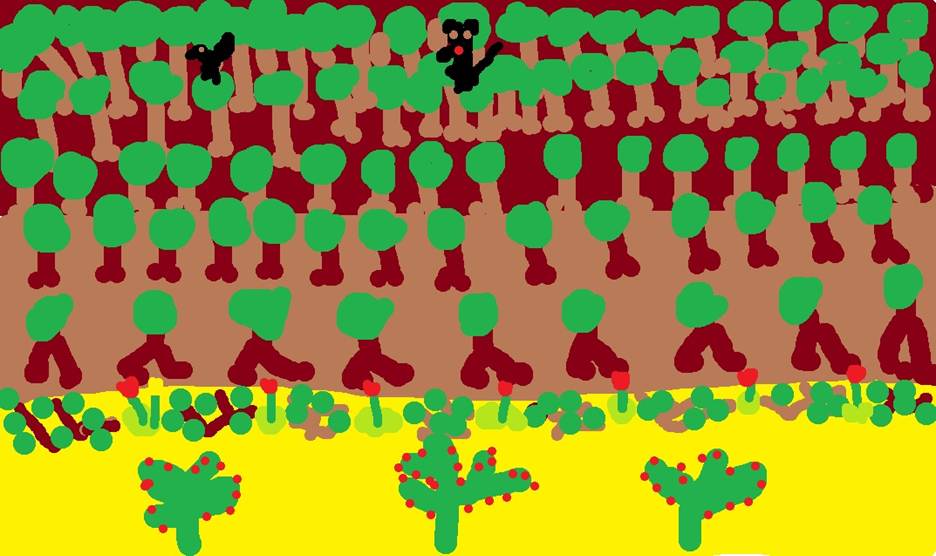
The March of the Trees continues, by Danièle and Olivier
“Any last words, comrade Danièle?” asked comrade Sophie who was moderating.
“Yes we should pursue our true green dream of back to the woods, and not have our lives turn around gadgets, be they as nice as harpoids and plushbots… And not around fasco sabotage either,” Danièle stated to thunderous applause.
“Well done, comrade Danièle. You’d have to research it, but you are probably the youngest student ever to present a university entry project at age thirteen. And we have a special treat for a preview this time,” Sophie took over again. “Remember, last time we presented some predictions on the projects by the fourth generation revolutionaries. We shall get to the fifth generation’s projects when their time comes, don’t worry, and we can anticipate some of them through the time tunnel. Yet even before that, and to bridge the gap until they are born and grow, we shall need some reports on how the fight against fasco saboteurs and for peace, ecological deconstruction-reconstruction, democracy in the harp assemblies, free allocation and distribution in the economic circuit with the help of the trefoil, and non-hierarchical, revolutionary education and culture, en bref, in short, how permanent revolution is going all over the world at our friend’s places. Where shall we start? In Africa maybe? The cradle of humanity? Remember, comrades Omsinbaba, Seth, and Noah, Rashida, René, Kaltouma, Zafira, and Jean-Wadi, as well as comrades Sandrine, Nahel, Tahir and others, probably, will go there again as well. We shall no longer neglect Africa. Now you have the word, comrades Dulcie from South Africa, Sosthene from Lake Chad, Mamadou from the Congo, Pel from Angola, and Barack from Kenya.”
“Well, we all know that South Africans were special victims of colonialism,” Dulcie began. “Yet one of the few advantages we had from that was to be able to participate in the Northern hemispheres’ women’s rights movement. In ‘My day as brigadier’, I, and other African comrades, Aisha, Khadidja, and Okuhle, as well as comrades Arlette from the French lands, Rosa and Kamala from North America and others will trace how our situation as women on backward continents has changed in the revolution since 2021.”
“There are no backward continents,” grumbled Zafira. “There are only backward colonialists.”
“Well, that has to do with democracy, so has our next topic,” said Sosthene, from the Nelson Mandela cooperative on Lake Chad, “‘Quorum’. Reaching a quorum for certain decisions, such as organising mutual help, catching a criminal, running a hierarchy, material or self-management check, is a special problem in the desert, where population is sparse, hence there are few live bio-wifi towers, and sometimes there is not even enough food to motivate people and other harpists.”
“And that leads into the next topic,” said comrade Mamadou from the Congo, “which ties in just perfectly with what comrade Danièle has just presented, ‘The March of the Trees continues,’ which will also be on how we are organising the junglenet, meaning intranet in the jungle, as well as regreening the desert.
“We ‘African miners’ have been the victims particularly severely hit by neo-colonialist, imperialist resource exploitation,” said Pel. “We have also invited miners from other parts of the world. Sergei and the Moscow Recycling Hounds, Changlong and the Almond Tree Brigade in Beijing, and comrades Evo and Dina from the Andes in South America to help us with this vast and difficult subject.”
“And finally, the South American assemblies of village assemblies comrade Evo has been organising have given me the cue. I, Barack from the Kenyan lands want to organise a forum ‘Black lives triumph. Final stretches’ to make sure black lives triumph and thrive in Africa, and all over the world just like the march of the trees. And in this context, we shall also talk about the ‘The Yellow Revolution’ in North America and elsewhere which made us overcome the final residuals of racism against mixed colours.”
“Claro, but we shall not start with the assemblies, but with the geography of our beautiful half-continent, South America, which is so little known in the rest of the world,” said Evo.
“First, I José from Pueblo del Desierto, I am comrade Miguel’s father by the way, comrade Ernesto from Cuba, and Daniel from Nicaragua will seek to elucidate ‘True Communism’ on the basis of stories from our lands.”
“Then, in ‘Banana Communism’, Pedro, Hugo, Emmanuella, Gustavo and I, Pablo from Costa Rica, will try to explain the nefarious impact of the neo-colonialist, imperialist legacy even in the revolution.”
“In ‘Smoking out Colonia Dignidad’, we, Raoúl and Martí will tell the story of how we got rid of one particular vicious remains of fasco resistance in the Chilean lands.”
“And I, Antonio, will present comrade ‘Ramón’s self-defence’ against the trumped-up charges of corruption against him and his friend, comrade Diego.”
“Finally, I, Evo will present you our practice of ‘Our way. An assembly of assemblies’, in the hope that it will be successful in other continents and large world regions as well.”
“Well, for instance, in Asia. However, the Asian lands have been very fragmented in the revolution. That is why we call the experience of our urban or agglo cooperative and the way it tries to promote revolutionary changes ‘Whispers of the Almond Tree,’”comrade Junfeng took over here for the Chinese comrades. “Yet then we Chinese and Indian comrades shall also report on our joint assemblies in ‘Almond Tree Brigade meets Gandhi 2.1.’,” added comrade Adjip.
“We Vietnamese decided to focus on a problem particularly rampant in Asia even after the revolution, what we call the ‘Over-population blues,’” Nyugen took over here for Dong and her.
“Well, it is clear that we need more resolute de-industrialisation and de-construction, and we Japanese, Koreans, and Chinese with the help of comrade Tim and other European deconstructionists will tackle this problem in ‘Communist Samurai’,” said comrade Hee-Jin.
“We are not as developed yet as you North-East Asians,” said Santoso. “And Jamilah and I will tell our South Asian story in ’Communal kitchens.’ “
“Oh, yeah, and you might think, we’ll have no report from Australia, which is part of Asia after all, but I found a case of a village assembly that disagreed with all others for ‘One village out’. And it is the village of Lambs Creek in Australia,” interjected young comrade Cécile. “So, look forward to my presentation in this context as well.”
“You would think we Europeans are above all this poverty, far from it. In fact, in Britain, without ‘Austerity as a Revolutionary Catalyst’, the revolution of 2021 would have totally flopped. Peace, feminism, Black lives matter, farming, ecology, even Covet, all these other issues would not have been sufficient as a trigger,” explained Jeremy.
“And we needed to revive the revolutionary tradition,” said Siobhan, buddy of Volya and Liubko. “Here in the Ukrainian and Russian lands, it is live and awake. In Ireland you had and still may have to resuscitate it, as our children Dermot and Aoife will with their presentations on “1916 – Lessons from a Defeat” on the Irish revolution of the 20th century and “The revolutionary liri and fili”, on the role of bards and writers in our tradition.
“’Why Bulls like Red’ is on the terrible practice of the bull fights,” said Mao, son of Andres and Wuzhuo from Madrid. “Lucky that my presentation is still a few years in the future, because you, comrade Danièle would not be able to stand it.”
“My thesis is short and sweet,” said Marcello from Italy. “The post-revolutionary fasco mafia may be ‘Worse than the Italian’. That will be the title. And it will be blood-curdling, let me tell you.”
“What will happen if the revolution just shuffles along?” comrade Nude introduced the next region. “That will be the topic in my ‘Belgian Chocolate’ and comrade Martin’s ‘Mountain Manifesto’.”
“’Agglo of a Million Trees’ will be our report from Budapest, which has made the same commitment as Paris and the Moscow region,” comrade Marcsi spoke up from Budapest. “And ‘When Oligarchs rebound’ will be our contribution from Poland and the Baltics, comrade Reigo concluded the European section.
“Wait a minute, we Russians belong to Europe, you Westerners always make the same mistake,” sighed Sergei. “So, we shall remind you of our contribution as the ‘The Moscow Recycling Hounds’, comrade Danya from the Novgornyi Recycling Hounds will tell you about Russian village architecture in ‘Novyi Mir’. Comrade Zhenya also from Novgornyi will talk about the tradition of the flying construction brigades, ‘Shabashka’ in the 2021. You won’t be surprised to hear that it also does deconstruction. Comrades Natasha and Volodia will talk about ‘Revolution in the Soils’ to tie in with comrade Tahir’s ‘Pure Air’ and comrade Rashida’s ‘Holy Water’. And comrades Maksim, and young comrades Mikhail and Olga will present ‘A Pruzzen Trilogy’, vol. 1 Prutens and Vudevuts and the three Graces, vol. 2 Ramava, and vol. 3 A First Chance. The Russian Conquest of East Prussia from 1756-63.”
“We shall live differently once the buffalos have really returned to the prairies and imposed their Nomadic life style on us,” Mazanape re-launched the North American story. “We call this the ‘Buffalo Rumble’.”
“You can guess that ‘Cowbot Romances’ will be on interaction in the harp,” said his girl-friend, buddy Wagmu Chikala. “And I promise you, love will be in the air.”
“It will take a while for the humans, even Indians and trappers, let alone farmers and ex-city dwellers to accept buffalo and other animal moderators at harp assemblies,” explained Nora, the young buffalohuman comrade from Novosibirsk. “That is why we buffalohumans shall once more travel all the way from Novosibirsk to North America, but this time probably disassembled on a yellow beam to help make ‘Buffalo Moderators’ more palpable.”
“’Friends with the Bear’ is an old legend from the Little Bighorn Mountains,” said Mato, son of Tatanka-Ha and Ehawee, born by Wagmu-Chikala. “And ‘Mountain Harp’, you may have guessed, is the story of how the harp may function even in hardly accessible mountain region. Comrade Martin from the Swiss lands, Evo from the Andes, and other comrades mountain-dwellers from all over the world have promised to participate in our experiments with the intranet, bio-wifi, assembly meetings up on high summits, and much more,” concluded Chayton, son of Wagmu Chikala and Mazanape.
“Well, if I may have my final words of conclusion now,” said Danièle, tired but happy, “you can see from these previews how our permanent revolution world-wide is still oscillating between reliance on technology versus return to nature, organisation versus discussion, and conflict versus peace. My presentation was a plea for nature, discussion, and peace, always, without exception. Let’s go back to the woods where humanity started and seek a new beginning.”
The discussions and adventures of the Illyrians, the inhabitants of the garden colony, the manouche camp, and the neighbourhood assemblies Casa Latina Russki Dom Peace Dove shall continue in Life in Communism 2.1. Red Cells. The Role of the Trade Unions, In the Name of the Peace Dove. Gasping for Air, The World Belongs to All, Intifada – Revolution, Food for everybody – Food for all, African Trilogy, vol.1 On a Rubber Dinghy, vol. 2 The Coup, vol. 3 Green Timbuktu, Revolutionary Accounting, Les Jours Heureux. Marius’ Wonder-Cattle, The Metalmongers, and The Kindergarden Manifesto, 2nd edition.
Glossary of Back to the Woods words:
agglo(-meration) – a collection of villages or former city quarters, possibly with ever fewer human and more plant and animal inhabitants, Paris now calls itself the agglo of a million trees
bio-message – a message sent by intranet, the basic bio-message is audio-visual
bio-wifi – intranet transmitted mostly by live towers, such as humans, trees, large and small animals, birds and fishes, bushes and grass, as well as some intranet-capable materials and things
brain app – is like an image of a revolutionary app on an intranet phone in the brain, allowing its holder, for example, to learn nature-speak and nature language, participate in harp assemblies, present requests for hierarchy or material checks, or order goods from a workshop, market stall, or share point even without accessing a device
grow-up-with-you harpoids – live-size robots in the shape of a human, animal, traditional robot, plant or even dinosaur shape that can grow up with a child both in size as well as in learning and understanding
harp – human, animal, robot, plant interaction, for example in a brigade or an assembly
harpist – anyone participating in a harp – human, animal, robot, plant assembly
haproid – the prototypes for harpoids, see below
harpoids – human-, animal-, traditional robot-, plant-, or dinosaur-shaped robots
intranet – or red intranet, the revolutionary communication via low frequency neural or brain waves that allows communication not only between humans and their robots and other devices, but also with animals and plants
plushbot – or plushtop, the third generation revolutionary laptop, the first already featuring the One World operating programme, the browser Aurora, and the revolutionary apps, the second one natural intranet rather than harmful internet connections and the Chinese Wall Security Suite fortified by Bio-Thicket, and the third the replacement of all unneeded metal and other scarce resource components and the integration of the device into a young user-friendly plush cover in various harpoid shapes
university entry project – the second task along with the baccalauréat examinations every French secondary school student has had to complete since the revolution in order to qualify for a course of study at university
Map and Plan of our rural cooperative Illyria, Yvelines, and our neighbourhood assemblies Casa Latina Russki Dom Peace Dove on 76 rue de Lorraine, Saint-Denis, State Year 20 of the Revolution during comrade Danièle’s presentation on “Back to the Woods”, there are 17 three-room apartments with the bedrooms occupied as follows, Young Revolutionaries marked in italics:
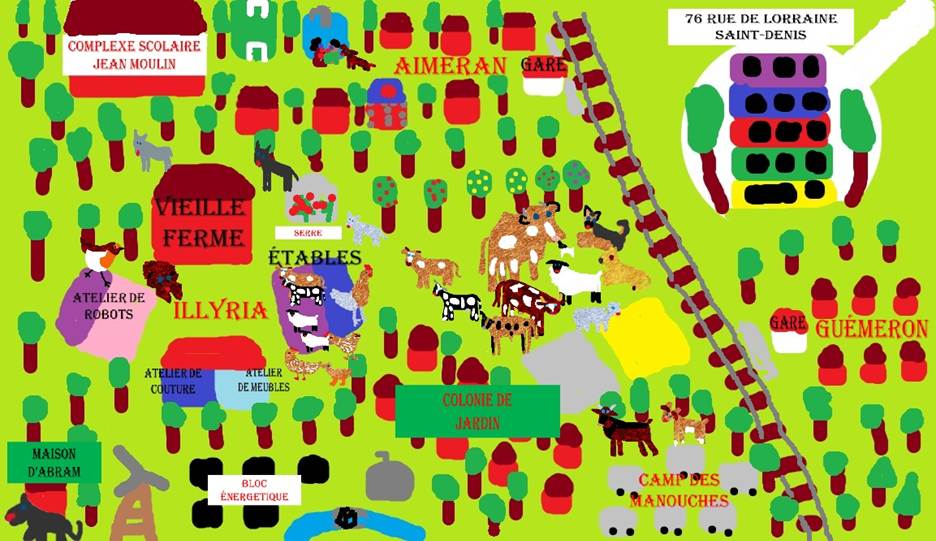
Map of Aimeran at the time of comrade Danièle’s presentation “Back to the Woods”, in March of Year 20 of the Revolution, by Marius and Jean-Luc
| Apartments in the old Farmhouse Noah and Michelle Malik and Mao and baby Aisha Claudia and Miguel | Jana, Youssef, and Salma Anton and Monique Marius and Jean-Luc | Michel and Fabienne Pierre le Gars (Peter Gar) and Égale Yoga Room Ronggang and Quan | ||
| Muhammed and Aini Hisham and Rim Bashir and Sevim and baby Asma, born in January of Year 20 | Marie and Daniel Omsinbaba and Fofana Lulu and Maurice, and toddler Bouna | Arlette and Jérôme Karla and Maher, baby Soho Pléiades Room Jean-Vladimir and Adilah, and toddler Akila | ||
| Patrick and Marianne Abram and Francine Olivier and Danièle, baby Flore in planning | Youth Club Che, Georgette, and toddler Salvador | Jean, Mina, and Hélène Laurent and Véro Zamir and Odile | ||
| Apartments above Robot Workshop Emilia, Robespierre, Sophie, and Pascal Lénina and Jean-Fidel, and baby Evo Alexandra and Jean-François and baby Max | Apartments above the stables Denis and Laure Young Revolutionaries Room Jean-Saïd and Natalie, baby Lina to come in September | |||
| Danton Inès, and toddler Ramón Julie and Zelim-Philippe, and baby Giles to be born in April of Year 20 New Pléiades Room Assad, Kaltouma, and baby Nahel | Boris and Karima Jean-Wadi, Zafira, baby Sandrine Rashida and Seth, baby Tahir | |||
| Philippe and Anisah Renée and Guillaume and baby Comet Aslan and Zamira | ||||
| Apartments above Clothes Workshop Alain and Bulan Félix and Leyla Saïd and Rodion | Georges and Jeanette Pierre and Marine Aleksei and Evgenia | Apartments above Furniture Workshop Annie and Frédéric Léon and Martine Rosa, Josip, and baby Fabien | Camille and Zelim Sylvain and Nicole Guest Room |
Red: House 1, Old Farmhouse; Dark Blue: House 2, Clothes workshop; Light Blue: House 3, Furniture workshop; Dark violet: House 4, Stables; Light violet: House 5, Robot workshop
Garden Colony and Manouche Camp
| Garden Colony Louise, Tim, and Mélanie | Arthur and Huguette, daughter Françoise, and granddaughter Murielle | |
| Raphaël, Jacqueline, Fabien, Catherine, their kids Cédric, and Charolaine Sabine, Charles, their kids Colin and Cécile | Misha, his partner Yvonne, his friend Cato, their young son Jean-Michel, and Misha’s mother Carla | |
| The Cambodian martial arts Dan, In, Ayak, and Vit | 1st generation: Bouna, Zyed, and Muhittin, 2nd generation: Mireille, Marwan, and Zima, baby Tonyi | |
| Bérénice and son Pierre | Raoul and Josetta, baby Evita | |
| Manouche Camp | ||
| Django, Manou, their son Orel and his friends | Roman and family | |
| Matthias, Céline, and baby Isabel |
Neighbourhood Assemblies Casa Latina Russki Dom Peace Dove at 76 rue de Lorraine, Saint-Denis
| Luc, accountant at l’Humanité, wife, children, daughter Lucille, and grand-son Jean-Luc | Bertrand, works at l’Huma, Illyria and peace movement, and family | Clément, works at l’Huma, Illyria and anti-fake vax movement, and family |
| Sebastien, gardener, wife hairdresser, and family | Mathieu, concierge, wife post-office worker, and family | René, doctor for refugee children and family, daughter Sarah |
| Béa and François, Gabriel and Benoît, Repentant terrorists, now gardeners | Dominique, peace activist, and family, daughter Laurence | Aurélie, New Workshops, trade union activist, and family, son Emmanuel |
| Illyrians, their visitors, live and online | Rebecca, Marwan and son Faroukh | Pauline and Jacques, Pauline’s son Antoine and partner Murielle, and toddler Zac |
| Youth Club Casa Latina and Russki Dom Toddler Crèche | Homework club, All Pléiades, New Pléiades and Young revolutionaries | Marxism reading courses and adolescent and student hangout |
Yellow: first floor, youth club; Green: second floor; Red: third floor; Blue: fourth floor, and violet: fifth floor. 2nd and 3rd floors: Casa Latina Russki Dom, 4th and 5th floor: Peace Dove.
Other works by Carla O’Gallchobhair you will also enjoy:
Life in Communism 2.1. Terrorism as the Epitome of Fascism, by Carla O’Gallchobhair. You expect boring security theory, and instead what a cliff-hanger! For his university entry project – he wants to be a sociologist –, comrade Olivier, member of the 5th International Brigade, son of comrades Marianne and Patrick, or Aslan rather, will do a sociological analysis of fascist terrorism as of spring of Year 20 of the World Revolution, 2021 being Year Zero. Olivier is working on a comparison of the fasco brown cells with the Red Brigades of the 70s and 80s, reruns of 9/11, Covet, and state terrorism. As if to dissuade and scare Olivier personally as well as all other revolutionaries, the fascos have reinvented one of their original crimes: kidnapping and torture, as well as a new virus, the MA or moral atrophy virus.”
“What a smasher,” comments Peter Gar. “The MA or Moral Atrophy virus will get you, unless you get the MS or Moral Strength one.”
Life in Communism 2.1. Des révolutions colorées à la révolution rouge, by Carla O’Galllchobhair. (in English) It turns out that capitalist trouble-makers inspired the majority of Middle Eastern part tragic, part choreographed demonstrations and uprisings under late capitalism themselves, just so as to prevent any viable revolutionary organisation to emerge. Yet the grievances and yearning for freedom of the different populations in the various regions were real. Youssef analyses the way true class solidarity finally paved the way for the real Communist revolution. He takes us on a historical journey through Moroccan, Algerian, Tunisian, Libyan, Egyptian, Sudanese, Yemeni, Arabian and Emirate, Iraqi, Iranian, Syrian, and Palestinian stories to show how the diverse currents of anti-capitalist and anti-imperialist resistance in the Middle East finally fused in the World Revolution of 2021.
Life in Communism 2.1. Regreening the Taiga, by Carla O’Gallchobhair. Hardly have they returned from Palestine that Jean-Saïd and Natalie and their Illyrian and Russian comrades start out again to explore the ecological state of the Siberian Taiga after centuries of capitalist abuse. Sure enough, their Neonazi German detractors are back as well with new plans of sabotage. To thwart their evil plans, our brave young comrades launch into an attempt at fast-tracking ecological renewal and adventures they will never forget.
Life in Communism 2.1. Mixed Brigade, by Carla O’Gallchobhair. Three members of the 5th International Brigade – named after the famous Communist brigade in the Spanish civil war of 1936-39, against the fascos, comrades Jean-Saïd, Natalie, and Olivier, accompanied by senior comrades Jean-Vladimir, Jean, Saïd, and Rodion –, travel to Palestine to protect Jean-Saïd while he participates in a mixed Palestinian-Jewish brigade in cutting-edge physical engineering research, the yellow transport beam brigade. The other Illyrians are holding their breath at home. Although it is already Year 20 of the World Revolution, the situation in Palestine is still murky, but not because of internecine ethnic conflict.

Preview of Life in Communism 2.1. vol. 47-51. Return of the Buffalos, by Carla O’Gallchobhair. How will the young revolutionaries overcome the challenges of AI, robotics and the dangers of their weaponisation by the ex-capitalist class enemies (Josip’s topic), coming of age under threat by the fasco terrorists (a collective work by all 40 young revolutionaries), running the revolutionary media in the age of extreme de-centralisation and replacement of the traditional internet by intranet-naturespeak-biomessaging based on harmless but more personal green, brain or neural waves (Patrick, Bernard, Clément and others), social problems caused by ex-capitalist refugees and explorers and the restaurationist threats they pose (Mao), and finally but foremost, ecological reconstruction, in particular the return of all but extinct species to their natural habitats (Malik)?


THE IRON DOME MAY FALL
TRUMP IS A MENACE
VACCINES ARE NOT SAFE, OR ONLY FOR THE RICH
https://thepeoplesvoice.tv/worlds-top-vaccinologist-comes-clean-we-lied-about-vaccines-being-safe

CHEMTRAILS/SPRAYING — A DANGER TO HUMANS AND NATURE AS A WHOLE
COVID VACCINES WERE WEAPONS OF MASS DESTRUCTION
SON OF A CO-FOUNDER OF THE WEF DEBUNKS THIS ELITIST CLAN
IRREFUTABLE EVIDENCE: ALL COVID VARIANTS MAN-MADE
COVET-19 VACCINE: CLOTS AND DEAD BABIES
https://www.bitchute.com/video/DnwyDJttKPxJ
A Warning from La Quinta Columna
The absence of a vaccine is blamed for conditions caused by bad work and living conditions.
TB: Cows, Lies & Koch-Ups
https://www.bitchute.com/video/7g13T7phuG5x/
https://www.bitchute.com/video/P0AMsMwDJsrv
Elon Musk: Ventilators Euthanized MILLIONS Globally, Not COVID
WARNING: VACCINE ID
https://www.bitchute.com/video/nWcoGWx2Wq4
POORNIMA WAGH STUDY

DELETED STUDY: 74% OF 325 DEATHS AFTER COVID VACCINE WERE VACCINE-RELATED
https://www.naturalnews.com/2023-07-17-study-74percent-deaths-caused-by-vaccines-deleted.html
LOUIS FARRAKHAN ON VACCINES, FLUORIDE AND ALUMINIUM IN WATER AND THE BIG PHARMA PLOT

EXPLAINING THAT VACCINES NEVER SAVED A SINGLE LIFE
NEWEST MONKEY BOY AND DR. MCHONK
https://www.bitchute.com/video/uh30ANTqPoc7
DOCTORS FOR THE TRUTH ON COVID — INTENDED AS INSTRUMENT OF CONTROL
https://vk.com/@secretxgovernment-ultimate-proof-covid-19-was-planned-to-usher-in-the-new-worl

DR. KARY MULLIS, ANTI-COVET FRAUD LEGEND
WHEREAS NOW, THEY ARE PLANNING A PERMANENT PANDEMIC

COVID HOAX UNRAVELLING
NO SUCH THING AS COVID
ON THE COVID VACCINES
https://www.bitchute.com/video/J87rgnaa7zNB
ON THE CAPITALISTS’ PRIVATISATION OF POLITICS
AS WELL AS THE SYSTEMATIC AND PROFITABLE KILLING OF OLD PEOPLE
https://www.bitchute.com/video/VfB52dfeNzaT
BRANCH COVIDIANISM/VACCINE ADVOCACY IS A KILLER, LIKE THE CAPITALISM THAT GIVES BIRTH TO IT
https://www.bitchute.com/video/Ti2zaLh4wUkX
AT LEAST THREE GREAT BLOODY HOAXES ALREADY IN THE 21st CENTURY: 9/11 with all the events that followed, Afghanistan, Iraq etc, MAIDAN 2014, it was orchestrated, the ukrainians were getting energy and lots of things cheap from Russia for just a little political neutrality and tolerating the Party of Regions, no reason to go on a rampage against the Russians in Odessa, AND OF COURSE COVET 19…
https://www.bitchute.com/video/Gru4BAJGqmlZ
ANOTHER BOMBSHELL REVELATION BY BIG PHARMA CRITIC MICHAEL CHOSSUDOVSKY

OTHERWISE IT WILL GO ON THIS WAY… THE SOUNDS OF SIRENS

COWS SUDDENLY DIE AFTER BEING VACCINATED (BE CAREFUL, THESE ARE DISTURBING PICTURES)
https://www.bitchute.com/video/rx76XdzjxD9g
DEMONIC VACCINE

THE VACCINE AS A BIO-WEAPON
THE MIDAZOLAM?MORPHIUM HOSPITAL MURDERS
https://www.bitchute.com/video/6OfU8VpDwAPp
MICHAEL YEADON ON THE UNHOLY TRINITY OF THE COVET VACCINES: USE OF SPIKE PROTEINS, UNDERMINING OF AUTOIMMUNITY PROCESSES, INFLAMMATORY AND CONGESTING NANOLIPID TRANSPORTERS
https://www.thetruthseeker.co.uk/?p=271834
MURDER OF DR. ANDREAS NOACK, BECAUSE HE REVEALED GRAPHENE OXIDE IS IN THE VACCINE
NEGATIVE EFFECT OF VAX ON SEXUAL HEALTH
https://www.bitchute.com/video/JJTh59yu70nE
THE CORONA VIRUS WAS NEVER TRULY ISOLATED, SO WHY THE GLOBAL SCARE
PEOPLE WERE INJECTED WITH ELECTROMAGNETIC DEVICES
100 YEAR OLD DOCTOR EXPLAINS HOW INTERNATIONAL ORGANISATIONS PROMOTED CAPITALIST PHARMA PROFITS
https://brandnewtube.com/watch/9LmtYKiR0bO5AUV
TOXIC ELEMENTS IN THE COVET VACCINE WITH MICHAEL YEADON, EX-FISHY
https://www.thetruthseeker.co.uk/?p=270671
DR. MCHONK AND MONKEY BOY: THE COVID PUSHERS AND THE CHILD ABUSERS ARE LINKED
DR. DAVID MARTIN (FORMER FISHY): COVID IS A BIOWEAPON THAT HAS BEEN EXPLOITED SINCE THE 60s
MATERIAL FOR NANOBOTS IN FOOD SUPPLY, MAY TURN MAN INTO PART-AI, BUT WHO WILL PULL THE STRINGS THEN? WE NEED THE SELF-MANAGEMENT REVOLUTION
SIRI, IS COVID STILL SERIOUS?
https://www.bitchute.com/video/SIBnTiGvfycp
NOW EMPRESS ULLA’S COFLU VACCINE WITH NANOBOTS IS BECOMING REALITY
https://www.bitchute.com/video/7pFDAN2atefa
REVOLUTION AND MATERIAL CHECK NEEDED — HUNDRED THOUSANDS OF VACCINE DEATHS IN THE U.S. ALONE
THE NEW MEGA BOOSTERS ARE THERE
SLOW KILL
https://www.bitchute.com/video/i1CkUVwIl3Cn
NO VIRUS
https://www.bitchute.com/video/sihvchiS7tht
RUSSIA DENOUNCES BIG PHARMA — ALSO LEARN ABOUT U.S. MADE GM MOSQUITOS AS BIOWEAPONS
https://vk.com/video-192615048_456243920

HOLD ON TO THEM, YOUR PARENTS MAY BE GONE FASTER THAN YOU THINK
https://www.bitchute.com/video/gOqh0ICammI4
SITUATION UPDATE – 20 MILLION DEAD FROM COVID VACCINE

VACCINE MURDER DUO
https://www.bitchute.com/video/8JEOhmNcZBZ8
MAGNETISED MEAT

SUPERMARKET MEAT FULL OF NANOBOT TYPE STRUCTURES

ARE CHILDREN SO RESILIENT?
THERE IS THE SUDDEN ADULT DEATH SYNDROME
HOSPITALS HAVE BECOME HOSPIKILLS
https://www.thetruthseeker.co.uk/?p=268242
DE-POPULATION AS A RESULT OF THE COVID VAX — THERE IS EVIDENCE
PFIZER (FISHY) NEEDS TO BE EXPOSED

EXCELLENT SITE
PCR FRAUD DOCUMENTARY

https://www.covidtruths.co.uk/
ADVERSE REACTION DATA
https://yellowcard.ukcolumn.org/

A CASE OF COLLECTIVE DISCOMBOBULATION
PERMITTED WITH THE “SPEED OF SCIENCE”, LISTEN TO MONKEYBOY AND DR. MCHONKHONK
KILLER VACCINE
https://www.naturalnews.com/2021-05-25-everyone-vaccinated-will-die-within-two-years.html

IN 2009 ALREADY, SHE KNEW THERE WOULD BE A SCAMDEMIC AND DEPOPULATION

AN ITALIAN DOCTOR SPEAKS OUT
https://www.bitchute.com/video/gcIxK3Sb1kEJ
https://www.brighteon.com/44daacb2-2741-4487-a5be-a46d595f0a09
DANCING NURSES
https://www.brighteon.com/44daacb2-2741-4487-a5be-a46d595f0a09
2012 OLYMPICS PERFORMANCE AS A PREVIEW OF A STAGED PANDEMIC
https://www.thetruthseeker.co.uk/?p=266933